Lilywhites in familiar semi-final territory
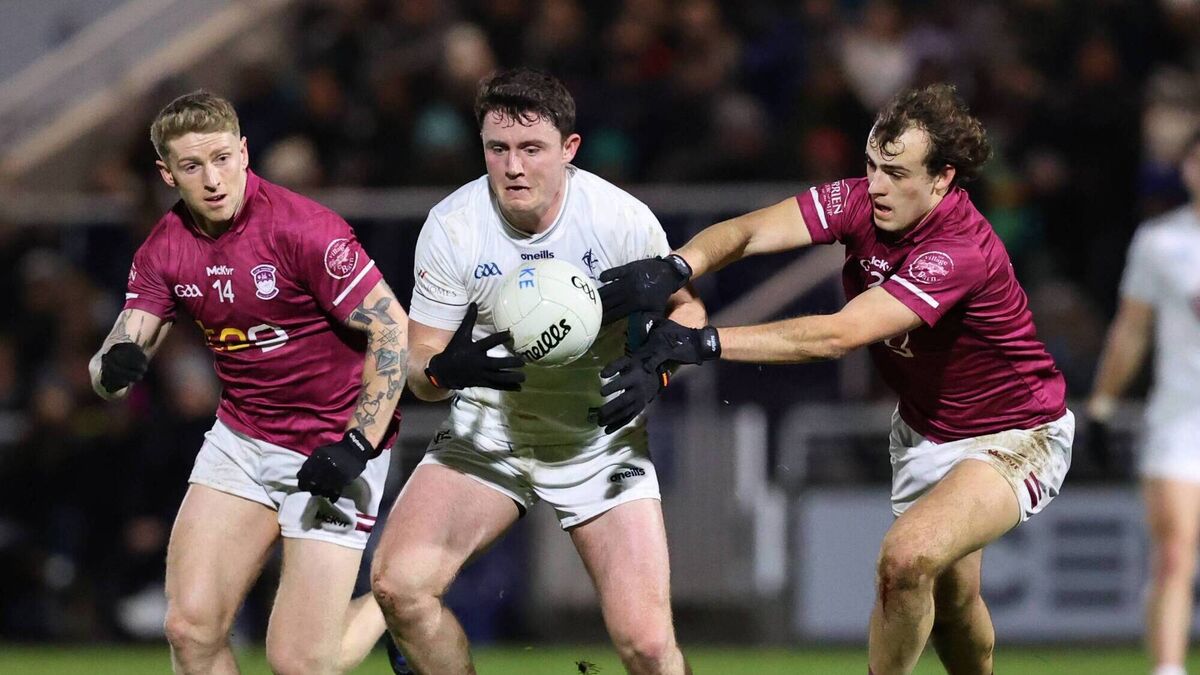
Alex Beirne tries to shrug off Westmeath's Luke Loughlin and Tadhg Baker during the O'Byrne Cup final earlier this year Photo: ©INPHO/Tom O'Hanlon
If Kildare playing in a Leinster semi-final feels familiar it’s not surprising. Were it not for a certain Carlow upset in 2018, next Sunday would be the sixteenth successive time the Lilywhites have made it to the last four in the province, dating back to the quarter-final defeat to Louth in Navan in 2010.
Indeed, the semi-finals are very much a natural habitat for Kildare footballers. Out of the 132 championships we have contested since 1888, we have reached the last four on 78 occasions, representing a 59% strike rate.
Overall, we have played 84 games at the last four stage including replays, winning 37, drawing 7 and losing 40, so close to a 50% success rate over the course of history.
Alarmingly, though, since winning the 2009 semi-final against Laois, Kildare have only won three of the fourteen semi-finals they’ve played. On the plus side two of those were against Sunday’s opponents Westmeath (in 2021 and 2022), the other against Meath in Tullamore in 2017. It’s not exactly a record to fill you with confidence, though.
Semi-finals in Tullamore have been relatively rare with the vast majority taking place in Croke Park. Sunday will be our ninth trip to O’Connor Park at this stage, and the record reads four wins, one draw and three defeats.
Only once before have Kildare met Westmeath at this stage at the Offaly venue. That was in 1992 when two Jarlath Gilroy penalties helped Mick O’Dwyer’s charges reach the county’s first Leinster Final in fourteen years on a 4-11 to 2-5 scoreline. Johnny McDonald and Declan Kerrigan netted the other two goals.
Over the course of history Kildare have met Sunday’s opponents only twelve times in the championship, winning ten times and losing twice. Those defeats were each by a single point and came in the 1960 quarter final by 2-9 to 2-8 and in the 2016 semi-final in Croke Park when Cian O’Neill’s side were beaten by 1-12 to 1-11 having led by six points at half-time.
Generally, Kildare have held the upper hand with five wins out of six at the semi-final stage dating back to their first meeting in the last four in 1919 in Edenderry. Jim O’Connor, the Two Mile House attacker, better known as a rugby player up to that, who only played seven times for the Lilywhites, scored all of Kildare’s four goals that day in a 4-3 to 1-5 win.
O’Connor holds the distinction of scoring goals in his first five Kildare appearances, all during that 1919 championship and culminating with one in the All-Ireland Final win over Galway later that year. Only one player since has matched his feat of four goals in one game, Pádraig Fogarty against UCD in the O’Byrne Cup of 2014.
One man who will certainly be out for revenge for Westmeath on Sunday is Ray Connellan, their towering midfield stalwart. Connellan was one of their stars in that 2014 encounter (Kildare have no one still involved) and also played in the 2021 and 2022 defeats. Not to mention his stellar performance in last year’s quarter-final in Newbridge where his injury-enforced retirement was instrumental in turning the tide towards the Lilywhites.
Connellan was to the fore again in last week’s win over Meath, notably intercepting their opponent’s final kickout, an intervention that led to the fourth goal, the final nail in the Royal coffin.
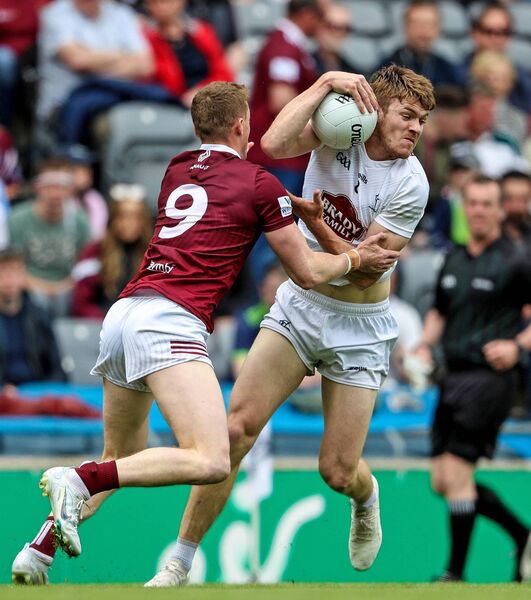
Westmeath have deservedly received plenty of plaudits for that win. They pulverised most people’s Leinster favourites Meath in the first-half with corner forward Shane Corcoran and Luke Loughlin inspired and then had to withstand a ferocious comeback from the Royals.
It wasn’t just about their scoring either, though adding 4-18 to the 5-25 they scored against Longford was pretty impressive. Westmeath defended voraciously and the likes of Eoin Cully and Ben Loakman will know they’ve been in a battle with the Lake County’s full-back trio of Daniel Scahill, Charlie Drumm and Conor Dillon. The latter, a surprise choice to many, tracked Jordan Morris almost into oblivion in Tullamore.
Brian Flanagan, of course, has history with Westmeath having coached them under Jack Cooney’s management so he will know them reasonably well even aside from last year’s clash and this year’s O’Byrne Cup final, where the Lake Men caught Kildare late to take the trophy.
Flanagan’s team got the show back on the road with that curate’s egg of a performance against Laois. It was nowhere near as impressive as Westmeath’s win over Meath, but any win would almost have sufficed on the day. Kildare just needed to snap that five-game losing streak to put the league behind them.
But looking ahead to Sunday, there are so many areas of improvement needed by the Lilywhites. They were so open at the back that a relatively poor Laois team (a mid-table Division 3 finish didn’t lie as we suggested here it wouldn’t), got through with relative ease for two first half goals. Better teams will punish that to a greater degree and Westmeath are a better team.
We talk about injuries with Kildare but unfortunately, there is no cavalry riding towards Tullamore packed with teak-tough defenders. Yes, perhaps Harry O’Neill will be fully fit, and Pádraic Spillane could be available, but neither would be automatic choices and it seems likely that Flanagan will go with the same backline unless James McGrath’s heavily-strapped thigh isn’t up to the battle.
There was little sign of a tactical improvement against Laois in the backline and that has to be a worry for Kildare and a major opportunity for Westmeath.
Kildare’s kickouts were a disaster, statistically, two weeks ago. They only won one in four of their first-half restarts and although that improved after the break to a degree, Laois still out-fielded them over the course of the game. Connellan et al offer more than Laois around the middle so that’s another area of concern for seasoned Kildare watchers.
The word from Flanagan after the Laois game was that the attacking resources should be replenished for this weekend and while it would be naïve to expect those players coming back to hit the ground running at one hundred per cent, you would certainly hope that a team featuring even a couple from Alex Beirne, Colm Dalton and Jack Robinson could put Westmeath on the back foot.
It will be interesting to see how Westmeath react to all the positive attention they’ve received in the last couple of weeks. Reaching a first Leinster Final since heavy defeats to Dublin in 2015 and 2016 would be huge for the county, particularly one where they’d feel they have a chance of winning.
For once, it is Kildare waiting in the long grass, with little attention or fanfare. That might just suit them, but they will need to improve incrementally on anything we have seen to date.