Ambulance strike: Pay disagreements in the public service are always resolved, Burke says
Eva Osborne
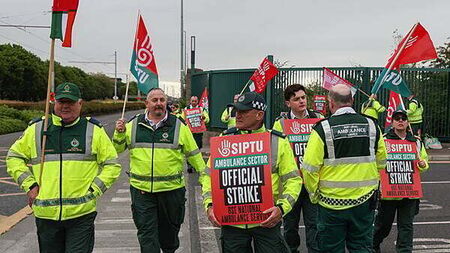
- Ambulance workers are engaging in a 24-hour strike action over a pay dispute
- The HSE said ambulance services will be significantly impacted by industrial action
- Elderly people who are uncertain about calling an ambulance during the strike are being told to still take action and not to delay seeking help
- Today's strike is expected to be followed by a 48-hour stoppage from May 19th and a 72-hour stoppage from May 26th
3pm
Enterprise Minister Peter Burke said there is a clear process for dialogue between the HSE and the union workers.
"It's important that people work through those processes to get an agreement. One thing I always say about disagreements in pay agreements in the public service is that we always do get a resolution," he said.

"So, it's about getting around, talking around the table, working with the institutions that are there to stand ready. And, obviously my colleague, Minister for Health Jennifer Carroll MacNeill, will be doing a huge amount of work in that regard."
2:25pm
People Before Profit leader Richard Boyd Barrett, said the strike action taken by ambulance workers comes down to the failures of the Government and the HSE.
"The responsibility for the industrial action that the ambulance workers have been forced to take lies absolutely squarely at the door of the Government and the HSE," he said.
"So, we absolutely want to support the ambulance workers, and we believe the Government and the HSE should acknowledge the legitimacy of the claim of the ambulance workers and improve their pay accordingly."
Earlier today
Picketing ambulance workers have said they are “prepared for the long haul” after they began 24-hour strike action over a pay dispute at 8am on Tuesday.
Almost 2,000 SIPTU members in the NAS voted overwhelmingly last week for strike action relating to a dispute over updated salary scales within the service.
The Department of Health has said it is “regrettable” the strike has gone ahead and that the industrial action would have a significant impact on service capacity.
The unions say qualifications, clinical responsibilities and operational duties of emergency medical technicians (EMT), paramedics, advanced paramedics, paramedic specialists and paramedic supervisors have expanded significantly in recent years.
They also say a 5% increase recommended under the benchmarking II process has not been delivered.
Speaking to reporters in Dublin after the strike began, Taoiseach Micheál Martin said: “It is not satisfactory for patients or the people generally that a first-responder service should be mired in industrial action of this kind.”
He urged unions to re-engage in dialogue, adding: “It is the only way this will get resolved.”