Council will not rule out solar farms on Kildare agricultural land
There is a “huge amount of fear and worry in the area” of south Kildare about solar farms according to a local representative
LOCAL councillors have disagreed over a motion regarding the use of agricultural land for commercial solar development, with Kildare County Council rejecting a call to consider only industrial sites in the Athy Municipal District as locations for such projects.
Cllr Veralouise Behan brought forward a motion at yesterday’s municipal district meeting, proposing that ‘the council considers only industrial sites in this municipal district as locations for commercially generated solar energy’.
Cllr Ivan Keatley argued that cllr Behan’s motion was “too sweeping and broad”.
The motion came in the context of around 140 locals attending a public meeting at Levitstown Hall on Monday, 7 September, where opposition was expressed to BNRG Solar’s proposed 114-hectare (281-acre) project.
BNRG’s application, which is currently being considered by Kildare County Council, will span the rural townlands of Beaconstown, Johnstown North and South, Kilkea Upper and Crooket, near Kildare’s borders with Carlow and Laois.
Acting senior planner Jane O’Reilly issued the council’s written response to the motion, outlining that the local authority already has planning policies for solar energy set out in the County Development Plan.
The response indicated that the council will not automatically rule out solar farms on non-industrial land, with each application assessed individually based on planning policy, environmental impacts, the local area plan, government guidelines, and feedback from residents and other relevant bodies.
Concerns have been expressed by locals in Maganey and nearby areas over a perceived lack of public consultation, alongside worries about noise, road infrastructure, agriculture, future expansion of the project and potential lithium battery explosions at the solar farm.
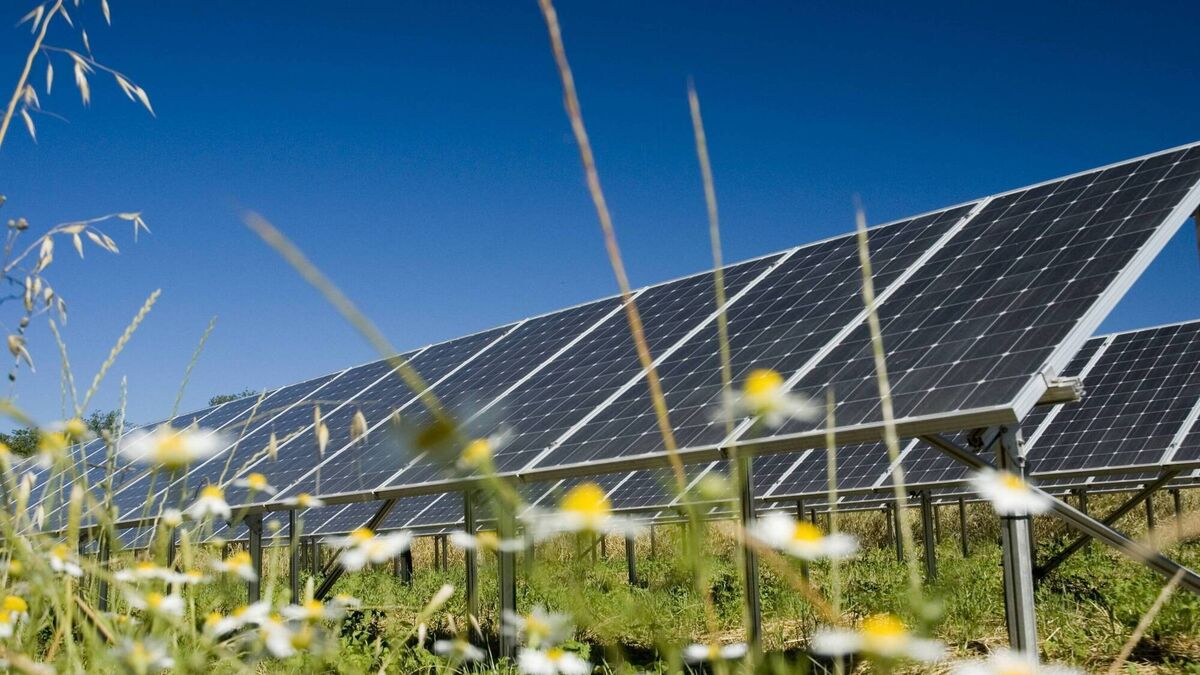
The application includes 496,308 square metres of solar panels, along with 48 Battery Energy Storage System containers and 12 Medium Voltage stations.
A BNRG spokesperson recently disputed claims made at the meeting, telling the Kildare Nationalist that the company engaged extensively with the community and that feedback from locals led to changes in the project’s design.
The company also disputed concerns about noise, stating that solar farms are generally very quiet and that noise assessments and site design measures were used to minimise any impact on nearby residents.
BNRG has said the development could power the equivalent of 14,000 homes and save an estimated 21,300 tonnes of carbon emissions annually.
Speaking at the council meeting, Fianna Fáil councillor Behan described the proposal as “an industrial solar park” rather than a solar farm.
She told the meeting that “it’s very important to have clean energy where we can” before saying that “it’s coming at a cost”, with that cost, in her view, set to be damage to tourism and agriculture in the Maganey area if the proposed project goes ahead.
She said that only 5 per cent of the industrial sites in Kildare are within the Athy Municipal District, arguing that commercial solar energy projects should be focused in the districts north of her own.
Fine Gael councillor Keatley, attending the meeting virtually, argued that cllr Behan’s motion was “too sweeping and broad”.
He said that he does not want council policy to be as “restrictive” as the Fianna Fáil councillor does.
He did, however, say that there is a “huge amount of fear and worry in the area” of south Kildare in question, having voiced his support for the campaign at the Levitstown meeting.
Director of services for planning Alan Dunney said that “every planning application has to be assessed on its own merits”.
Both cllr Keatley and director of services Alan Dunney referenced the prospect of further guidance from central government.
The Department of Housing, Local Government and Heritage said that there are currently no statutory national planning guidelines in place for solar energy developments.
The department said earlier this year it will prepare a new National Planning Statement on Solar Energy under the new Planning and Development Act 2024.
An Taisce has also recently lodged a submission with Kildare County Council raising concerns about the Maganey proposal and pushing for national guidelines on solar development. The environmental organisation said: ‘This is a large-scale solar farm proposal which, in conjunction with other recent and concurrent applications nationally, are being advanced without either an effective national strategy for solar deployment and specifically Planning Guidelines for land based or rooftop solar panels.’
An Taisce added that this means planning authorities are left to assess potential impacts on communities, farmland, ecology, landscape and heritage without overarching guidance.