Kildare biodiversity policy launched
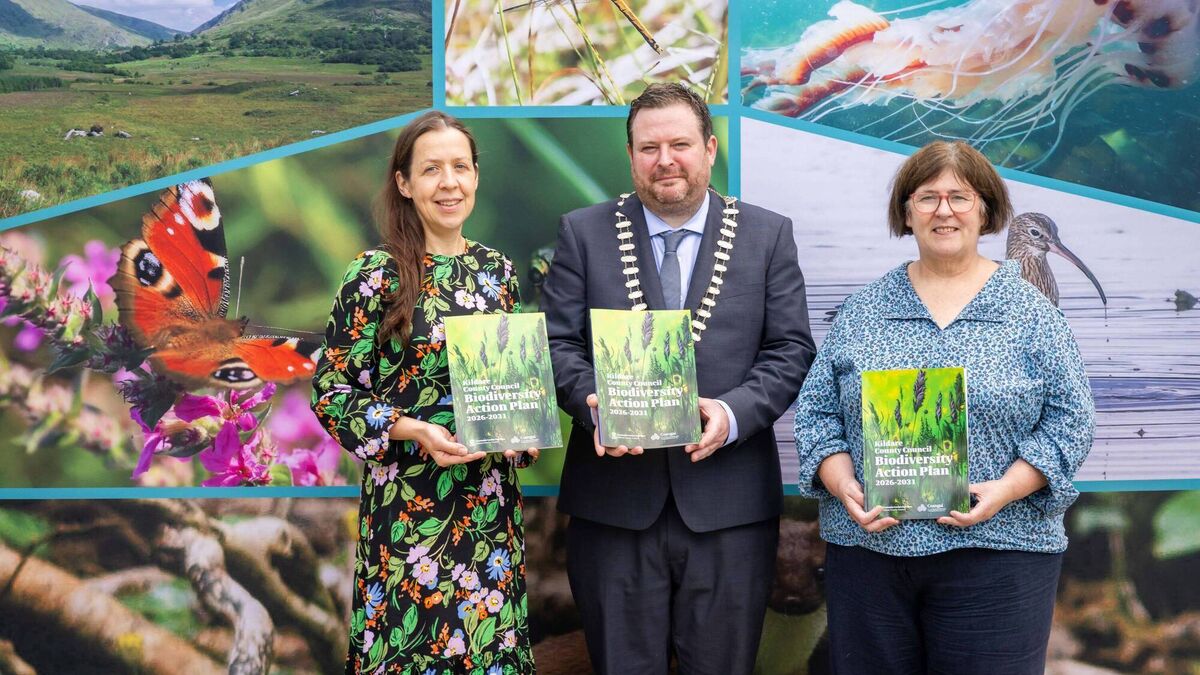
Dr Méabh Boylan, biodiversity officer of Kildare Co Council; cathaoirleach of the County of Kildare, cllr Tim Durkan; Catherine Casey, Head of Climate Change, the Heritage Council
KILDARE County Council has launched the Kildare Biodiversity Action Plan 2026–2031, setting out a framework to protect biodiversity and support nature recovery across the county over the next five years.
The plan represents the culmination of an extensive consultation process involving council staff, elected members, community groups, farmers, landowners, environmental organisations, state agencies, educational institutions and members of the public.
It acknowledges that the protection of nature is one of the defining challenges of our time and that meaningful action is required at local level to address the ongoing decline of habitats and species.
The Kildare Biodiversity Action Plan 2026–2031 sets out actions to support habitat recovery and restoration, species conservation, nature-friendly land management, community engagement, evidence-based decision-making and partnership working.
This includes protecting existing biodiversity-rich habitats throughout the county, supporting the recovery of degraded ecosystems, including wetlands, peatlands, grasslands and river corridors.
It will also support the recovery of threatened and declining native species, expand and strengthen ecological networks to help wildlife move through the landscape.
This will embed biodiversity considerations across all areas of Council policy and service delivery by supporting communities, schools and local organisations in taking action for nature, and improving biodiversity data collection, monitoring and research to inform future conservation efforts.
The action plan recognises that biodiversity action must extend beyond designated conservation sites and become part of how land, water and public spaces are managed throughout the county.
It is founded on the principle that nature deserves protection not only because it provides benefits to people, but because it possesses value in and of itself.
"We often speak about biodiversity in terms of the essential services it provides to humanity, such as clean water, oxygen, pollination, food, climate regulation and recreation opportunities,” said Dr Meabh Boylan, Biodiversity Officer, Kildare County Council.
“While these benefits are important, the Kildare Biodiversity Action Plan recognises a deeper truth: nature has an inherent right to exist, flourish and evolve.
“The countless species with whom we share this county are not merely resources for human use or extraction.
“They are part of a living community to which we belong, and their protection is an ethical responsibility as much as an environmental one."
"The plan is right that biodiversity action cannot stop at designated sites. Most of the county's nature lies outside them, in hedgerows, river corridors, peatlands and the working landscape, where restoration also delivers for climate, water quality and flood risk. Kildare has set out what needs to be done. Delivery is the work of the next five years."
The plan seeks to foster a renewed relationship between people and nature—one based on stewardship, respect and coexistence. It aims to ensure that future generations inherit a county where thriving rivers, species-rich grasslands, healthy peatlands, mature woodlands and abundant wildlife remain central features of Kildare's landscape.
The Kildare Biodiversity Action Plan 2026–2031 is now available on the Kildare County Council website and will guide biodiversity policy and action across the county over the coming years.
The Kildare biodiversity officer post is co-funded by the Heritage Council through Ceangal, the Local Authority Heritage Programme, a joint initiative of the Heritage Council and the County and City Management Association.
The heritage council also provided grant funding for the preparation of the Kildare Biodiversity Action Plan 2026–2031.