Kildare ponds workshop drew fascinated audience
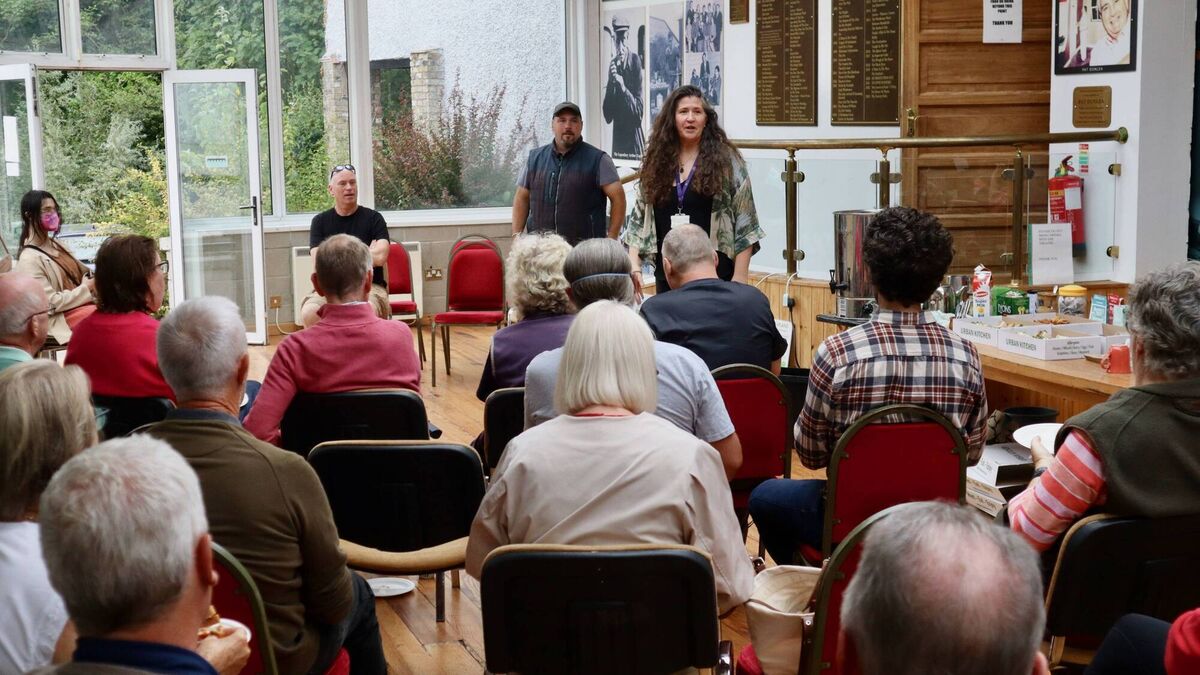
A fascinated audience at Kilcullen Town Hall for the ponds workshop
SMALL actions by individuals, when multiplied in neighbourhoods, towns and beyond, can have a huge impact on the environment and biodiversity, people at a Kilcullen workshop about making ponds were told. The well-attended event in the town hall was facilitated by wildlife consultant Rob Gandola, who said ponds can be provided in balconies, gardens and public spaces.
The workshop was sponsored by the River Basin Management Service, formerly the Local Authority Waters Programme (LAWPRO).
A fascinated audience absorbed the three basics of setting up a pond, which are that it be functional (“it has to be able to hold water”), that it has an amenity value (“or looks great”), and that it has a ‘wildlife value’ (“if you’ve designed it right, the wildlife is going to come in anyway”).
The core message of the evening was to keep things simple, at a time when a resurgence of interest in ponds means that people are being overloaded with information. “A pond is something that’s going to go into the ground or be raised, and is going to hold water for about eight months of the year and offer a clean habitat,” the audience were told.
The presenter emphasised that once installed, the pond owner shouldn’t have to do anything for years except to enjoy it. A pond should be low maintenance, without need for pumps or aerators. “Our native aquatic plants are perfectly good at doing all that for free,” he said.
The water source is the most important consideration, he said, with rainwater being the ‘gold standard’. The heatwaves of this summer have highlighted the advantages of a water butt system to harvest rainwater and have it available.
“This is going to be so important in the future for people who invest in these aquatic habitats. You don’t want river water in your pond because the wildlife from the river doesn’t like still water, and if somebody does something extreme upstream it can be dangerous. Canal water is a big no-no, because if there’s something in that, it can destroy your pond over a few years.”
Construction of ponds has been enjoying something of a revival in Ireland, after a hiatus since the 1970s. Renewed interest is coming through various sources, including schools and community groups.
Mr Gandola suggests interest was sparked during the Covid pandemic, as people developed a greater appreciation for their environment and realised the need to address air quality, habitats and the current direction in their protection.
“It’s all now about habitat provision. It’s diversity of habitats, irrespective of whether it’s a community space or your own garden or something far bigger. Aquatic habitats have a greater concentration of species and species diversity compared to rivers, lakes and other aquatic habitats. It’s incredible what they do.”
Ponds become home to invertebrates such as aquatic beetles, dragonflies, damselflies, water scorpions, water stick insects, freshwater snails and aquatic lice. They host a variety of mayflies which are more tolerant of nutrient influx than their river cousins.
Amphibians such as frogs and newts, and the native Irish lizard, are commonly found near water bodies. “They’ll move in quickly.”
Generational memory in Kilcullen will recall several local ponds and wetland spaces that have disappeared over short decades, in many cases through development. Mr Gandola believes there’s a regulatory shortfall here. “In the UK they have biodiversity net gain. They’ve got more protected species, like great crested newts, where they say: we acknowledge that you have to remove these ponds to build housing. But you have to replace them with a similar habitat elsewhere on-site or at another location that we deem to be appropriate. We don’t have that here.”
The situation is better in relation to farmland, where several nature enhancement schemes encourage Irish landowners to reinstall ponds that may have been removed through intensive farming. “They may have a bit of neglected land, and they have funding streams available for, like, doing a mini-orchard, making a biodiversity plan for the site, with money then to install a pond.”
But for individuals at home, as the meeting heard, it can all begin for the simple cost of the price of a bucket on your balcony.