Athy during the state's first housing crisis
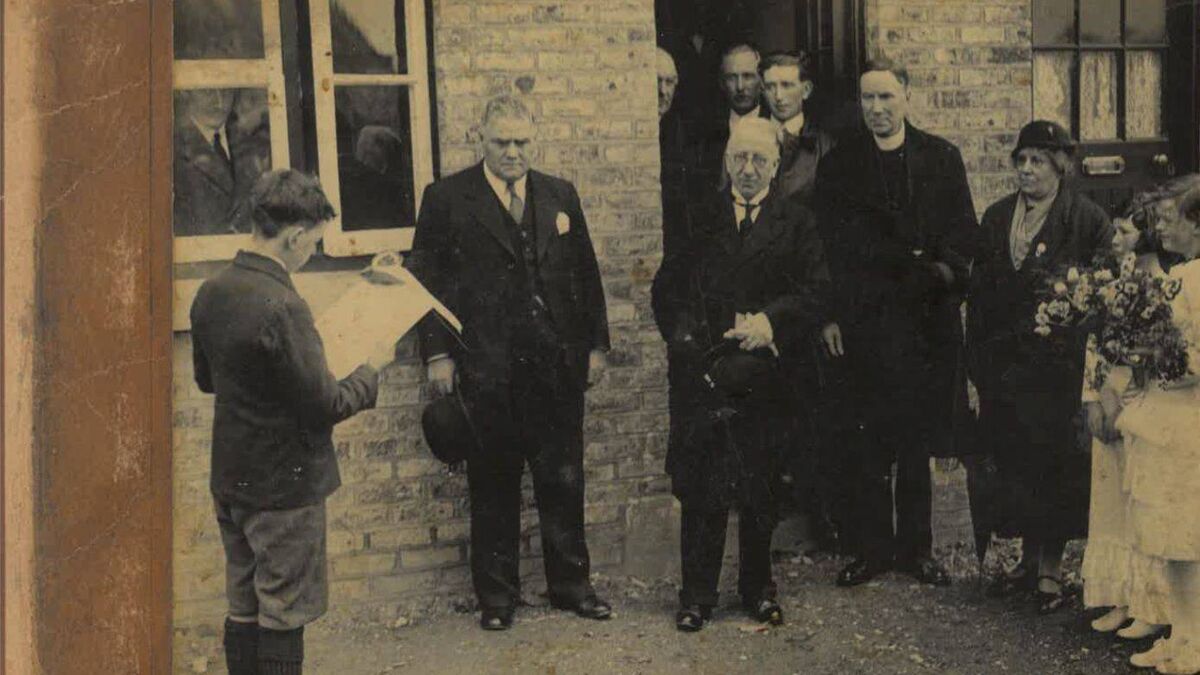
Official Opening of Dooley’s Terrace by Sean T. O’Ceallaigh on 5 April 1934. Also present is Canon McDonnell, Parish Priest and Athy Urban District Council members Michael Dooley, Tom Carbery and Brigid Darby
THE housing crisis affecting Ireland today is so different from the housing crisis which hung over the newly established Irish state of the 1920s.
Today, the Affordable Housing Scheme which was launched in 2022 allows Councils to offer newly built houses at reduced rates for first time buyers and other eligible buyers.
The price paid by the purchasers is based on their income and mortgage capacity and the council retains an equity in the house. The council’s equity can be redeemed at any time, although there is no obligation to do so.
The newly formed government of the Irish Free State did not have the financial means to meet the pressing need for additional housing in the 1920s.
There had been limited council house building projects in Athy in the years prior to 1931. These included the building of 22 houses in 1913 at Meeting Lane, Woodstock Street and Matthew’s Lane (now St Michael’s Terrace).
This was the first housing project of Athy’s Urban District Council, which was established under the Local Government Act of 1898. It followed a 1906 report on housing in Athy by Dr James Kilbride, local medical officer that ‘the floors in many houses are lower than the laneways in front and the fall of the yard is to the back door, consequently the floors are wet and sodden in rainy weather and frequently flooded … in less than a dozen cases was there found any sanitary accommodation.’
Nevertheless, the town clerk was able to report to the council that the 22 houses built ‘were all occupied principally by artisans. None of the tenants belonged to the labouring classes’.
The council’s second housing scheme saw the building of eight houses known as Bleach Cottages in 1924.
In 1930 a housing inspector appointed by the Department of Local Government carried out a house-to-house inspection in Athy and found 316 houses unfit for habitation and 27 houses considerably below normal standards which might be made fit.
Within a year the council opened its third housing scheme at St Patrick’s Avenue.
The 36 houses were let at a rent of six shillings and three pence per week, which families living locally were unable to pay. As a result, seventeen of the original tenants were not from Athy and included a family from Blackpool, England, another from Enniskillen and four Dublin families.
This prompted the Department of Local Government to write to Athy Urban District Council advising that the council should let the council houses ‘in the best interest of the public health of the district as they do not seem to have been let to families living in unsanitary districts’.
It was W.T. Cosgrove’s government which passed the 1931 Housing Act, but it was de Valera’s government elected in 1932 which oversaw the first and second slum clearance programmes in Athy.
The first slum clearance programme was carried out in 1933, and the second programme in 1935. That first programme ordered the demolition of specified buildings in the town and required that those building be vacated within specified periods.
That clearance order made in June 1933 affected 1,350 persons living in 334 family units. The building of houses at what would become known as Dooley’s Terrace and Upper St. Joseph’s Terrace were completed and let in February 1934.
Those appointed as tenants, unlike tenants appointed to previous council housing schemes, were housed from areas included within the council’s slum clearance areas and their landlords M.P. Minch and J. Carbery were instructed to demolish vacated unfit houses.
However, that direction was later changed to allow the houses in question, although deemed unfit for human habitation, to be occupied by families previously living in Shrewleen Lane and New Gardens.
A public enquiry was held in Athy in March 1934 in connection with the council’s first Slum Clearance Order. The council’s solicitor, R.A. Osborne, explained that the order affected 127 unfit houses, most of which consisted of a kitchen and one room. The council were faced with two difficulties, he explained.
If they proceeded to have the unfit houses demolished, the occupants would have nowhere to go.
The council could not, without state assistance, build houses and let them to tenants at anything like a reasonable rent in comparison with the cost of building those houses.
The official opening of new houses at Dooley’s Terrace and Lower St Joseph’s Terrace was performed by the Minister for Local Government, Séan T. Ó’Ceallaigh, on 5 April 1934.
Shortly afterwards, Athy Urban District Council submitted to the Department of Local Government a proposal to build further houses in Athy.
No wonder that submission by the council was accepted by the Department as the Minister acknowledged at the opening on April 5th that the council had responded better to his housing initiative than any other council and went on to state ‘this was a good Christian country with Catholic morals prevailing and families were increasing and would have to be provided with houses’.
In June, 1935 the town clerk was instructed to write to some tenants of Dooley’s Terrace to stop whitewashing the lintels, windows and brick of the recently built houses. Clearly, old habits associated with the unfit housing of the past were difficult to give up.
Continued next week