Living Greener: Build a home for cheap? Try using straw
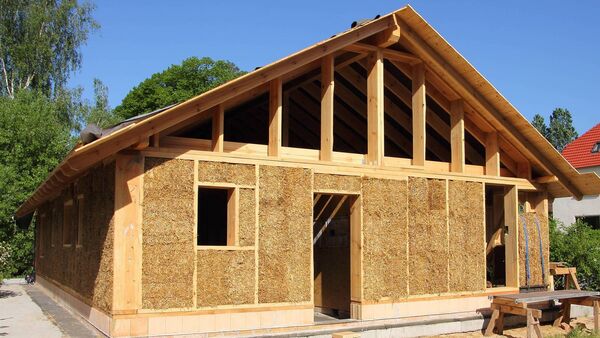
Straw can form load-bearing walls or can simply insulate while it is also eco-friendly
YOUR home might be the costliest thing you will ever pay for; ‘mortgage’ comes from the French for ‘death contract’.
Home construction is also one of the most energy-intensive things we do in the modern world, consuming enormous resources and generating colossal amounts of waste. Programs like ‘Grand Designs’ feature all manner of ‘eco-friendly’ homes, but they tend to be only for the wealthy and hi-tech.
There are other ways, however, to build homes by hand using cheap materials. I have written here about building with cob, that mix of sand, clay and straw.
I have written about wattle-and-daub construction, weaving wicker walls and plastering over them.
And one 19th-century practice is also being rediscovered as a promising way to build cheaply – straw.
Straw is plentiful; Ireland alone could probably produce enough straw to meet most of its building needs, without importing any more materials or clearing any more forests.
It can form load-bearing walls or can simply insulate. It is lightweight and easy to transport to a building site, unlike steel or stone.
It is easy to work with, and – if you use the old-fashioned, human-sized straw bales — can be stacked and plastered by amateurs. Unlike most building materials, it contains no toxins that seep out over time.
Gathering and baling it does no damage to the environment, and the building waste can be made into mulch. The building material can be cut and shaped with a simple chainsaw or even a regular saw, allowing virtually any shape of house.
It is also one of the most perfect insulating materials around. Insulation is measured in ‘R-values’, and the higher the R-value, the less heat escapes the home. Most conventional homes are estimated to be R-12 to R-20; most bale homes, R-30 to R-50.
The material has a natural trombe effect, allowing it to store heat or coolness and release it to keep your home’s temperature comfortable.
Isn’t straw flammable, you ask? Loose straw is, but bales are tightly compressed, and are no more flammable than wood.
The National Research Council of Canada, for example, found that a straw bale wall withstood temperatures of up to 1,850 degrees for two hours.
The big bad wolf cannot blow the house down – the Building Research Center of the University of New South Wales, Australia found in 1998 that bale walls withstood winds up to 134 miles per hour – equivalent to a Category 3 hurricane.
In addition, they are beautiful. Since the walls are thick, they create deep niches for plant-boxes or window seats, and the plastered exteriors look rustic and natural but clean and satisfying.
Typically the house has a frame of wooden beams, and then straw bales are used to create the walls, and the straw plastered over to create an adobe effect.
Bales should not be used as load-bearing walls. It’s better to have a strong frame and let the bales form the walls, as bales themselves can warp out of shape or shift over time.
It also means that a wall damaged by moisture can be taken out and a new wall installed quite easily.
Americans in the Old West used this technique to build homes, barns, and even churches, and while the approach was abandoned for decades, builders have realized how sturdy, cheap and ecological most of these homes were.
Straw-bale homes are not perfect; the walls must be kept free of moisture, so most such homes would need decks in rainy Ireland.
Pests and rodents might also be tempted to take up residence – although that has been the case in most homes here, straw or not.
Most of all, it would be difficult to get planning permission to build this way these days, so most people who built this way did so secretly.
I visited a couple in rural Wales, two scientists who had worked on climate change for many years and wanted to build a sustainable community.
They and three other families bought some land and built gardens, raised animals and, most importantly, built four straw-bale homes quite quickly and easily – all themselves, while never having worked on such a project before and with no professional building experience.
The homes cost them a miniscule amount compared to most homes, and as their insulation is so thick, their heating costs are also tiny.
Now, several years after their homes were built, they are all in great shape, and they had no expensive mortgages to pay off.
To find out if bale building is for you, consult books like ‘Serious Straw Bale’ by Paul Lacinski and Michel Bergeron, or ‘More Straw Bale Building’ by Chris Magwood.