Vanishing pubs & empty premises in Athy
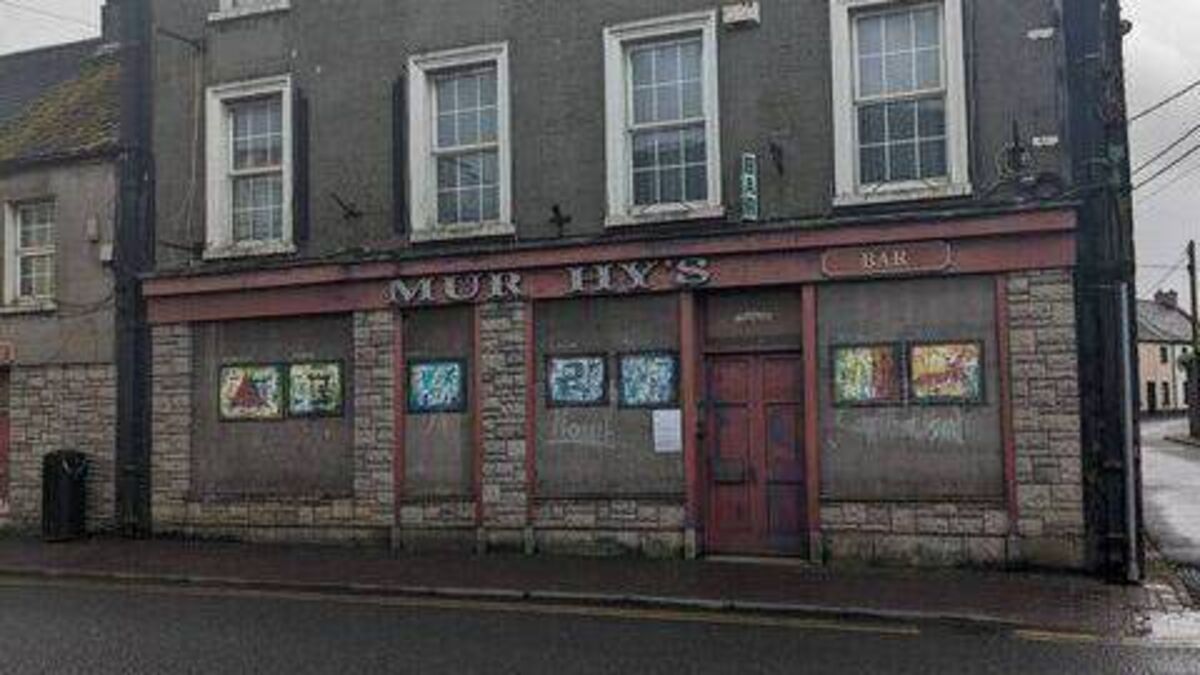
The vacant Murphy's Pub in Athy
I HAVE been back living in Athy since 1982 following an absence of 21 years which saw me sharing experiences with folk in Naas, Kells, Monaghan and Dublin.
I returned to the town where I grew up in the second half of the 1940s and the treasured years of the 1950s.
I remember Athy in those days as a thriving town with little or no vacant shop premises and a business life which revolved around a multiplicity of public houses, grocery shops and three excellent drapery shops, Shaws, M.G. Nolans and Bryan Brothers.
I cannot recall any coffee shops or beauty salons then, though the biggest change in Athy today is how few public houses are still operating.
I wrote an article many years ago listing the forty public houses licenced to operate in the town in 1924.
This was when the town’s population was in the region of 4,000 or so.
Today we have a population of about 11,000 and increasing, yet the number of public houses has collapsed to single figures.
What I ask is the explanation for that.
Is it because of the enforcement of strict drink driving laws?
Is it because many of the pubs of one hundred years ago provided a grocery service such as is still to be found in O’Brien’s of Emily Square?
The emergence of supermarkets consolidated grocery sales into the hands of a few supermarkets originally located in Leinster Street and Duke Street.
That business element has now been concentrated in three supermarkets, Pettitts, Lidl and Aldi, all of which provide free car parking, a facility which the old grocery shops could not provide.
The closure of so many public houses in Athy without any apparent attempt to utilise the vacant buildings for a different purpose is somewhat surprising.
On the far side of the River Barrow we find the recent closure of Doyle’s pub following the retirement of William Doyle, who continues to live over the premises.
On William Street, what I will refer to as Cunningham’s Pub, has been closed for many years.
As we trace our steps back towards the Crom a Boo bridge, we find a closed and unused pub premises formerly owned and operated by Barney Dunne.
Barney died several years ago and since then his pub premises has remained closed. On the opposite side of Duke Street Kavanagh’s pub, identified as the Dublin Bar, disappeared from the scene several decades past.
Stirling’s pub, later Chopsy Dillons on Barrow Quay and more recently called the Emigrant, closed for a few years past and awaits a reopening when the new owner completes refurbishment work.
On Stanhope Street, Michael Noonan’s pub has been closed for many years. while his brother Des’s pub in Leinster Street now operates as a fast food takeaway.
As I walk up Leinster Street, I am reminded that the premises at the corner of Chapel Lane was once a public house operated by Dave Walsh.
Opposite at the corner of Meeting Lane was Murphy’s pub, now closed for many years. It was a hugely popular pub.
Further up Leinster Steet was once the former Railway Hotel, owned in 1924 by Eileen Butler, which was the only premises in the town with an Irish sign over its door.
It was sold to Thomas Flood late in 1924. Leinster Street that year had 15 public houses. Today with the closure in recent years of Smith’s public house and Brereton’s, and more recently Anns, formerly Lalor’s, there are four pubs in Athy’s Leinster Street.
In the middle of Offaly Street, directly opposite where I lived in number 5, lies the closed public house once operated by Joseph Whelan, later by Dowling’s and later still by John W. Kehoe.
It is not the only Offaly Street business which has shut its doors in recent years as we find Kitty Webster’s sweet shop and Mona Sylvester’s shop also closed and now adapted to provide housing accommodation.
Public houses immediately outside the town which we have also lost quite some time ago include Barringtons in Grangenolvin and the Bleeding Horse at Castlemitchell. Both these public houses benefitted from the Liquor Laws which allowed Athy folk to drink there if they travelled a three-mile distance.
The ending of that statutory facility led to the closure of many pubs throughout rural Ireland.
What then are we left with in terms of active local public houses?
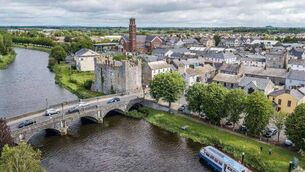
The Auld Shebeen on William Street, Paddy Dunne’s pub on Woodstock Street, The Duke public house, formerly Smugglers, in Duke Street and The C.I. Bar alongside White’s Castle.
On the far side of the laneway lies Anne’s Pub, which I learned today is now closed, while the former Emigrant pub on Barrow Quay awaits reopening.
Across Emily Square is to be found O’Briens, the only pub with a grocery section, a reminder of the liquor licenced premises which were to be found in such numbers one hundred years ago.
Opposite O’Briens is the former Anderson’s pub, now the Market House. We walk up Leinster Street to meet Norton’s pub, known as The Nags Head and next door Clancy’s, before meeting McEvoy’s pub at the top of the street.
One hundred and two years ago, Athy had seven public houses in Duke Street, seven public houses in William Street and fifteen public houses in Leinster Street.
I am told that in 1968 Athy had thirty-four licenced premises.
Between 1924 and 1965 Athy lost six pubs, but in the last fifty-six years we have lost more than twenty-four pubs, leaving us with nine pubs operating in the town today with one further pub under reconstruction and expected to be open in the near future.
The closure of so many pubs may not be regarded as an indication of widespread business decline.
However, the closure of pub premises and the failure to adapt the vacant premises for other retailing needs is a concern which reflects badly on Athy’s standing as a market town.
Business people especially must get together with the local enterprise centre to agree an action appropriate for the rejuvenation of business in the town. Action is required now.