Asian hornet pose huge threat to Kildare wildlife
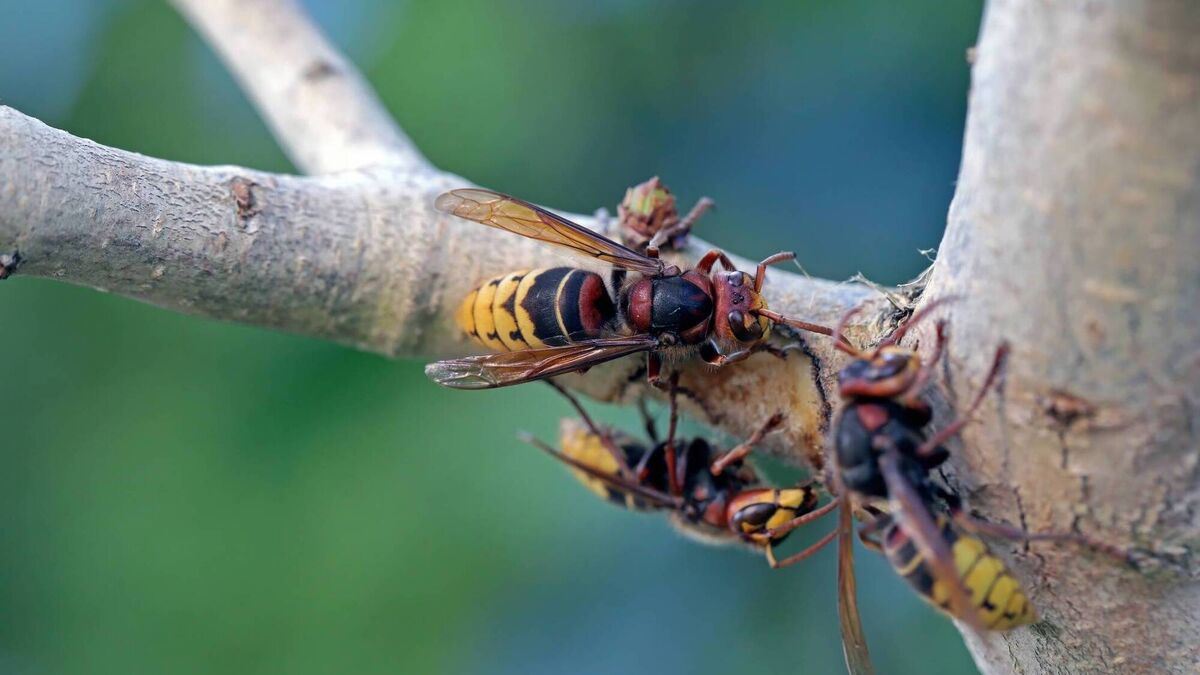
Take extreme care if you spot an Asian hornet
RECENTLY I had occasion to call on the help of local beekeeper, Gerry Walsh, to remove a wasp’s nest from a bird box in my back yard.
Gerry is a man with a huge knowledge of all things to do with bees, and particularly the threats to our native bees.
I asked him about the Asian Hornet and the threat they pose.
Gerry told me that this insect is reported to have arrived in France in a shipping container in Bordeaux in 2004. Since then, it has spread to Belgium, Netherlands, Germany, Spain and Italy.
It is well established in Jersey and less so in the other Channel Islands.
More than five hundred nests were recorded and destroyed in Jersey in 2025.
In recent years nests have been discovered in southeast England and some as far north as the Scottish border.
Nests were discovered and destroyed in Co Cork in late summer 2025 along with one in Dundonald Northern Ireland.
All were destroyed by a pest control company and the nests sent for examination.
They did not have signs of possible queens which would form this year’s population of hornets.
One individual hornet was observed in Dublin.
The area in Dublin was checked for several weeks subsequently but no other hornet was observed.
It was concluded that this hornet was a lone traveller on a shipping consignment of a vehicle entering the country at one of the ports.
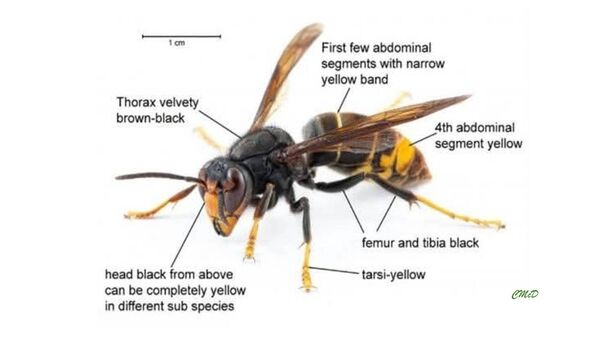
The Asian Hornet has an orange face, its body is black or brown with a very distinct yellow band on the rear segment of its body.
The legs have orange/yellow tips, and they measure 2.5 to 3 centimetres in length.
I asked Gerry what people should do if they suspect an insect, is a hornet.
He advised extreme care as the hornets can be very dangerous, but if possible, take a photo of it, record your location by pin drop on smartphone app and report to invasives.ie as soon as possible.
Do not approach the hornet or the nest; do not kill it as live hornets lead to the nest.
It is better to destroy the entire nest rather than one individual hornet. Gerry went on to talk about Asian Hornets nests and described the physical features of the nest.
Primary nests can look like a small paper bag on the roof of a shed or in dense vegetation close to the ground. Secondary nests can be high in trees.
The nest discovered in Cork last summer sixty feet (19metres) up a sycamore tree in a suburban garden. Nests can be difficult to see if in dense vegetation and foliage so care must be taken when walking in rough terrain.
There have been some fatalities where hill walkers have inadvertently disturbed a nest. Bird watchers and hikers and ramblers should be aware of this species.
He told me that the hornet is a huge threat to our native wildlife, they have a voracious appetite and that one Asian hornet nest consumes around 11 to 12.5 kilograms of protein-rich prey, primarily pollinators like honeybees, over one season to feed its larvae.
The Asian hornet will eat bees: especially honeybees, which they ambush at hive entrances.
Other insects include flies (including hoverflies, blowflies), wasps, bumblebees, butterflies, moths, beetles, and caterpillars. Spiders are also a common part of their diet.
They will scavenge meat, fish, or even pet food. Adults feed on sugary liquids like flower nectar and water to fuel themselves.
The main protein intake (insects) is used to feed the developing larvae in the nest, with a large colony consuming significant amounts of insects per season.
As generalist predators, they adapt to locally abundant prey but pose a serious threat to native pollinators like honeybees, bumblebees, and solitary bees, as these insects lack strong defences against them.
They originated in Asia in a prey-predator balanced relationship with indigenous species. European species have not co-evolved so this is why they can do so much damage. Individual hornets eat up to 50 bees a day.
Irish beekeepers ask the public to be vigilant and careful and to report any suspected sightings to the National Biodiversity Data Centre at invasives.ie.