Data centre zoning motions voted down by councillors as roll-call vote rejected
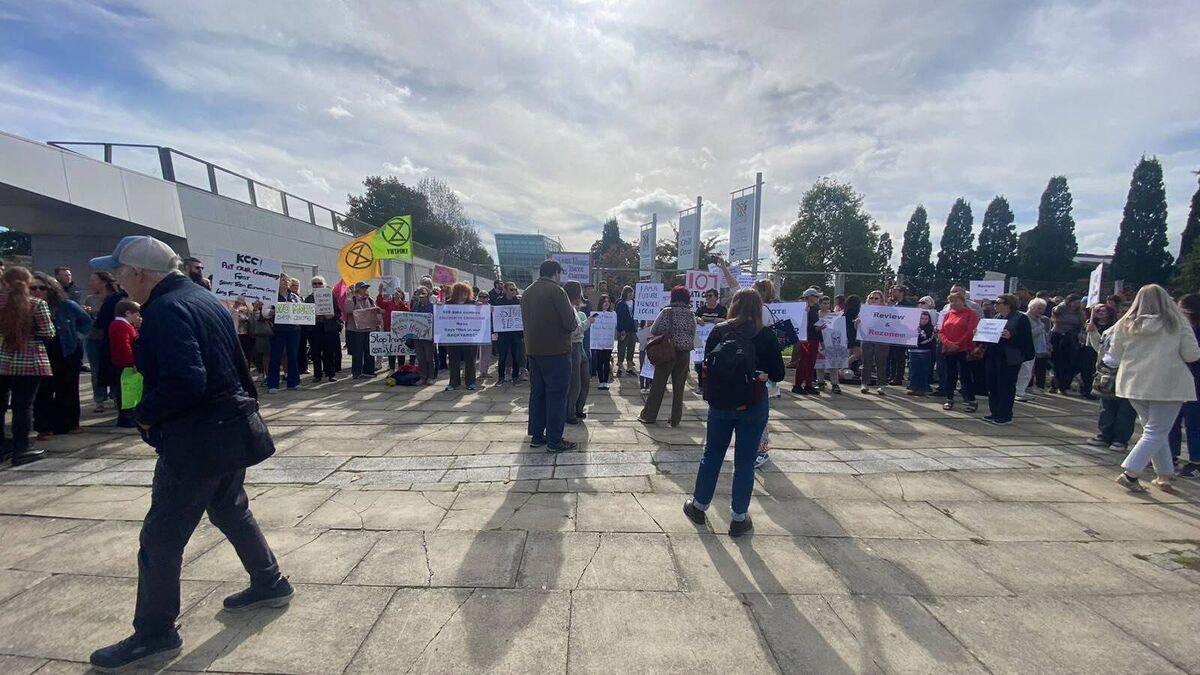
Above and below: scenes from the data centre protest before the meeting of Kildare County Council last week
FINE GAEL and Fianna Fáil councillors cited concerns about undermining the planning system as they rejected two motions seeking a review of data centre zoning at a meeting of Kildare County Council last Monday, 28 September. This was after the people of Naas turned out in force ahead of the meeting, urging Kildare County Council to overturn the zoning, citing concerns such as the environmental impact of data centres, and noise and air pollution.
Hundreds turned up outside Áras Chill Dara, among them leaders of the campaign against data centres as well as elected representatives such as Kildare South TD Shónagh Ní Raghallaigh and Kildare North TD Aidan Farrelly.
Councillors voted down the two motions seeking changes to the zoning, with 22 councillors voting against, 11 voting in favour, and seven abstaining.
Ahead of the voting, the councillors voted against a roll-call vote, meaning the exact breakdown of the vote was not available to observers. Only three councillors voted in favour of the roll-call vote, which would have offered a fully transparent account of which way each elected member voted.
Councillors from the two government parties largely voted against the motions.
There were two motions on the meeting agenda regarding the zoning. They had a similar intent to one another and were voted on together. The first was brought by Independent Ireland councillor Bill Clear to Naas Municipal District on 8 September and referred to full council. It read: ‘That the council considers commencing the statutory process to vary the Naas Local Area Plan, with a view to reviewing the existing “P Data Centre” zoning designation on lands at Jigginstown/ Maudlins, Naas.’
The council executive took issue with the motion. Director of services for planning, enterprise and economic development Alan Dunney issued the official written response, stating that ‘this motion is effectively calling into question the informed decisions made by the elected members in respect of the Naas Local Area Plan 2021-2027’.
Council management were of the view that any proposed development should be tested through the normal planning process. During this process, third parties can participate, and if planning permission is granted, can appeal to An Coimisiún Pleanála.
Sinn Fein councillor Noel Connolly’s motion was framed more broadly, seeking a variation of the Kildare County Development Plan rather than specifically naming the Naas Local Area Plan. He also proposed that the council, in accordance with planning legislation, ‘requests the chief executive to prepare and submit a report on such a proposed variation for consideration by the elected members’.
Mr Dunney also issued the response, reiterating the same points made in his response to cllr Clear, as well as pointing out that ‘there are no existing zoning provisions that specifically facilitate data centre development in the county development plan’.
Cllr Clear told the meeting that all councillors had “received substantial emails on the issue”, noting the contentious nature of it. He reiterated a point he had made previously, that he once had a “benign view” of data centres but this had changed as new information came to light to light and after he visited the data centre in Clondalkin, which he said is “having a very adverse effect” on locals. He criticised it and said it was a key factor in his change of view, due to the noise from it and other issues.
He said there had been a change whereby new data centres, rather than being connected to the national electricity grid, are often using their own gas turbines. He cited the prevalence of ‘AI slop’ as another factor in his stance and added that he wanted the land rezoned for agricultural use.
Cllr Connolly said that his motion was not looking to ban data centres or overturn a planning application, rebuffing the council’s response to his statement, pointing out that “reviewing a policy decision is not a criticism of council decisions”. He urged members to support his motion, asking them to “respect democracy”.
He said he was disappointed with “the majority of councillors” who “effectively ignored hundreds of emails on this issue”.
Social Democrats councillors Nuala Killeen, Claire O’Rourke and Chris Pender, Labour Party councillors Aoife Breslin and Anne Breen, Independent Ireland councillor Ger Dunne and independent councillor Tom McDonnell all spoke at the meeting either to voice direct support for the motions or to express opposition to council or government policy on data centres, or data centres more broadly.
Independent councillor Seamie Moore, Fine Gael councillor Tracey O’Dwyer and Fianna Fáil councillor Rob Power all spoke to express opposition to the motions.
Cllr Moore claimed that “Ireland does not use fossil fuels to energise data centres”.
Data centres accounted for 23% of Ireland’s metered electricity consumption in 2025, according to the Central Statistics Office. The electricity system from which grid-connected data centres draw power includes generation from fossil fuels.
Cllr Moore also claimed that there are “no problems whatsoever with the other 106 data centres dotted around the suburbia of Dublin”.
Cllr Breslin noted her party’s call for a moratorium on all new data centres and stated her belief that the council should raise the data centre issue with the minister for climate. She added that “however, the Naas Local Area Plan will expire in December 2027, it is our belief that motions for rezoning need to be addressed as part of a review of the development plan”.
Cllr Power said that “a review of the zoning does not give us the insight that a planning application, properly scrutinised, would”. He said that it is important that the matter is looked at in the next county development plan.
Just before the vote was held, Mr Dunney said that “if a planning application is ever received for the lands in question, there will be a robust assessment of the proposal”.
The land was zoned for data centre use under the Naas Local Area Plan 2021-2027.
Software giant Microsoft confirmed back in 2023 that it was at an early stage of developing plans for a data centre campus on the site. However, no planning application has yet been submitted.
The Fine Gael and Fianna Fail councillors issued a lengthy, 658-word joint statement in the aftermath of the vote. They argued that retaining the zoning does not give a data centre planning permission, and that objections to any actual development should be dealt with through the planning process rather than by reversing the zoning. They said changing the zoning without a change in material circumstances could undermine the planning system, and also criticised personal allegations made during the campaign against data centres.
The statement opened by saying: ‘Today’s vote was solely on a motion regarding the plan and would not have altered or changed the existing zoning of the lands as appropriate for consideration of a data centre planning application’.
The councillors from the two government parties argued that zoning had already gone through public consultation and scrutiny, with no objections from relevant statutory agencies that the proposal in the Naas plan was flawed. They also voiced their support for data centres in Kildare, describing them as a piece of ‘critical infrastructure’ that are needed for areas including finance, healthcare, communications and business, and noted that Kildare’s technology sector provides employment and economic activity.
The statement finished with a comment on public engagement, taking aim at those making ‘unfounded allegations’: ‘With the emergence of social media as a valuable tool in campaigning, it is important to adhere to a reasonable code of conduct. Naming of officials, making unfounded allegations about individuals or attributing factual status to unsubstantiated opinions only serves to undermine this medium for future use.
‘The scale of this campaign has made it impossible for many councillors across the county to reply to every email, many of them identical in content, and while we apologise for that, the role of a councillor is not a full-time position and we do not have staff. Please be assured that the matter has been given very serious consideration and for the large part we applaud the commitment shown by the local community throughout this campaign.’
Before the county council meeting was held last Monday, the huge crowd gathered outside council buildings chanted “Clean water, clean air, no more data centres here” and “KCC (Kildare County Council), who do you work for?” Krystle Foley of the Kildare Data Centre Awareness Campaign told the that the response from local councillors had been “poor”, and she was of the view that they had failed to adequately listen to and represent residents who would be affected by the proposed data centre.
Ms Foley believed that the changing context around data centres and AI meant that zoning must be reconsidered, saying: “We’re in 2026 now and things have changed. With the massive explosion of AI, they are not just small data centres anymore; they’re huge energy guzzling, water consuming buildings.”
She continued: “Where the plan is for P2, it’s backing 130 metres onto houses. Can you imagine if you’re opening your windows in the morning and you’re hearing the hum of a data centre, you’re smelling the fumes from the gas turbines … it’s no way for people to live.”
P2 is the local shorthand for the site identified by Microsoft. A neighbouring data centre to be built by Herbata Ltd has already received council approval but this decision is under appeal.