Fuel demonstrations prove protests ‘effective’, say neutrality campaigners
By Bairbre Holmes, Press Association
Last week’s fuel demonstrations have shown the power of protest, the supporters of a march in support of Irish neutrality have said.
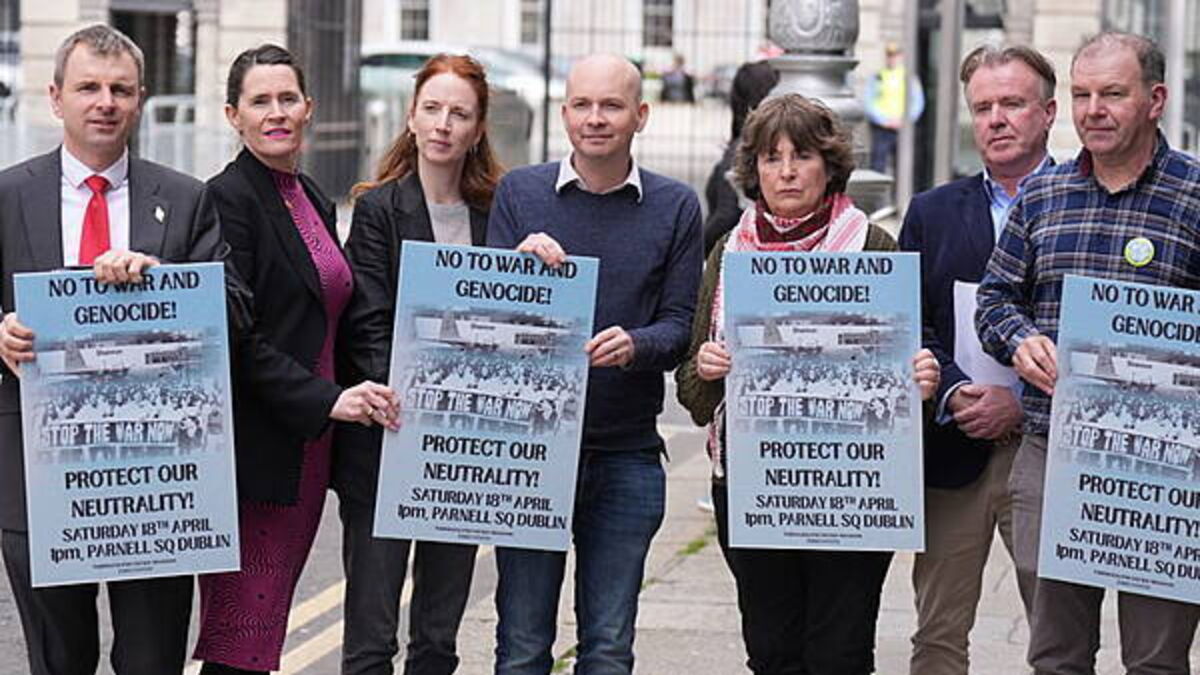
A national anti-war demonstration is due to take place in Dublin city centre on Saturday.
Organisers say they want greater protections for Irish neutrality and to send a message to the Government to take a stronger stance on US and Israeli actions in the Middle East.
Arranged by the Irish Neutrality League, the protest is supported by left-wing opposition parties, a number of unions and anti-war groups.

Speaking at a press conference in Dublin on Wednesday, People Before Profit TD Paul Murphy said “regardless of your view of them (the fuel protests), you can’t deny that they’ve proved the protests are effective”.
“I don’t think anybody believes the Government when they say, ‘Oh, we had this package planned and they’re nothing to do with the protest whatsoever’.”
Murphy was referring to a package of support measures announced by the Government on Sunday to tackle rising prices, caused by the Iran war.
Asked if the movement would consider replicating the disruption caused last week by organising their own blockades, Sinn Féin TD Ruairí Ó Murchú said the public needed to be made aware the Government was “willing and hoping” people would “sleepwalk into” a situation where neutrality protections were taken away.
He said it did not mean there “needs to be absolutely heightened protests from the beginning”, but added that “it is only when it hurts those that are in power” that they will “move”.
“If we don’t put the pressure on them, they are going to sail along, and we will lose that protection we have,” he said.
Representatives of the the Teachers Union of Ireland, Sinn Féin, Social Democrats, the Irish Neutrality League, the Ireland Palestine Solidarity Campaign, People Before Profit and independent senator Tom Clonan took part in the press conference.
There was a strong focus on the importance of Ireland’s triple lock, the mechanism for sending Irish troops on peacekeeping missions.
Under it, Ireland cannot deploy any more than 12 Defence Forces peacekeepers overseas without a peacekeeping mission being approved by a vote of the UN security council, by the Government and by the Dáil.
Legislation, the Defence (Amendment) Bill 2025, put forward by the Government last year, proposes to remove the triple lock.
Social Democrat TD Sinead Gibney said: “The removal of the triple lock, and this defence Act that the Government is trying to push through right now, is a major risk to our reputation on the global stage as peacemakers.
“It is a risk to our ability to negotiate and to represent small nations.”
Senator Clonan, a former member of the Defence Forces, said the Joint Committee on National Security had confirmed that had the triple lock not been in place: “Irish soldiers could have been ordered to go and participate in the invasion of Iraq.”
“That’s not hyperbole,” he said. “That’s on the record.”
The group also criticised what they said was the Government’s “lack of condemnation” of US and Israeli military action in the Middle East.
Sara O’Rourke, of the Irish Neutrality League, said: “It is just not acceptable that this Government is not just refusing to condemn, but is actually facilitating these actions, through the use of Shannon Airport, trade with Israel, and a number of other ways in which they have made Ireland complicit.”
In 2003, an estimated 100,000 people marched through Dublin city centre in protest at the Iraq War – the supporters of Saturday’s demonstration acknowledged it was increasingly difficult to capture public attention.
Gibney said she was “hoping for a big turnout”, but said: “It’s a difficult time because it’s just so noisy right now, there is so much going on.
“People feel overwhelmed, but this is an issue that people overwhelmingly feel strongly about, and hopefully we get the message out.”