Group claims ballroom at Trump's Doonbeg resort must wait until rare snail starts to prosper
Seán McCárthaigh
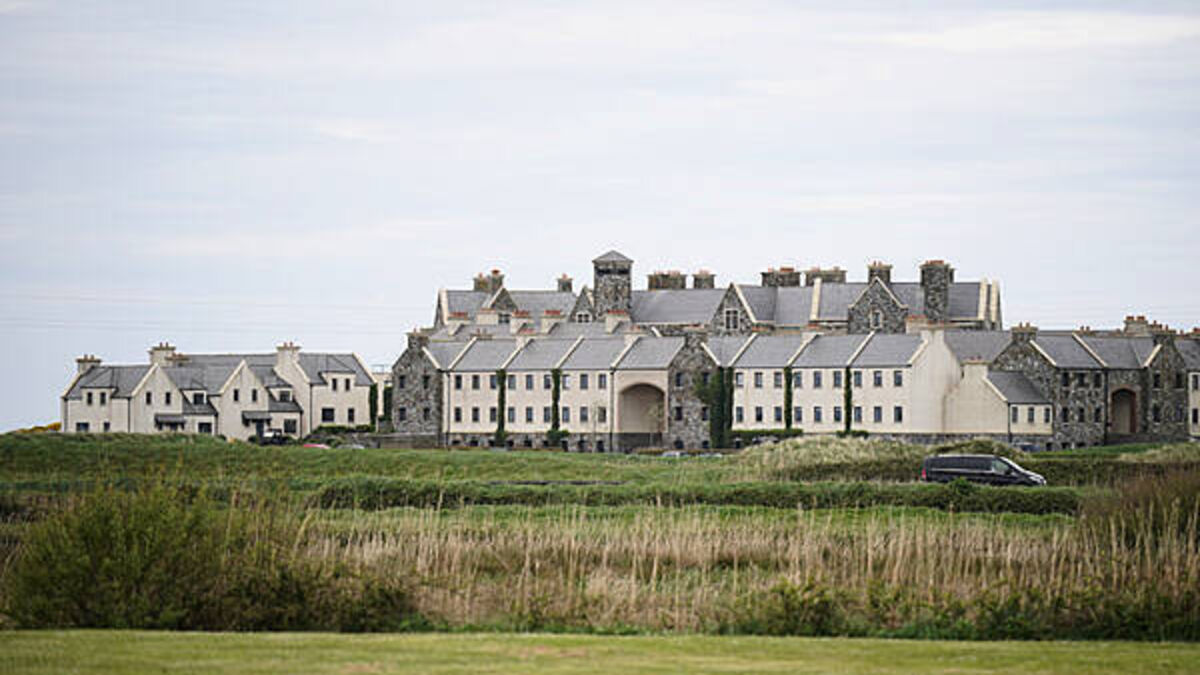
An environmental group, which challenged the original plans to create a golf course at Doonbeg in west Clare over 25 years ago, claims planning permission for a new ballroom at the Donald Trump-owned resort cannot be granted until conditions set in April 2000 to protect the habitat of a rare species of snail are met.
The Friends of the Irish Environment claims the “terminal decline” of the protected snail species, Vertigo angustior, threatens the plans for the proposed large ballroom on the site of an existing event marquee at the golf resort.
The FIE maintains that a High Court settlement in the original case contained an order which ensured any future development would be “bound by the objective of maintaining favourable conservation status” of the rare snail.
FIE director Tony Lowes claimed the Trump family, which acquired the golf resort in 2014, appears to regard a court order as “nothing but a piece of paper.”
The claim was made after a planning application was recently submitted by TIGL Ireland Enterprises to Clare County Council for permission to develop a ballroom at the Doonbeg resort with the capacity to accommodate 320 guests.
The company, which operates the Trump International Golf Links and Hotel, insists that the planned ballroom will have no impact on the Vertigo angustior which is a protected species under the EU Habitats Directive.
A report on the snail by consultants for the Doonbeg resort claims no mitigation or further action is required for its protection.
However, it acknowledged that the conservation status of the snail at Doonbeg remains unfavourable with the species in terminal decline at the location since 2019.
The report noted that there had been “a rapid continuing decline” from 133 snail shells counted at 50 sampling locations on the golf course in 2024 to 51 last year.
The FIE claims a High Court order from April 2000 contains a compromise agreement between the parties, including the Minister for Arts, Heritage, Gaeltacht and the Island and the Minister for Tourism, Sport and Recreation as well as the Attorney General which ensures any development at the Doonbeg resort is “bound by the objective of maintaining favourable conservation status” of the rare snail.
Mr Lowes said the condition requires the developer to ensure that the favourable conservation status is “maintained or improved” as required by a condition of the original planning permission for the golf course, which was confirmed by the court order and a subsequent management agreement in 2004.
He pointed out that TIGL Ireland Enterprises simply stated in its latest planning application that the ballroom and site changes would have “no adverse effect” on the snail population.
However, Mr Lowes said that is not what is required as the developer must ensure that the favourable conservation status documented in 2000 is maintained or improved.
“Until and unless he meets this condition, no further planning permission can legally be issued by the planning authority,” Mr Lowes argued.
He expressed hope that the Irish courts would take a different view to the Trump-owned resort “should we have to return to them.”
TIGL Ireland Enterprises claims the proposed ballroom will replace outdated facilities and is “appropriately sited, technically robust, environmentally responsible and aligned with the resort’s long-term operational strategy.”
The company said the ballroom was needed as the existing marquee no longer met contemporary standards in terms of “operational efficiency, environmental performance, guest experience or long-term resilience.”
It claimed the ballroom would be critical for supporting off-peak visitation, business tourism, weddings and conferences that extend the tourism season and diversify the resort’s offering “beyond golf alone.”