Kildare Co Council can’t find landowner in suspected illegal development case
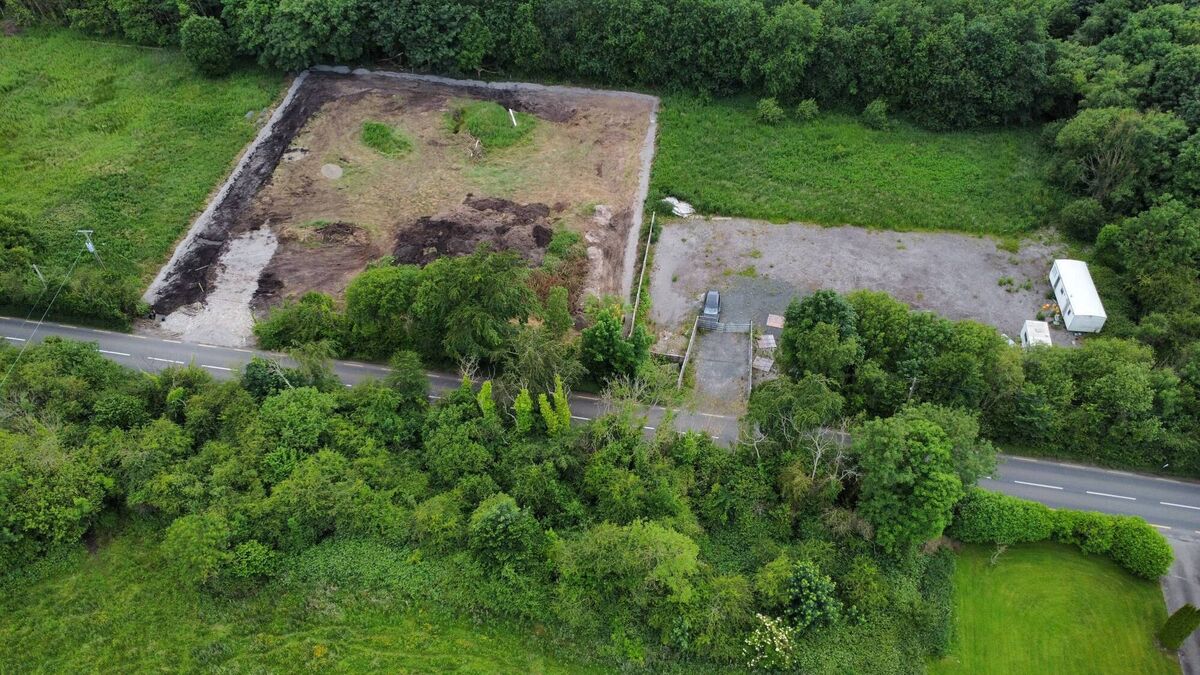
The site in Co Kildare
A MAN who has complained to Kildare County Council for four years about an unauthorised development (UD) near his property was told enforcement could not be pursued as the council could not locate the landowner.
The difficulties Kildare County Council has in enforcement of planning legislation was brought to light recently by one frustrated property owner and also elected representatives.
The man, who did not wish to be named, had made a complaint about a development in north Kildare.
The complainant alleges that after the site was bought in May 2022 the owner made an illegal entrance onto the site off a rural road.
“As well as that he has put down hard top [stone] and installed mobile homes,” said the man who wished to remain anonymous.
An enforcement officer visited the scene, but the man was angered to receive two letters in recent months that the council is now closing a file and after not being able to find the owner or occupier.
One of the letters says that a current address of the site owner is required to facilitate personal service of legal documentation.
‘The planning authority have undertaken exhaustive but unsuccessful efforts to identity the landowner(s). This has included the engagement of a specialist firm in legal tracing, process serving and summons delivery’.
A director of services had subsequently made the decision to close the file on the case.
In a subsequent letter, the council confirmed another file is open on the development, and a warning letter has been issued.
The man said he subsequently wrote to the chief executive but received no response.
“And it gets worse. The same community came along with two JCBs and opened another illegal opening which is now subject to a new UD file.
“I’ve reported it to everyone, and to be fair, the councillors have done their best but can’t get any answers.
“I have done everything in my power to get answers.
“They’ve put in fencing, gates, a second entrance.
“It’s only an acre of land, and they have already dug foundation trenches.
“It looks like he’s putting in a pathway for caravans.
“The council have told me that if I persist with my questions they will restrict replies due to staffing and resources.
“This is a rural road and it’s illegal to put a new entrance off this, and the council are doing nothing about it.” Kildare County Council said it would not comment on individual cases.
At a recent meeting of Kildare County Council, councillors also complained about the lack of court time allocated for planning matters.
Cllr Claire O’Rourke described it as “absolutely scandalous” and raised concerns about the local authority’s ability to enforce planning laws.
Cllr O’Rourke said she had been told that “the allocation of legal time for the council in county Kildare is one Monday per month” and that bank holiday Mondays reduce that to around six days of court per year, which she described as “absolutely scandalous”.
Director of Services Alan Dunney issued a detailed report, which pointed to rising workloads, staffing pressures and growing demands on the court system.
The response noted Kildare is one of the fastest-growing counties in Ireland, creating a heavy workload for planners and enforcement staff.
The council also revealed that 906 planning applications have been received, 68 housing developments are being monitored, and 4,390 building inspections have been carried out so far in 2026.
Mr Dunney told the meeting that, with regard to judicial capacity, chief executive Sonya Kavanagh has written to the Master of the High Court seeking additional resources for Kildare.
Cllr O’Rourke had tabled a motion calling on the local authority to report on whether it has enough staff, resources and systems in place to properly implement and enforce the new Planning and Development Act 2024.
Cllr O’Rourke said she tabled the motion following “the high numbers of representations from constituents about unauthorised developments”.
The council’s response noted that there was ongoing staff training for the new legislation, two additional planning enforcement posts approved in the 2026 budget, expanded digital planning systems and participation in national recruitment and planning-capacity initiatives.
Funded by the Local Democracy Reporting Scheme