Kildare town 'at breaking point' due to traffic congestion
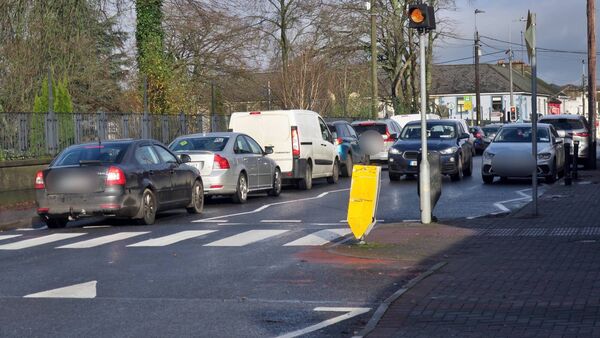
Photo for illustrative purposes only
KILCULLEN town centre is under significant pressure from heavy through-traffic, according to a major new study commissioned by Kildare County Council.
The survey, carried out by IDASO Ltd, found that 176,262 vehicles passed through the town during a four-day survey period in May 2025, highlighting the scale of traffic using Kilcullen as a key route rather than a destination.
The study examined traffic volumes, pedestrian activity and parking usage, providing the council with a detailed evidence base for future planning decisions.
According to the findings, Kilcullen is operating as both a busy town centre and a “strategic through-route”, with a high proportion of vehicles travelling through the area rather than stopping.
Traffic levels peak during weekday commuting hours, particularly 7.30am and 9.30am and again from 4pm to 6.30pm.
Private cars account for the vast majority of movements, while heavy goods vehicles and buses make up only a small share.
Despite the traffic volumes, the survey recorded strong pedestrian activity throughout the town, particularly along Main Street and The Square, near schools and in commercial areas.
The presence of children, older people and those with mobility challenges was noted, confirming Kilcullen’s role as a walkable town centre, reinforcing the design of “pedestrian-first” infrastructure.
The report also examined 680 parking spaces across Kilcullen and found that overall occupancy remains relatively low, averaging below 40% throughout the day.
However, demand is heavily concentrated in central areas, with parking in parts of Main Street, The Square and Millstream Court reaching up to 80% occupancy at peak times between 11am and 2pm.
In contrast, parking on the outskirts of the town is significantly underused, suggesting that the issue is not a lack of spaces but their location and accessibility.
Local councillor Tracey O'Dwyer said the report highlights serious challenges but also contains what she described as a key flaw.
While welcoming the data, she said the inclusion of privately owned parking spaces creates a misleading picture of availability.
“In reality, only Main Street and Market Square offer public parking and this distinction is critical for any future urban planning,” she said.
Cllr O’Dwyer described the volume of traffic as “the most striking takeaway”, warning that the figures do not reflect additional surges during major events such as Punchestown or when incidents on the M7 and M9 divert traffic through the town.
She said the findings reinforce long-standing calls for major infrastructure projects, including a ring road and improved access to the motorway network.
“The data confirms that Main Street and Market Square are struggling under a dual function, serving as a local town centre while also acting as a strategic through route,” she said.
She added that high levels of pass-through traffic are also impacting local businesses, with some customers choosing not to stop due to difficulties finding convenient parking.
“The survey proves Kilcullen is at a breaking point,” she said. “The town is managing ring road levels of traffic through a village layout.” The report concluded that Kilcullen’s challenges are driven more by traffic volumes and the distribution of parking than by an overall shortage of spaces.
It recommends measures such as traffic calming, improved pedestrian crossings, better use of existing parking and greater investment in active travel.
The findings are expected to inform future planning decisions in line with national policies including Town Centre First.
Funded by Local Democracy Reporting Scheme