Kildare workshops a wake-up call on invasive species
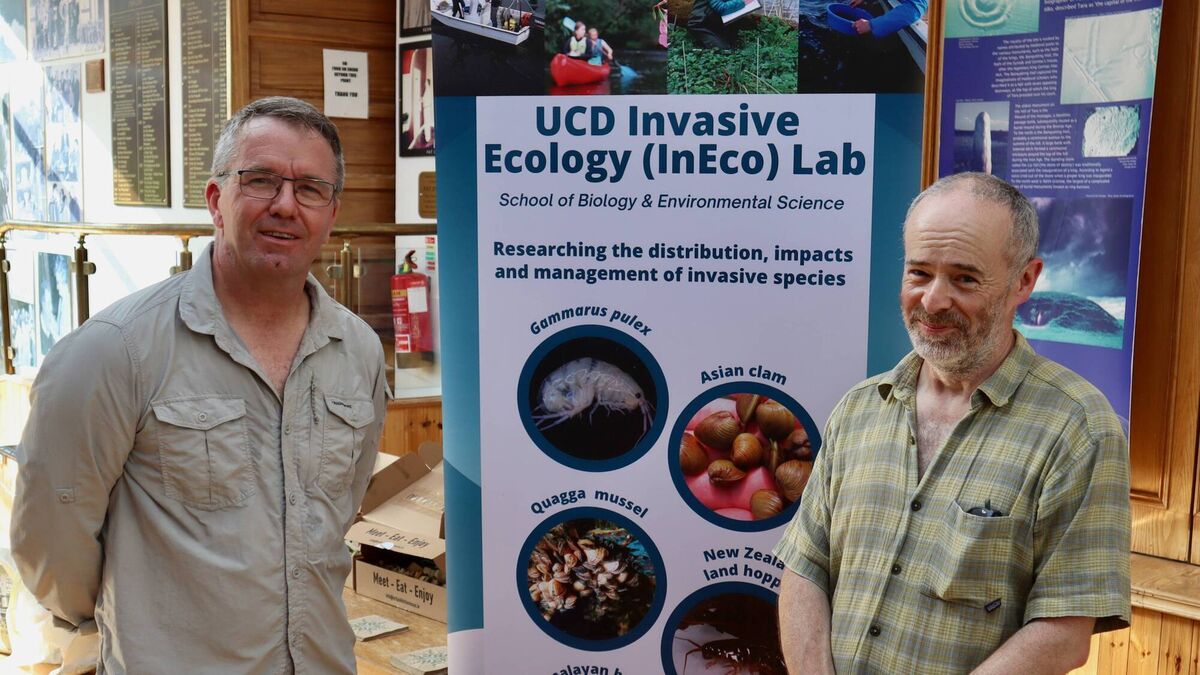
Dr Jan-Robert Baars with Brian Browne
Ireland's biodiversity is open to ever-increasing threats from invasive species, according to one of the country's leading experts in the field.
But he says there's no national plan dedicated to dealing with the danger, which, he adds, is affecting Irish ecosystems at almost every level.
Dr Jan-Robert Baars of the School of Biology and Environmental Science in UCD, speaking at two events in Kilcullen Town Hall for Invasive Species Week, also called for increased funding for dealing with the problems, and greater awareness of the significant ramifications of the connectedness of the effects of invasive species.
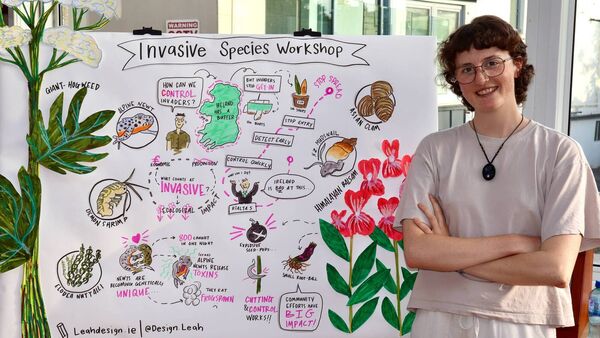
The Kilcullen events were supported by Kildare County Council and Creative Ireland and included live exhibits and information panels on several invasive species, which are currently problematic generally in Ireland and locally to the upper Liffey.
There was also a demonstration on the physical control of Himalayan Balsam, which the Ballymore Eustace community has helped to eradicate from several locations along the Liffey in its area.
Dr Baars, who lives in Kilcullen, noted that while certain funding streams have been available for several years for individual invasive species monitoring and control, they are small-scale.
"We have a national biodiversity plan that mentions invasives, but we really need a specific national plan to target and deal with them, and integrate it with other conservation plans."
There's general public awareness of impactful invasive species such as the grey squirrel, mink, and Japanese knotweed, which are in the terrestrial environment and are easy to detect.
But many others are already adversely affecting our national ecosystems. Dr Baars believes those developing in Ireland's waterways are probably the most dangerous.
"In both freshwater and marine environments, they are difficult to monitor and control.
Unless we're regularly monitoring, we don't pick them up until it's often too late. By the time we actually discover them, they are super-abundant and widespread."
He cited as an example a new invasive crustacean, native to eastern Europe and first detected in Ireland last September, which has now spread through the Shannon system, probably via boats, and to the canals.
"It did trigger a national alert, but there should then have been a national response. If we had a better system in terms of treating boats, we could have reduced the likelihood of the spread. But it just shows that when we have found something has come in, it's almost too late."
Plants for domestic gardens are also a concern, as the garden trade can often offer plants which are actually on the invasive species list.
Among these are variations of the flowering aquatic plant Hydrocharitaceae. "There are 16 species of these in the world which are invasive, and some of these are advertised and sold in Ireland, often misidentified. They are a disaster waiting to happen."
Another commonly purchasable aquatic invasive is Lemna minuta, or duckweed.
There are issues, too, with the implementation of the EU invasive species directive here, first issued in 2014 but only ratified in Ireland in 2024.
Currently, there are 114 species on that list, which at the EU level is constantly being revised.
"If things are on the EU list, they are not allowed to be distributed or sold. Whether that's being enforced here, I think, is questionable."
Pets can be another problem, a specific current example being the Alpine Newt, which arrived in Ireland through the pet trade.
"We need to be careful and know what such pets are likely to do if they get released and out into our environment."
The Alpine Newt consumes frogspawn, directly impacting the protected frog populations in Ireland.
It doesn't have a natural predator here and is toxic to anything that tries to consume it.
Dr Baars and his team have been conducting pilot eradication efforts at two sites, a bog in the Midlands and in Galway, the first such research in Europe.
Among several other species discussed at last week's talks was the Quagga mussel colonisation of lakes and rivers, which was described as a “serious problem” that will, among other effects, result in more and more intense algae blooms.
Dr Baars also spoke about the spread of the algae starry stonewort, native to Europe but not to the UK and Ireland.
"It is actually becoming quite invasive — the whole of Lough Derg has got huge populations now. It's in Loch Ree and was recently discovered in Loch Sheelin. It's spreading all the time, which is really concerning."
Especially in the absence of a national invasive species plan, local authorities play a key role in current efforts of monitoring and control.
Kildare County Council has funded work for the last six years to deal with both Himalayan Balsam and American Skunk Cabbage along the Liffey to Celbridge. The effort is arduous and time-consuming, and Dr Baars highlighted the dedication of the Ballymore Eustace community, who put in some 500 hours in 2024 to manually remove Himalayan Balsam, resulting in an 85 per cent reduction of the species in the area.
"We have secured further funding, and this year our target is to clear about eight or nine kilometres downstream from Ballymore."
A recent 'horizon scan' of potential invasive species to Ireland, to try to make conservation biology a proactive rather than a reactive science here, began with 348 candidates in marine, freshwater, and terrestrial categories.
Of these, 186 were brought forward for closer consideration, and those have been filtered down to 40 species to be monitored in Ireland through 2027.
But resources for this are scarce, despite the fact that every study globally shows that prevention is better than the cost of dealing with something when it gets here.
"We have 3,300 water monitoring stations in Ireland, and some of those are used to detect invasive species, but it's not comprehensive in terms of where it is implemented.
“So, the way we're monitoring our systems is not good enough to detect the species that are coming in."
Wake-up call, anyone? Anyone in power listening?