Burke wary of experimental rules after college tests
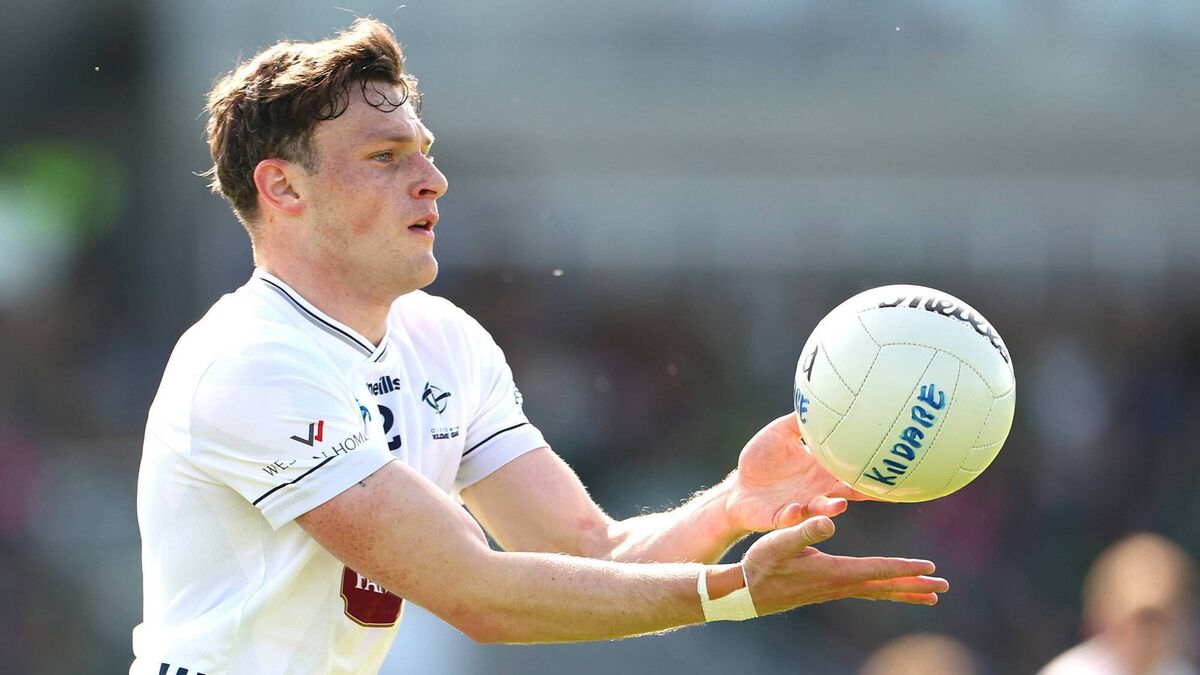
Ryan Burke under the trialled rules for Maynooth University Photo: ©INPHO/James Crombie
Kildare defender Ryan Burke has questioned the practicality of several experimental rules trialled in recent college football competitions, arguing that some would place an unreasonable burden on referees and may not deliver the intended improvements to the game.
The Caragh clubman featured in four matches under the proposed rules as Maynooth University reached the Division 1 Higher Education Senior Football League semi-finals before losing to DCU last week.
Burke said he sympathised with referees who already have enough to monitor during games without also being required to count consecutive hand-passes, with teams restricted to a maximum of three in succession.
“I understand they're trying to improve the game, but there are a couple of rules that are probably stretched too far. I don't know how they'd actually implement them into county games, let alone club games across the country. They'd be asking a lot of referees.
“There's one hundred and one things going on on the pitch and you can't expect referees to get everything right. It could be just another layer for people giving out because hand-passes are counted incorrectly. I think they're just asking too much of referees who, in a lot of cases, are only doing it to stay involved in the game,” said Burke.
While many supporters believe restrictions on hand-passing would improve football, Burke is unconvinced from a player's perspective.
“It seemed when these rules were announced that they were designed to speed up the game, but they're actually having the opposite effect.
“If the ball goes up the right wing after a hand-pass and a forward is making a run, realistically he can play a one-two and that's it. He can't hand-pass again. What's actually happening is lads are standing around the edge kicking exaggerated solos to each other instead,” he explained.
A ban on fisted points was also trialled, and again, Burke is unsure on that change.
“I know opinion is split on it, but at the end of the day, if you're getting a score and setting up to press a kick-out in what could be a tight game, I'd rather that than going for a 50-50 goal chance,” he said.
Of all the trialled changes, the proposed four-point goal appeared the most likely to advance towards formal consideration at Congress before being placed on hold pending further analysis.
Burke, however, has reservations about its impact.
“The four-point goal is a huge momentum swing. We've noticed in a lot of the college games that the moment a goal goes in, everything changes.
“It happened to us against DCU when Darragh Swords scored. We went from being two points down to six points down in an instant because of one misplaced pass. Is that too harsh an impact on the scoreline? It's hard to know.
“As a defender, I'm always going to want it to stay at three points, but looking at the bigger picture, you might see teams allowing one-point shots and putting more emphasis on protecting against goals. They could sit in a low block and leave the space between the arcs completely free, deciding they'll allow points rather than risk conceding a goal.
“But it's difficult to judge because we've been playing these rules through the depths of winter. It could be very different in June and July when the ground is firmer and everyone's fitter,” he said.
Despite Maynooth's defeat in the league semi-final, the campaign leaves them well positioned ahead of the Sigerson Cup, while last week's Leinster Championship draw has already sharpened Burke's focus on Kildare's inter-county ambitions for 2027.
Kildare will face either Offaly or Longford in the quarter-finals, with the prospect of a semi-final clash against Dublin awaiting should they progress. Draws elsewhere mean that Kildare know it's likely they will need to come through those games and reach a Leinster Final if they want to play in next summer's Sam Maguire Cup.
“I think regardless of how the draw went we knew we'd be facing some difficult games. Although we're avoiding Meath, Louth and Westmeath on our side of the draw, there are still some difficult matches ahead, and we won't be looking past our first game.
“The draw is tough and it will take huge focus from us, but the aim is to keep progressing and see how far we can go in Leinster. If beating Dublin in a semi-final is what's required, then we'll have to deal with that,” he said.
Even before that, attention will first turn to the National League, where Kildare appear set for a demanding start to their Division 3 campaign, beginning away to Clare before home games against Westmeath and Sligo.
“Division 3 will be every bit as difficult to get out of as it was two years ago. Ourselves and Offaly went up then, but both counties came straight back down, which was disappointing.
“It's too late to do anything about last year's campaign, so we just have to focus on what's ahead. It looks like we have Clare and Westmeath in the opening games. If we can get through those first two matches with two wins, that would put us right in the mix, but it's going to be a very tight league,” said Burke.