Kildare author to launch new novel inspired by 1798 Rebellion

Martin Malone
KILDARE author Martin Malone, known for his works of historical fiction, has recently published a new title, Pike Hill: A Rath Massacre, drawing on the 1798 Rebellion while focusing on the human side of the story.
Mr Malone described the book as a long-awaited project, one that had originally been accepted for publication more than two decades ago before being shelved and eventually rediscovered among old manuscripts.
The story centres on an event often referred to as the “Rath Massacre,” where hundreds of rebels were reportedly killed after assembling under terms of surrender. While some accounts suggest as many as 350 deaths, the author notes that the true number remains uncertain, reflecting the blurred line between documented history and folklore.
“We have fragments, letters from the military side, but much of the story is shaped by legend and oral history,” he said.
Rather than focusing solely on historical fact, the novel aims to reconstruct the emotional and psychological realities of those involved.
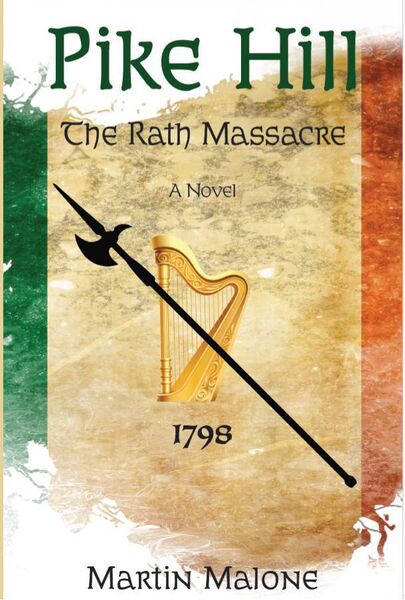
According to the author, historical fiction requires balancing known facts with plausible interpretation.
“You pare away the landscape, take in the facts, and then work with probabilities,” he said. “But what matters is bringing the human element to life, what people felt, how they reacted, and how they lived with the aftermath.” The book also explores the broader social tensions that led to the uprising, including resentment among the peasantry, the influence of revolutionary ideas such as ‘The Rights of Man’, and the heavy-handed actions of militias formed in response to fears of a French invasion.
“It didn’t happen overnight,” the author noted. “There was deep grievance, and people were pushed to the edge.” A key theme in the novel is the long-lasting impact of violence on communities. The author highlighted how trauma can persist across generations, drawing parallels between Ireland’s revolutionary build up and modern examples such as the Palestinian genocide.
“When something like that happens, it doesn’t disappear in ten or twenty years,” he said. “It leaves a stain on the land and on the people.”
The work is also informed by the author’s own experiences, including time spent teaching refugees and witnessing the effects of post-traumatic stress. These insights shaped the portrayal of characters dealing with loss, fear, and inherited anger.
“It’s not just about what happened,” Martin explained. “It’s about what it does to people afterwards, and how that carries on.”
The novel is dedicated in part to the rebels involved in the massacre, as well as to Martin’s own ancestor, who died during the 1798 rebellion. This personal connection, uncovered through family history, added further depth to the project.
Early reception has been positive, with the book already stocked in several Irish shops and cultural centres. Local support has been particularly strong, with the book featuring on shelves in Barker & Jones in Naas, The Irish National Stud and Japanese Gardens, Kildare Heritage Centre, An Seanchai in Kildare Town, and Farrell's Bookshop in Newbridge.
Looking ahead, the author expressed hope that the novel will encourage readers to engage more deeply with Irish history, especially stories that remain underrepresented in film and media.
“We have so many powerful human stories that haven’t been told,” he said. “If this book gets people thinking about the ground they’re walking on, then it’s done its job.”
The novel will be officially launched at an upcoming Irish Military Seminar on 28 May in Naas Library, introduced by Kildare-Newbridge Municipal District Cathaoirleach, cllr Noel Heavey.