Athy's 1798 memorial deserves pride of place
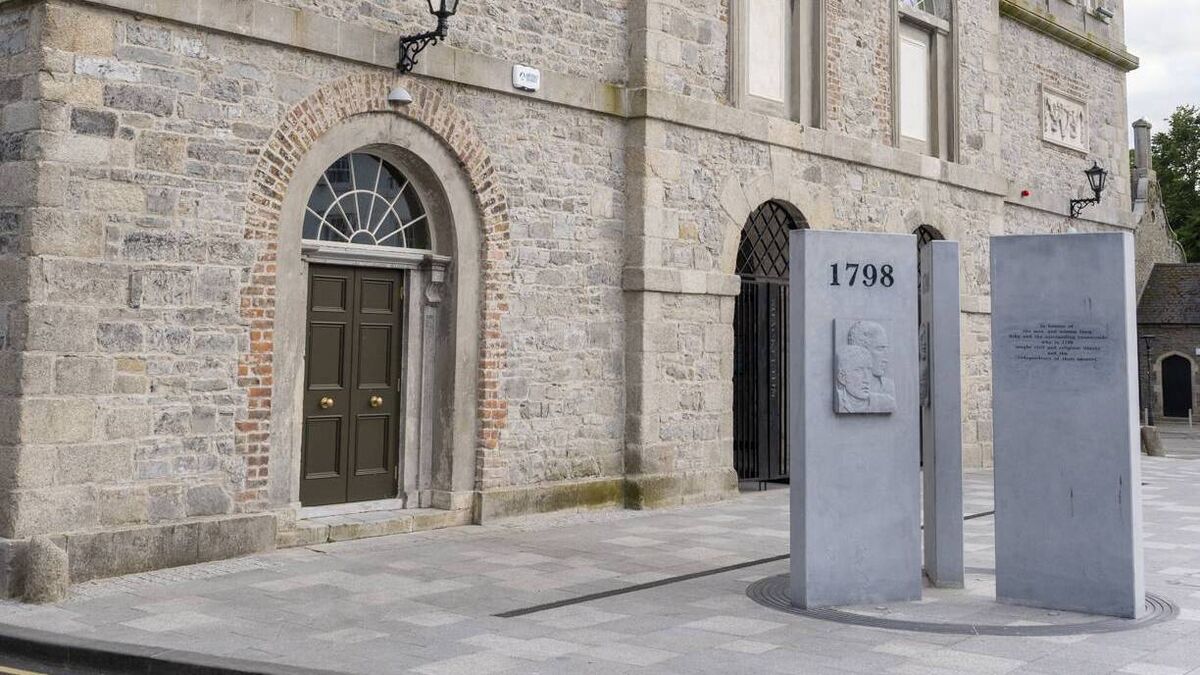
The 1798 monument Photo: Aisling Hyland
I WAS a young fellow when in the 1950s I visited the Athy library once a week in the evening in my search for detective novels.
The library, based in a small room on the first floor of the Town Hall, was accessed through the side door which now remains permanently locked opposite the Royal Garden restaurant. The library was seldom used, at least that is my memory of almost 70 years ago.
The librarian was Kevin Meany from St Patrick’s Avenue, one of a number of brothers, whose day job was as an engineering assistant to Mossie O’Sullivan, Athy’s Town Engineer.
Kevin, apart from being a nice man, was also something of a local historian, although I am not aware if he ever published anything.
He is remembered by me for making me aware of the published work of Kilcoo man Patrick O’Kelly.
It was only long after I had reached adulthood and while working away from Athy that I first came across a copy of O’Kelly’s book on the 1798 Rebellion.
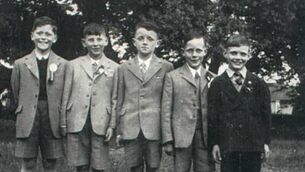
O’Kelly was a young man when appointed colonel of the United Irishmen in the south Kildare area.
He published an account of the 1798 Rebellion in 1842 after he returned to Ireland having spent some years in America and France.
He recounted details of the punishments imposed on the locals and in particular he reported how seven men were tried and hanged in Athy in the early days of June 1798.
Six of those men were from Narraghmore and the seventh man, named Bell, a graduate of Trinity College, was from the Curragh area, as recounted by O’Kelly.
O’Kelly’s work in relation to rebel activity in and around Athy in 1798 was supported by another publication which appeared in 1949. It was William Farrell’s previously unpublished writings, published as ‘Carlow in 1798’, which gave an account of the floggings which were carried out in the Market Square, Athy.
Farrell wrote:
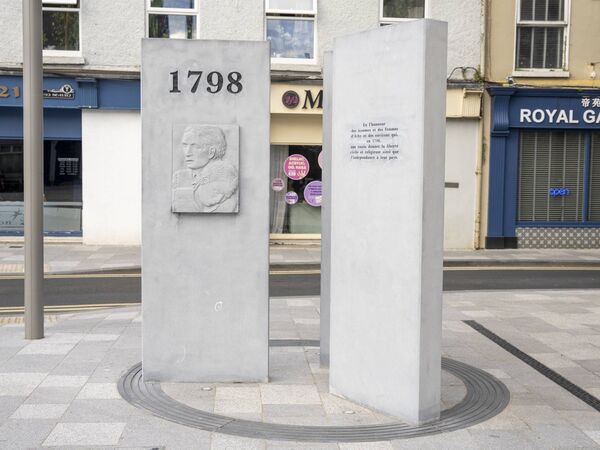
During one of my terms as chairman of Athy Urban District Council, I brought the events of 1798 in Athy to the attention of the Council members who agreed that a suitable memorial to the victims of 1798 should be erected in Emily Square.
This was finally done in November 2010, almost ten years after the council decision.
The 1798 Memorial was situated in a central position in Emily Square and there it remained until the recent improvements in the Square.
Unfortunately, the position formerly taken up by the memorial was given over to the remains of the drinking fountain which was no longer working.
The fountain was donated by the Duke of Leinster around the same time as the piped water scheme was extended to Athy.
I have no memory of the fountain working during my young days and I suspect it had been out of commission for many, many years.
Why it should be retained in Emily Square is a mystery and even more mysterious is why the 1798 memorial should be assigned to its current position.
It would suggest that Kildare County Council made a mistake similar to that which saw the Shackleton mural on the side of Brennan’s office partially shielded by thoughtless electrical works by the ESB.
It is a pity that more thought is not given by bodies such as Kildare County Council and the ESB in executing public works.
The fine work in Emily Square is for me at least lessened somewhat by the unwise position of the 1798 memorial. The patriots of 1798 deserve better than to have their memorial squeezed almost unnoticed into a corner of Emily Square.
O’Kelly’s book, deserves to be reprinted.
I wonder if Kildare County Library services would consider doing so given their recent success in reprinting Mary Leadbetter’s .