Former Kildare soldier recalls Ireland's first peacekeeping mission
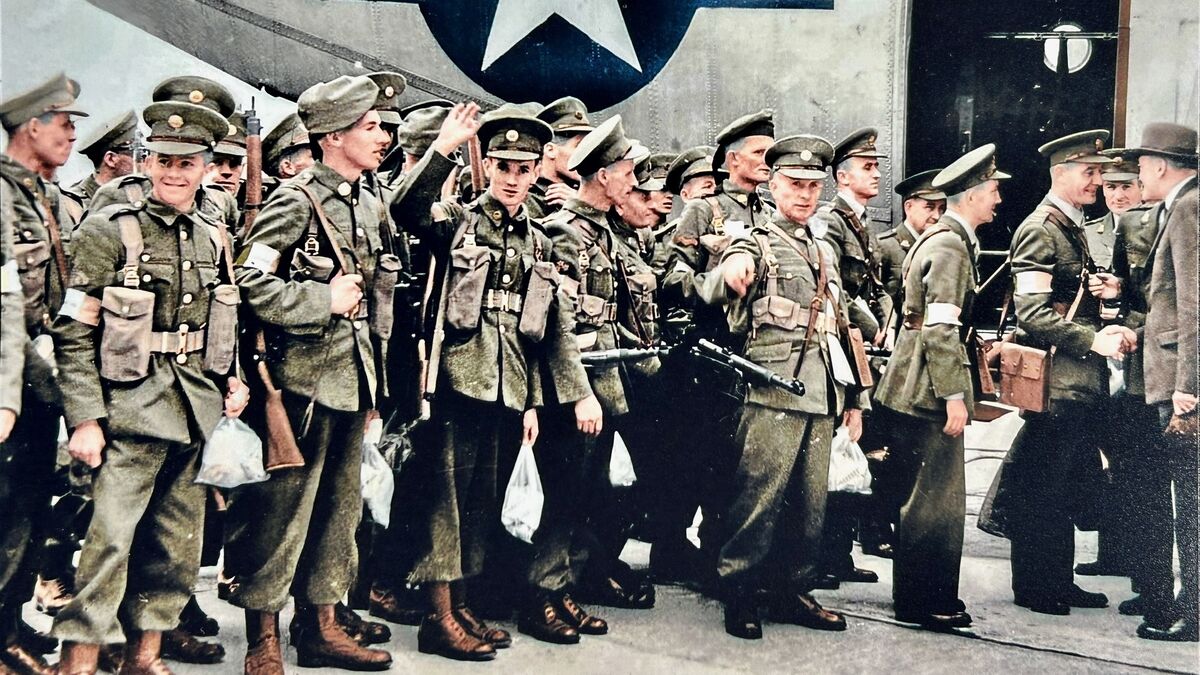
Wireless operator Billy Redmond is pictured here, second from left, with some of the 32nd Infantry Battalion being flown by the US Air Force Military Air Transport Service from Baldonnel on 27 July 1960. They are being seen off by the then Irish Minister for Foreign Affairs, Frank Aiken TD. The plastic bags carried by the soldiers contained two ham sandwiches, an apple and an orange, to sustain them for the flight
WHEN a local storyteller approached Kilcullen man Billy Redmond at a story house session in Rathdangan, Co Wicklow, and told him her sister had been housekeeper to one Fr Jim Stone, ministering in Killester, Dublin, in the 1960s, it closed a circle in his former Irish military career.
She had been prompted to talk to Billy, who plays button accordion at such gatherings, because she had read an article the former soldier had penned in 2021, describing his posting to the then Belgian Congo as parts of Ireland's first major overseas UN peacekeeping missing in July 1960.
The same Fr Stone, an amateur radio 'ham', had provided a vital link between Billy's battalion in the Congo and Irish Army HQ in Dublin, a matter which had been noted in the article.
"Once again, it's a small world," Billy recalled the story recently during a gathering of amateur radio enthusiasts in Shannon, for the AGM of the Irish Radio Transmitters Society (IRTS). As an invited speaker, he had earlier told them that on a visit to a vintage radios exhibition in Howth, Dublin, in 2010, he had been shown what turned out to be Fr Stone's own radio, an Apache model.
The original connection had happened in a roundabout way. A member of the 32nd Infantry Battalion, 657 Irish troops who had been flown out to the Congo at the request of the United Nations, radio operator Billy was involved in organising communications between the battalion’s units scattered across their operational area in that large African country.
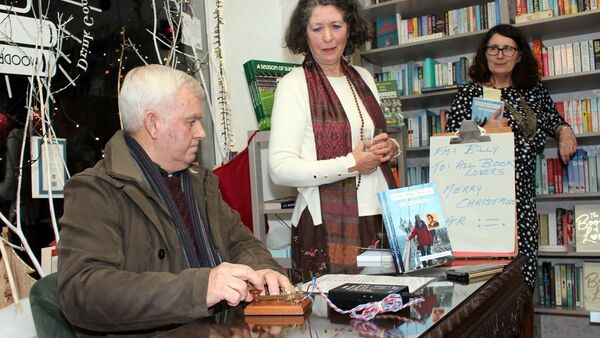
"At home, our battalion units would likely be no more than 20 miles from each other," said Billy. "But in the Congo, some could be several hundred miles away. However, after a few days, we were settled in, and our inter-battalion network was set up just fine, with a PYE C12 high-frequency radio as our main set."
There was still a problem, though. The equipment they had couldn't keep the battalion command officers in touch with their GHQ back in Ireland.
"Since our country had not been involved in World War 2, our resources were very limited indeed. However, after some prowling the radio waves, we discovered a Mr Terry Tierney, a civil engineer working on a project in Kampala, in the neighbouring country of Uganda."
A ham radio enthusiast, Mr Tierney turned out to be in weekly contact with a fellow enthusiast, Fr Jim Stone, back in Ireland.
"Bingo, suddenly we were online back to Dublin, with Terry relaying our messages backwards and forwards to GHQ, via Fr Stone. It meant all the administration and support details for our new group on the ground could be dealt with."
After several weeks working this way, Terry Tierney put together a transmitter-receiver for the unit so they could connect with Fr Stone themselves until a proper direct communications facility with Army GHQ had been put in place. Billy recalls that getting this transmitter required sending a patrol along a difficult trail to the Ugandan border where Terry Tierney could hand it over.
"In return, we gave him a box of Irish Military Pack Rations, which he appreciated."
In a full military career, which he finished out as a Regimental Sergeant Major, Billy participated in many overseas peacekeeping duties, including three in the Congo, two in Cyprus, and up to ten in Lebanon. Many of those places where he and many comrades tried to help bring or keep peace are still flashpoints today for one reason or another, and seeing the continuing difficulties in those places makes him sad.
"Goma, where a treatment centre for the current Ebola outbreak has been set up, is where I spent the initial three months of my first Congo tour. A lovely little village then and now a city, and in the news for all the wrong reasons."
As for Lebanon, he was stationed on many occasions close to the city of Tyre.
"I often visited there, and all the villages in the area that are evacuated now."
Speaking at the IRTC event, Billy, now in his 83rd year, described the various pieces of equipment which had been at the core of the military communications during that first Congo expedition. He also told how Morse Code had still been an important technology in those days, and radio operators like himself could send and receive messages in English and also any language that used the Roman alphabet.
"They could have been in French, Spanish, or Italian, and we may not have understood the content, but that didn't stop us from sending and receiving."
He is still proficient with the technique and, from time to time, demonstrates it at gatherings of people interested in the history of early Irish peacekeeping.
At the Shannon event, Billy met with several of his former Army colleagues whom he hadn't seen since the 1960s. He's looking forward to seeing more at the official opening in July of the refurbished workshops for the Army Communications and Information Services (CIS) at the Defence Forces Training Centre (DFTC) on the Curragh, which have been upgraded at a cost of €8.6 million.