‘No safe dose’: Laughing gas leaves young people with spinal cord injuries as calls grow for tighter controls
Ottoline Spearman
A 30-year-old American man is paralysed from the neck down after experimenting with a new party drug: laughing gas, also known as nitrous oxide.
He is suffering from spinal cord damage, brought on by inhaling the colourless gas that comes in a small, silver canister. Despite weeks of rehabilitation, he will never walk again.
In Ireland, doctors are warning that similar cases are happening here.
Professor Seamus Looby, a neuroradiologist at Beaumont Hospital in Dublin, told BreakingNews.ie about young people arriving at A&E, unable to feel their arms or their legs.
'Very distressing'
"We noticed a spike in young patients presenting with abnormal symptoms in their arms and legs, and they were presenting with this terrible uncoordination where you can't tell where your limbs are, so you actually can't use the limbs properly. So it's really distressing," Looby said.
"They can't do things like they can't walk, they can't feed themselves. They can't do the most... basically everything we take for granted."
Looby said that when neurologists see patients who can't feel their arms or their legs, the first thing they consider is the spinal cord.
MRI scans show any damage to the back of the spinal cord - an area that is responsible for coordination and balance.
"When we see a young patient presenting with those types of symptoms, with the history of nitrous oxide use, it's almost certain that's what's caused the problem. And the MRI scan shows it to us."
"They're [often] in a wheelchair, can't use their limbs properly and it's very distressing for them.
"So young patients presenting like that, something that we will ask them is, have you used nitrous oxide?"
Cases spiking
The number of people being admitted to hospitals is surging, Looby said.
This year, there have already been four cases at Beaumont Hospital. Between 2020 and 2024, according to a study published by Looby and his team, there were 25 cases, with 14 extremely severe cases with damage to the spinal cord that showed up in the MRI. The youngest of these people was 16.
But before the pandemic, there had been no such incidents.
Looby said that they suspect that the pandemic has contributed to the increase in young people using the drug.
"Our theory is that when Covid and the lockdowns and the pandemic came, traditional drugs were kind of harder to get, whereas nitrous oxide was easier to get. That's the reason for the resurgence," he said.
"Now we wonder, will it continue?"
Other hospitals in Dublin are experiencing a similar issue. Tallaght University Hospital had 18 people arrive between October 2022 and July 2024 after using nitrous oxide, the youngest of whom was 16.
And increasing numbers of young people are using the drug. Last year, nitrous oxide ranked third on reported substance use from teenagers referred to the HSE, according to a report.
There isn't a medication to reverse the effects of it
The effects of the drug are irreversible, Looby said.
Of the patients he had seen in Beaumont, "nobody was fully back to normal".
"A lot of them will get some of the function back with physiotherapy and occupational therapy. But there isn't a medication to reverse the effects of it.
"There are cases recorded of patients not making any recovery. The one absolute thing that we've found was that nobody returned to 100 per cent normal."
Looby said that the symptoms of what is called subacute combined degeneration (SACD) of the spinal cord often set in very quickly, often "within hours to days after the nitrous oxide use".
The lack of improvement is what prompts most of them to seek medical attention, he said.
Symptoms of SACD include numbness in the limbs and difficulty with balance and coordination.
"We're now at a point in Ireland, and I would think probably most countries in the Western world, where the commonest cause now of this condition [SACD] is nitrous oxide abuse."
Inhaling the gas can also cause a whole host of other damage to the body, including frozen or punctured lungs, and frostbite in the mouth and nose.
But what actually is it?
Nitrous oxide, colloquially known as NOS or whippets, is a colourless, sweet-smelling gas that is used as an analgesic - a painkiller - in medicine and dentistry. It is also used for producing whipped cream in cooking.
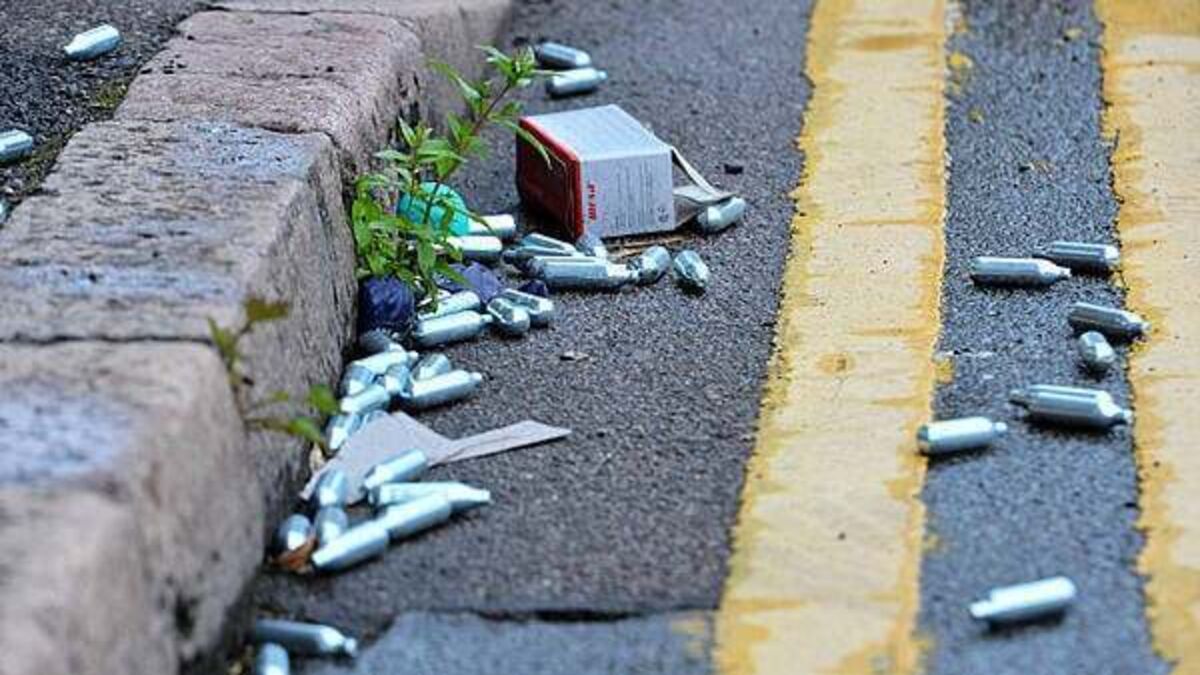
It is sold in silver canisters, which you may have seen littering the streets of cities in Ireland.
Last year, the Journal Investigates found the more common small, eight-gram canisters, as well as large canisters containing over 600 grams of the gas for sale online.
This is because the drug exists in a legal loophole. As there are legitimate medicinal and culinary uses for it, its sale is not illegal, and it is not controlled under the Misuse of Drugs Act 1977.
While it is regulated under the Criminal Justice (Psychoactive Substances) Act 2010 - which outlaws its supply if intended for consumption for its psychoactive or intoxicating effects - it is not a crime to possess it.
Further, it is not required that someone be tested for the drug if they are pulled over for intoxicated driving, making it even harder to clamp down on.
Sinn Féin TD Mark Ward, who put forward a bill to ban the substance, has expressed dismay at the decision of the Government to delay the bill by nine months. Addressing the Dáil in late January, he said: "Nitrous oxide is an epidemic and will only get worse in the next nine months."
He also mentioned a recent study by the adolescent addiction service in Cherry Orchard, which showed an increase of 175 per cent in the number of young people presenting to the HSE's addiction services looking for help with their nitrous oxide use.
"I have worked in addiction services. When you see an increase of 175 per cent in one year, you know there is a problem," he said.
He also referred to how the EU is looking put in place a derogation to prohibit the sale of nitrous oxide to the public because of the damage it is doing to people's reproductive health.
Protecting people
Cllr Danny Byrne has tabled a motion at Dublin City Council to raise awareness about the issue. The motion calls on Dublin City Council to develop education campaigns for young people to work with the Garda to address illegal sales and supply.
Byrne told BreakingNews.ie that there should be a licensing system to purchase the canisters, and people shouldn't be allowed to buy them "willy-nilly".
"Unscrupulous vendors are supplying them. But they're dicing with young people's lives."
Byrne said that the motion, which was discussed at a Dublin City Council meeting on Monday, is about "protecting people" rather than criminalising them.
Looby said that tighter regulation and enforcement were important, but the black market is "where most of it is coming from now" and it "isn't going to go away".
In 2023, gardaí seized 2,000 large canisters of the gas in Dublin, together with a large quantity of cocaine. Speaking after the seizure, assistant commissioner Justin Kelly said: "It is of particular concern to us that the same organised crime groups that are involved in the importation and distribution of cocaine are also involved now in the distribution of nitrous oxide and the resulting harm to our communities.”
Looby said that his team had been invited to talk to social and youth workers, and that this route "needs to be pushed every bit as hard as the legislation".
"The message we're trying to get out to people is don't use it. That's the key thing. There's no safe dose. Do not use it."