‘Worst-case scenario’ must guide decision on Tyrone gold mine, inquiry hears
By Claudia Savage, Press Association
The “worst-case scenario” should be assumed in the decision to grant consent to a controversial proposal to develop a gold mine in Co Tyrone.
The public inquiry into the plan is set to proceed on its third reconvention despite concerns raised about the admission of new information.
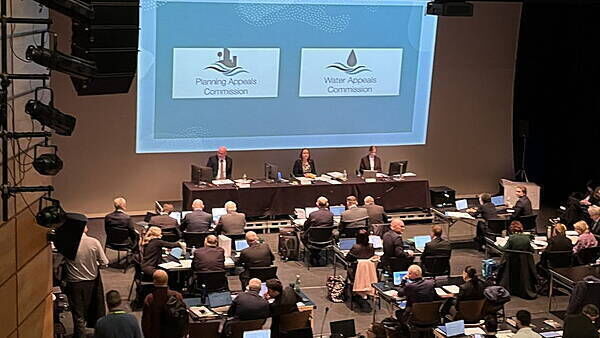
The investigation by the Planning Appeals Commission (PAC), taking place at the Strule Arts Centre in Omagh, struggled to make headway as third party representatives repeatedly expressed frustration with the process.
The mining firm Dalradian has been working on the Curraghinalt site near Greencastle in the Sperrin Mountains since 2009 and has applied to develop an underground gold mine.
There has been opposition to the proposal, which concerns an area of outstanding natural beauty, in terms of its impact on health and the environment.

The substantive issues to be discussed in the inquiry, which is scheduled to run to mid-June, are broken down into separate topics including water ecology, climate, transport, socio-economic, and waste management.
On Tuesday, commissioner Jacqueline McParland questioned Dalradian’s legal team on the processing of ore from the mine as part of the strategic issues module, specifically in relation to the amount of chemicals that would need to be used in processing.
Conor Fegan, representing Fermanagh and Omagh District Council, highlighted that the estimates for this from Dalradian were given in “approximate usage” in relation to the amount of ore mined, but should be given on a “maximum figure”.
He said the commissioner was probing “the need to ensure that any consent would be set within reasonable worst-case scenario parameters, and that would ordinarily indicate that we should be looking for what a maximum figure is, not an approximate figure”.
He added: “We should be consenting on the basis of a maximum figure to ensure that the envelope has been properly assessed.”

A legal representative for Dalradian confirmed that “explosives are listed in the documentation” as part of the mining process before saying that chemical reagents are used for “exploration” purposes.
Ms McParland said that ore removed as part of “exploration” would need to be included in the estimation of the amount of chemical reagents used.
Another representative from Dalradian said “exploration would potentially go into slightly wider areas”, adding “there will be some tunnels that are developed to get access to some areas, but it’s primarily drilling.”
Ms McParland said: “We’re going to come back to the fact that we have no drawings for any tunnels, or actually no information as to where you want to drill either.
“So in terms of the project that’s put forward, we have to assume that it’s worst-case scenario, so we can’t just simply say it’s primarily drilling that’s not being down as definite in the proposal before us, so worst-case scenario is the possibility of tunnels.”
When the inquiry opened on Monday there had been concerns raised about the Department for Infrastructure’s engagement with the Irish Government, and the Northern Ireland Environment Agency (NIEA) stated that a “significant volume of new information” was submitted as part of the transboundary consultation.
Opening the session on Tuesday Ms McParland said she was “satisfied with the reasons given” for the NIEA’s late submission of evidence and it would be included in the inquiry.
Friends of the Earth and some third parties had also requested to be able to give further written evidence in response to additional information given in Dalradian’s transboundary evidence.
Ms McParland said the inquiry does not require any further written submissions and the parties will have the opportunity to rebut any new evidence orally.
“I understand it may take time, if it takes time we’ll sit and do it,” she said.
Paul Haughey, a third party representative said he felt he was being “victimised” while former independent councillor Emmett McAleer said some people “are being cut off”.
The commissioner concluded the morning session saying that the inquiry is already “significantly” behind schedule having only answered 17 of 53 questions arranged for its first two days, and repeatedly urged third party participants to focus on the questions at hand.