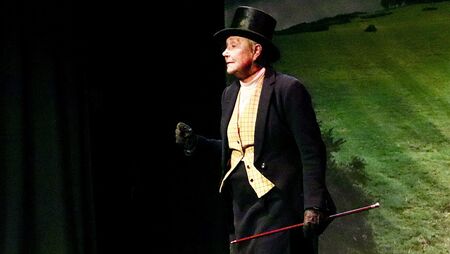
Kildare actor celebrates 50 years treading the boards
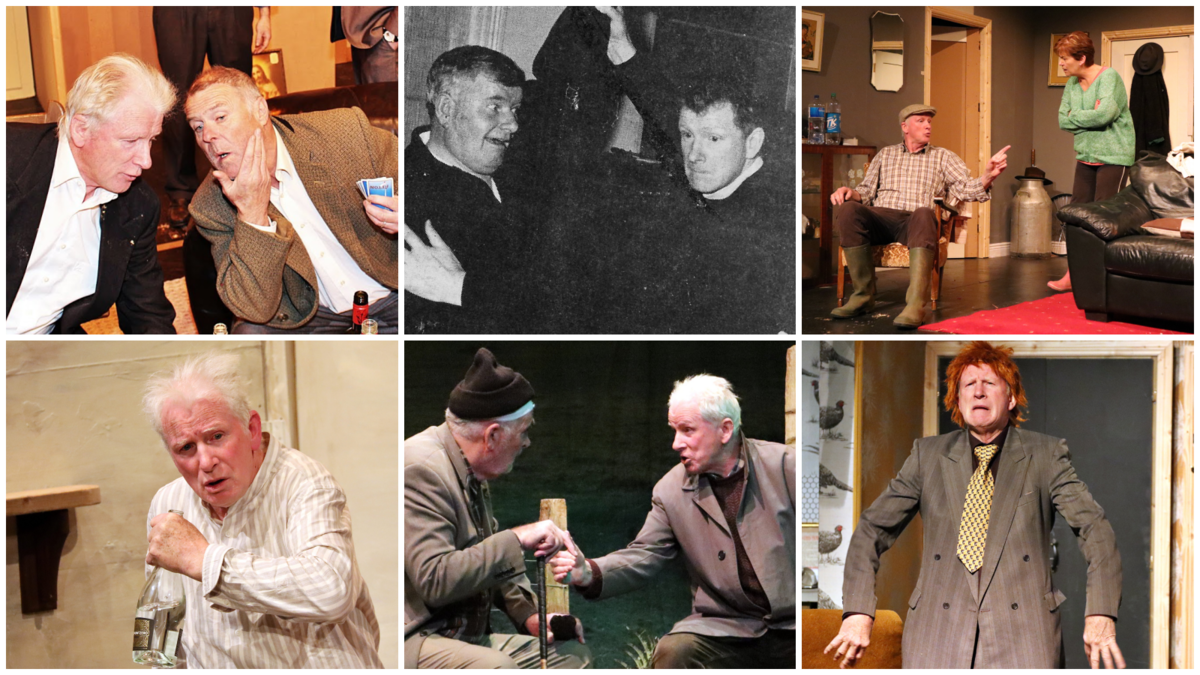
The many stage faces of Maurice O'Mahony â Clockwise from top left: With Fergal Sloan in The Seafarer, with Ray O'Donoghue in The Padraic Pearse Motel, with Esther Reddy in The Two Loves of Gabriel Foley, as Dinny in The Walworth Farce, with Gerry O'Donoghue in The Quiet Land, and as gravedigger Mick Dowd in A Skull in Connemara.
WHEN Maurice O’Mahony was interviewed for his first job as a teacher by the then Kilcullen parish priest, Fr Keogh, he was asked if he had any interest in drama.
As it happened, he had acted in a play while in college, and said ‘yes’.
This year, Maurice marks five decades of involvement with Kilcullen Drama Group.
“I think Fr Keogh was trying to work out if I would be more than a year in the parish before I moved on, and was signalling some areas of interest that might keep me here,” he says.
After taking up the job, he spent a few years bedding in to the village.
He got involved in the community in several ways, including helping with the then-new community magazine, .
Around 1976, he joined the drama group, founded in the 1930s.
“My first part was in , a one-act directed by the late John Martin. The group was going through some expansion then, and a series of one-acts was the way to give new members some experience before putting them in full-length productions.”
Over succeeding decades, he took part in several productions.
“Many farces, but also serious Irish plays like those from John B Keane. We began going to festivals, among them Naas, Leixlip, Littleton in Tipperary, and Kilmuckridge.
"We'd finish work, load props and actors into cars, then drive around the country. There were adjudicators, who we’d meet afterwards, and they’d give us more detailed information than had been said on the stage. I learned a lot from those sessions.”
Maurice doesn’t recall the total number of productions he’s been in, but some are highlights.
“Conor McPherson’s was a good, strong play, for instance. I had a challenging but enjoyable role. Further back, Hugh Leonard’s play — I was in that twice. First playing the father, Mr Drumm, and later, in a Paddy Melia-directed version, his son, Charlie, with Bernard Berney playing the father. I really enjoyed that.”
At the end of the 1980s, the drama group became temporarily inactive when the Town Hall was closed.
“Bernard Berney and I then got involved with a Dunlavin group, who put on plays in a local pub. We did , , , and , and we toured The Field to Kilkenny’s Watergate Theatre and Waterford’s Theatre Royal.”
The Kilcullen group reformed after renovations to Kilcullen Town Hall, and Maurice was elected chairman.
“It became quite a vibrant group, and we put on some very good plays. Sometimes with hitches: we were doing , which had two different sets. We could lift each set into the ceiling area, but during one performance, the set above, which had real windows in it, came crashing down.
"There was glass everywhere, and we had to stop and clean it up. But the audience just sat back until we opened the curtains again.”
What an audience gets to see is the final product of several months of preparation: script selection and learning, set design and building. Rehearsals a couple of times a week, and for each actor, learning lines can involve hours borrowed from home and, sometimes, work.
When a new play is chosen, it’s often not easy to grasp at first.
“Complex plays can take a number of rehearsals before you begin to appreciate relationships and situations. But you build an understanding of character dynamics over time.”
He says some authors’ work is easier than others.
“For instance, in John B Keane’s plays, the story is straightforward, with easy-flowing language. Others, like Brian Friel or Enda Walsh, can be much more difficult and less immediately accessible to audiences.”
Such was the case with the most recent production, Enda Walsh’s . It earned several standing ovations, but it was probably the most challenging production the group had ever attempted. For Maurice, that was apparent when he first read the script.
“I couldn’t make head nor tail of it — I really had to read it a couple of times. My main concern was that the audience wouldn’t get it.”
After feedback from the preview show, a brief explanation of the production and how the actors shifted into other characters was given before curtain up.
“I think that helped … the nights that we did that, people did get it.”
Maurice has fond memories of many fellow members with whom he has shared the stage.
They include John Martin, who recently passed away, the late Bernard Berney and the ebullient director, the late Paddy Melia. Actors Padraic Brophy, Patsy Aspell and Bridie Maloney come to mind.
“People in a drama group become a tight, supportive community,” Maurice muses, noting that working on stage brings trust between players, with sometimes complex scripts and demanding roles.
The group is currently in a period of turnover, with lots of new people.
“Sinead McKenny is the new chairperson, and we have a new treasurer and a new secretary. It’s good to refresh, and there’s a new enthusiasm.”
The group’s productions bookend key times of the year. Rehearsals in September and October give structure to the dark evenings, getting the players out when they might otherwise just stay home.
“For the audience, the autumn play marks the move into winter, the spring event marks the move out. In that sense, the drama group also functions like a family ritual.”
Drama in Kilcullen has been a place particularly for newcomers to get involved with their adopted community. Thus it was when Maurice O’Mahony came to Kilcullen. And so it is today for many of those recently new to the town.