Eye on the Past: Books have greatly enriched my life
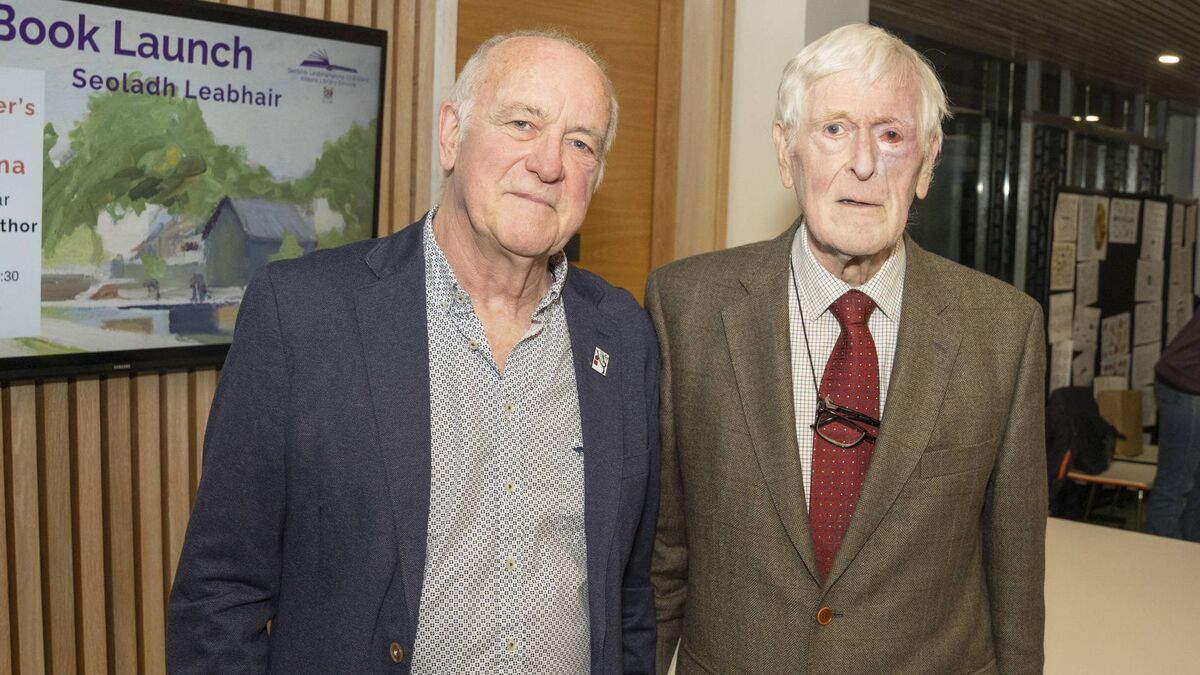
John MacKenna and Frank Taaffe at John's recent book launch Photo: Aisling Hyland
THE first of my many treasured literary pilgrimages was to the lakeside home of the Welsh poet Dylan Thomas many years ago.
I am afraid the poet was long dead at that time but visiting his writing cabin, at Laugharne, and later his hillside grave gave me an opportunity to understand and appreciate his contribution to Welsh poetry history.
On that occasion, I had been visiting the book town of Hay on Wye and Hay would be my base for further literary pilgrimages in Wales and England.
One literary pilgrimage I made on three occasions was to Haworth, the west Yorkshire home of the Bronte sisters and, for me even more importantly, the home of their father, the Irishman, Patrick Bronte or Prunty as he was once known.
Patrick, a Church of England clergyman, outlived his daughters and his son Branwell and the Bronte Parsonage Museum in Haworth is a fitting and magnificent tribute to the entire Bronte family.
At the recent launch of John MacKenna’s new book ‘The Lock Keeper’s Wife’ I mentioned my visit to Helpston in Northamptonshire to visit the home of the poet John Clare.
He was a pastoral poet who was first brought to my attention by John MacKenna and whose works I have returned to on many occasions. Another poet, although better known as a novelist, was Thomas Hardy who drew me to Dorchester and his nearby birthplace, the small village of Higher Brockhampton.
Dorchester has a statue of Thomas Hardy and his library/study recreated in the local museum attracts a lot of visitors. No literary pilgrimage can be expected to be made in England unless one has visited William Shakespeare’s Stratford-Upon-Avon.
I have been there several times and never fail to marvel at what the authorities have achieved in remembering and honouring England’s greatest literary figure.
Jane Austen was not overlooked, requiring visits to her birthplace in Steventon, Hampshire, Bath where she lived for a time and Winchester where she died and was buried in the local Cathedral. This was an important visit as one-time Athy resident Thomas Lefroy was for a short period Jane Austen’s love interest.
Thomas, who attended a private school in Athy, was later in life appointed Ireland’s Chief Justice. His brother who also attended a private school in Athy, set up home in the South Kildare town and built a fine residence at Cardenton which was subsequently acquired by the Shaw family.
One literary pilgrimage I made to an Irish village associated with an English writer was to Drumsna, Co Leitrim. It was there that Anthony Trollope lived and worked for a time while an employee of the Irish postal services.
I was then a member of the Trollope Society and the weekend events in Drumsna were organised by the London-based society and attended by 30 or so members including one Irish member all the way from Athy. President McAleese who had a holiday home nearby, gave a short address to the Trollope Society members and was surprised when one of the group (myself) thanked her afterwards in Irish.
Robbie Burns, the great Scottish national poet and songwriter, was a subject of my only literary pilgrimage to Scotland when I visited the Burns museum in the town of Alloway where he was born.
My literary pilgrimages throughout Wales and England took place over the last thirty-five years or so and strangely enough occurred after I ceased reading novels other than those written by local author John MacKenna.
I was an avid fiction reader prior to that and followed the great Irish writers of the Irish literary revival period and those of a later vintage. I worked in Dublin for twelve years or so just a short distance from Parson’s bookshop on Baggot Street Bridge.
May O’Flaherty was the proprietor and, during my weekly visits, May and her assistant Mary King introduced me to many of the great writers of the day.
I met Mary Lavin on more than one occasion as well as the poet, Patrick Kavanagh. I met and enjoyed the company of writers such as Sean O’Faolain, Mervyn Wall, Liam O’Flaherty, John D. Sheridan, León Ó Broin and Francis Stuart.
I had the pleasure of meeting Seamus Heaney and Edna O’Brien, each on two occasions.
I no longer read the fiction works of any of the English or Irish writers I have mentioned. It is amazing how the Irish literary scene has changed over the years.
The one-time male-dominated writer’s scene is now dominated by female writers and while their names are recognised by me, regrettably, I no longer see myself lingering over works of today’s fiction writers whether male or female.
My time and energies are confined to reading Irish history and all books relating to Ireland, English social history and English politics from 1800.
The reading of books is something I have always encouraged, and this is why over fifteen years ago I was responsible for opening the Lions Club second-hand book shop in Duke Street.
My thanks to Eugene Prendergast who did much needed repair work in the then vacant shop before the bookshop opened and to Alice Rowan who volunteered to open the shop five days a week.
The Lions Book Shop is a success story not least in running the children’s book scheme which allows young readers to claim a free book from the book shop once a month.
Another initiative was the holding of the twice-yearly Lions Book Fair which is held in the Athy Recreational Community Hall on the Kilkenny Road. The next book fair with dealers from around the country starts on Saturday 14 March at 11am. I hope to see you there.