Census offers snapshot into family history
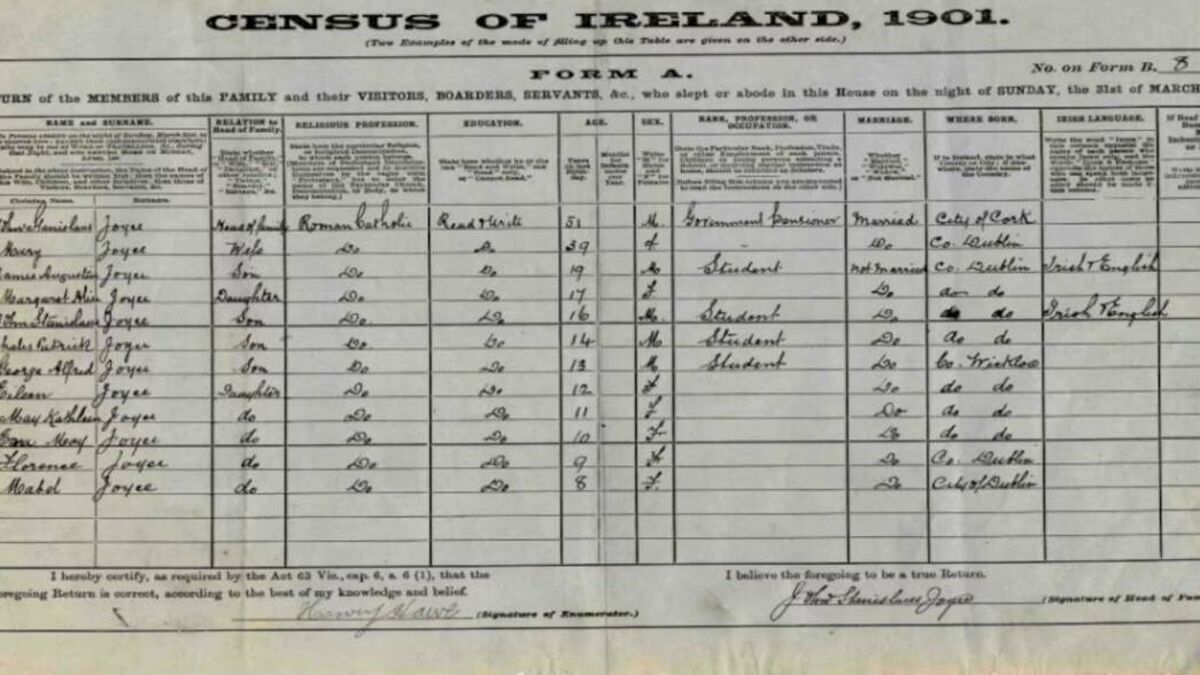
The 1926 census returns will undoubtedly provide a wealth of information regarding families now long gone and long forgotten
SEVERAL years ago, David Henshaw, then owner of Smugglers Public House and local engineering businessman the late Gerry Harkin, came together to form an Age Action Group to help provide facilities for elderly members of the Athy community.
It provided a wonderful service for many years, but sadly it slipped away when David returned to his native town of Athlone. The gap in providing social services for the elderly was filled by a voluntary group set up by the Chanders’ brothers, Dom and his recently deceased brother Martin.
Athy’s ‘Young at Heart’ group continues to operate under the chairmanship of Dom Chanders, assisted by Caroline Donovan, the group’s secretary.
To participate in the activities of the ‘Young at Heart’ group, all that is required is to reach the age of 60 years. The group organises a twice monthly bingo session in the hall attached to St Michael’s Church at the top of Offaly Street as well as day trips throughout the year.
Perhaps the group’s most cherished trip is an annual five-day trip which this year will be spent in the Southern Hotel in Sligo from the 21 June.
The volunteers who run the group receive an annual grant of €600 from Athy’s Municipal Council and given the size of the local authority’s contribution, the voluntary work of the ‘Young at Heart’ group is commendable.
The group is one of many volunteer societies in Athy which work for the good of the people they serve, and we can all be particularly proud of the men and women who give of their time and experience to help others.
I have been trying, without any great success, to delve into the 1926 Census returns. The apparently straightforward technical detail which one must master is still beyond my capabilities and so I’ve had to rely on the young Taaffes to unearth material for me.
I was delighted to read details of the garda barracks personnel in Cloonfad, Co Roscommon where my father was first stationed.
He was the youngest garda of five gardaí in the station at 22 years and 9 months. Nearby on a farm at Ballykilleen, which was located across the border in County Mayo, were the Regan family, headed by my grandfather John Regan, aged 52 years. Others in the Regan family Census returns were my grandmother Anne, aged 53 years, with their daughter Kate, aged 20 years and their son Anthony aged 19 years and my grandfather’s sister Winnifred, aged 56 years.
The Kate referred to was my mother, who always went by the Christian name Kathleen. I never met my grandmother who died in 1937, but my grandfather I met on many summer holidays spent with my mother and my brother Seamus on the Mayo farm before my grandfather died in November 1949.
The 1926 census is a remarkable source for completing the gaps in family histories and local history generally.
How remarkable to find the Cloonfad Garda Station which no longer exists was in 1926 staffed by a Sergeant and four Gardai. The closure of this rural Garda Station is typical of what happened throughout rural Ireland in the years since 1926.
Here in Athy the Garda Station in 1926 was staffed by a sergeant and nine Gardai.
I find it strange that the Cloonfad village of perhaps a few hundred people had five Garda, while Athy with a population ten times bigger had ten Gardai. While the Cloonfad Station has been closed for decades, the Athy gardaí numbers have increased to around 33 members.
Strangely, the sergeant in charge of Athy Garda Station was 22 years of age, the youngest member in the station. The oldest member was 35 years of age, while the rest were in their 20’s.
Including amongst them was a Garda Joseph McNamara, a native of County Clare aged 23 years. Was he, I wonder, the same man whom I recall lived on retirement from the gardaí in Stanhope Street?
The Christian Brothers monastery in Athy in 1926 housed six Christian Brothers, all of whom as you might expect gave their names in Irish. They ranged in age from 19 years to 52 years with two Brothers in their 30’s and two of them in their 40’s. In my time in the Christian Brothers school in the 1950’s, there were four elderly Christian Brothers in the Monastery.
When the monastery closed, there were only two very elderly Brothers left who had to be accommodated elsewhere.
The 1926 census returns will undoubtedly provide a wealth of information regarding families now long gone and long forgotten.
I was particularly interested in checking on the lanes and alleyways now no more. The likes of Kelly’s Lane and Connolly’s Lane with areas now long demolished once home to Athy families will hopefully reveal their hidden histories after we have mastered the census forms of 1926.
It’s a task which is presently beyond me but hopefully with some assistance I might be able to successfully return to the task in the not-too-distant future.
In the meantime, can I bring to my readers attention that this year’s local Famine Commemoration Service will take place on Sunday 24 May at 3pm instead of the previous Sunday as originally announced.
On Sunday, we will remember and honour the twelve hundred or so men, women and children of Athy and the surrounding areas who died in the local Workhouse during the great famine and who were laid to rest in unmarked graves in St Mary’s Cemetery.