Living Greener: Modern life has squandered tranquility
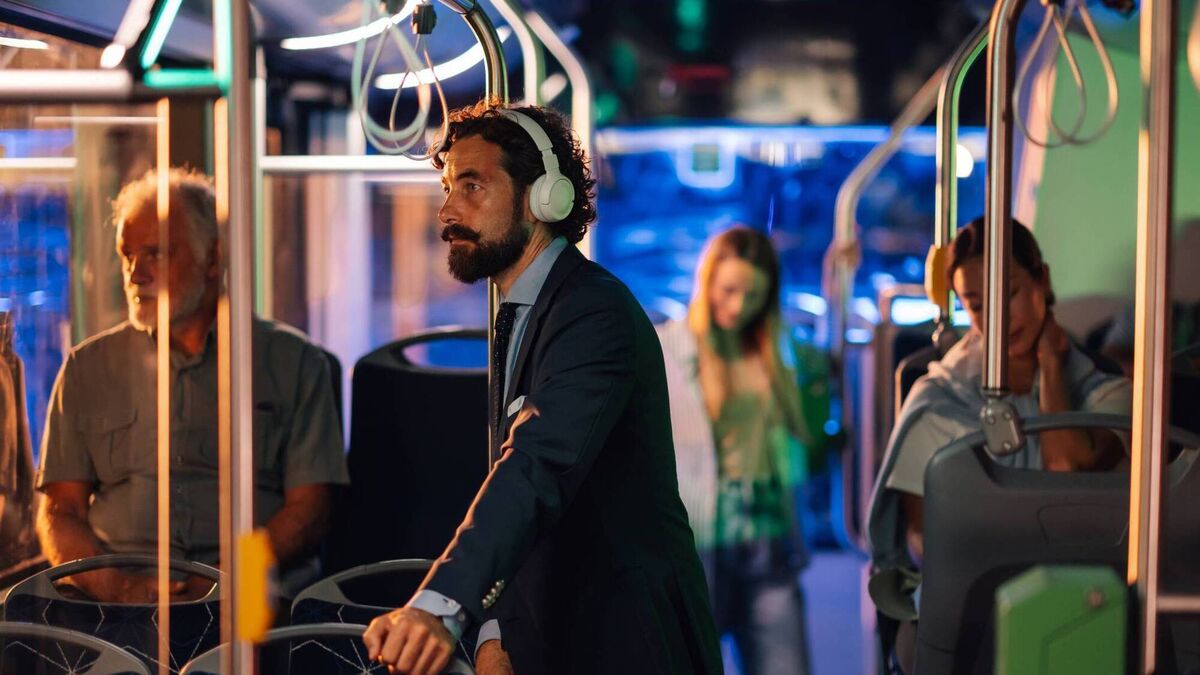
Businessman wearing wireless headphones, enjoying music while commuting on a modern bus during a vibrant city night
WHEN people embrace a more traditional rural life the usual reason is 'peace and quiet'.
I did that when I moved to the Irish countryside in the 2000s, though, that’s not what happened, any more than it is for most modern people.
Having to pay for that life, I took the bus to a Dublin office every day for 12 years – three hours on the bus, nine hours in the office – and one day measured how much of that time I spent without loudspeakers blaring in the background. It was zero.
Virtually every public and corporate space in the modern world – elevators, stores, lobbies, offices, doctor’s offices and gas stations – has overhead speakers and a piped-in sound system, often at levels I find deafening.
Most play the same dozen-or-so songs over and over, the reproductive and scatological obsessions of adolescents played to underage children and the elderly alike, but the choice of music is not the main issue.
When I ask the staff if the noise could be turned down, or even off, they usually look at me befuddled; they have never experienced life without the din and are not consciously aware of its presence.
They are obviously not enjoying something they are unaware of, yet when I suggested to co-workers that they leave the radio off, they looked offended.
“We need to have something on,” they insisted.
Most natural settings have little noise, so humans did not evolve to deal with much; 70 decibels has been suggested as a healthy maximum, and more than 85 does permanent damage.
Just as with light, though, our brains unconsciously adjust to more until we no longer notice how loud it is.
Modern city-dwellers get far more than 85 decibels every day; when she measured noise levels in Washington, DC, Julia Belluz found the metro screamed at an average of 92 decibels and up to 116 at times.
Each decibel level is ten times louder than the last, so 80 decibels are 10 times louder than 70, and a 110-decibel roar is 10,000 times louder.
Unsurprisingly, modern people are losing their hearing at ever-earlier ages; one in four Americans have hearing loss, making it the country’s third most chronic health problem behind cancer and diabetes.
A 1997 study of the elderly found that hearing loss doubled in the 30 years between 1964 and 1994, and we are almost 30 years further on from that.
We have spent generations with this background, a massive experiment on the human race. Developmental psychologist Lorraine Maxwell, who found that excessive noise warps children’s attention and memory and makes them withdraw from talking with peers.
Yet she also found that, when they are accustomed to working with noise, they cannot work without it; the quality of their work deteriorates.
Finally, when children learned to passively accept “uncontrollable noise” in the background, they show a “learned helplessness” to changing the world around them.
The only way to avoid the deluge of sound, for most of us, is to buy headphones, but that means that all the bus passengers who used to chat the ride away now sit in isolation even from the people they see every day.
We all live in a kind of enforced solitude now yet cannot enjoy the tranquillity that made solitude desirable. And if everyone – including the growing legions of the half-deaf – listens to headphones, we get bleed-over from the people around us, forcing us to crank up the volume more in a perpetual arms race.
Silence has become a privilege of the wealthy; airports now have special silent areas for the upper classes where the roar of the airplanes and other passengers are muffled.
The Ultima Thule Lodge in Alaska is so remote that digital devices can’t get a signal; its rooms start at $1,700 per night, with a three-night minimum.
We have to pay more money per night than some of my elder friends made in an entire year when they were young, all to get what most humans everywhere, until recently, enjoyed for free.