Remembering the Famine in Athy
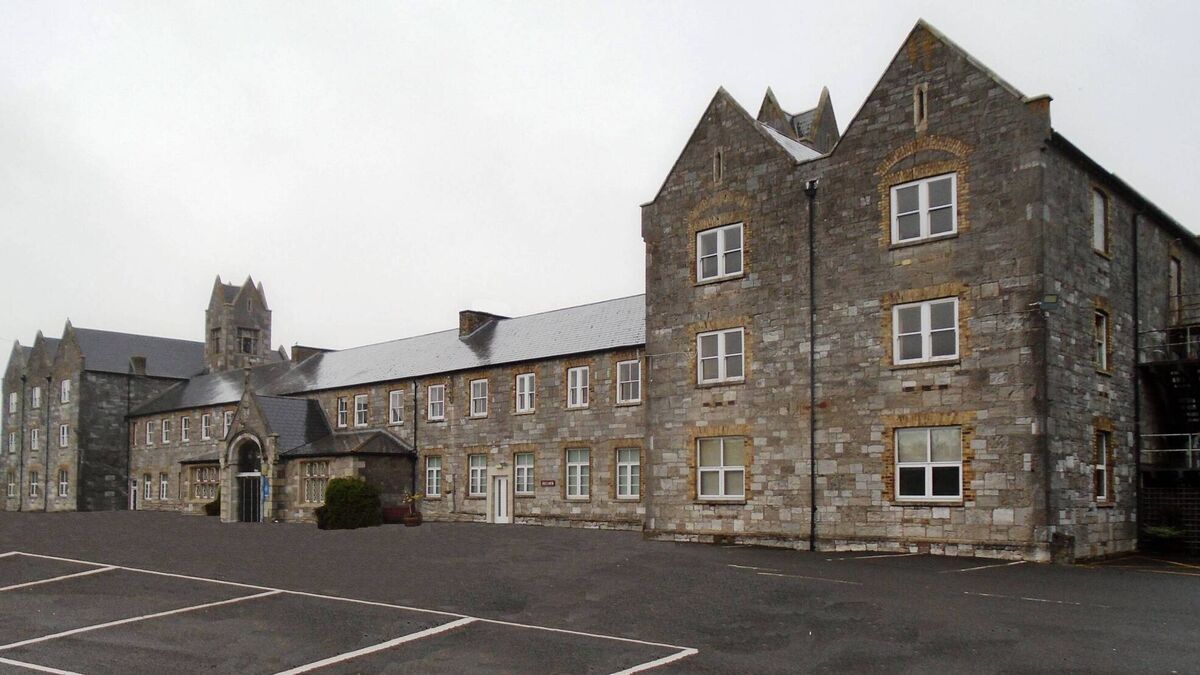
St Vincent's Hospital, Athy, formerly Athy Workhouse
AS you walk up the avenue towards St Vincent’s Hospital you see in front of you the same building which faced the unfortunate poor families who were about to enter the Workhouse during the years of the Great Famine.
Strong metal gates at the roadway confined entrance to the Workhouse to those permitted by the Workhouse Master.
It was from the same building and through the same gates that on each day of the Great Famine workers of the Workhouse or perhaps male inmates pushed a hand cart bearing the body of yet another inmate a few hundred yards to St Mary’s Cemetery for burial in an unmarked grave. During the five years of the Great Famine 1205 inmates of Athy’s Workhouse and the adjoining temporary Cholera Hospital died and were hurriedly buried in the nearby cemetery of St Mary’s which catered solely for the dead of the workhouse and the cholera hospital.
The substantial Workhouse building was opened in January 1844 and did not show any marked increase in inmate numbers in the first year of the Famine.
As the workhouse was the only place where people in need could receive assistance, it is clear that destitution in Athy and district as a result of the partial potato failure of 1845 was perhaps no worse than other years.
Not so the effects of the potato blight on the potato crops in the following year.
The loss of the potato crop in 1846 had a devastating effect on the people throughout the island of Ireland. Even in Athy and south Kildare families unable to feed themselves overcame their reluctance to enter the Workhouse. Daily the numbers coming to the Workhouse increased so that by December 1846 more than 700 men, women and children were inmates.
On entering the Workhouse, the men were separated from the women, the women separated from their children.
Their clothes were taken from them and they were given rough Workhouse uniforms before being segregated into separate dormitories for men, women and children. During the day the men were put to work breaking stones or picking oakum.
In the week ended 9 January 1847 seventeen inmates of Athy Workhouse died.
Two weeks later nineteen more inmates were recorded as having died in the space of one week.
As in life, their deaths were not marked by any ceremony.
Their emaciated bodies were hurriedly brought by hand cart across the Stradbally Road and over the Canal bridge to be buried without the benefit of clergy in graves which were to remain unmarked.
Two auxiliary Workhouses were opened at Barrack Street and in a canal store at Nelson Street in 1847 to cater for the large number of people crowding into the Workhouse.
A soup kitchen, operated by a local relief committee, was opened in Athy on 6 June 1847.
On one day 3088 persons from Athy and the surrounding countryside got rations at the soup kitchen which was to close on 15 August.
Old tradition relates that many hungry local people lived on praiseach, grown in fields near where the Ashville houses are now located.
The failure of the 1848 potato crop led to further hardship, such that at one stage almost 1300 people were living in the local Workhouses.
How many persons died in their own homes or on the side of the road we cannot now say.
It was to remember those once forgotten people who died during the Famine that I started some 16 years ago, with the co-operation of the local clergy, to organise an annual ceremony of remembrance for our Famine dead.
It is also planned to record on a stone monument the names of those unfortunate people who died in the Workhouse and the Cholera Hospital during the years of the Famine and work in that regard is progressing.
The Great Famine had a devastating effect on Ireland. It shattered the confidence of the Irish people and accelerated the flow of families from our island.
We can never ignore scenes such as those recorded by Canon O’Rourke, Parish Priest of Maynooth, who in his history of the Famine described people wandering through the Irish countryside in search of food, people dying of hunger in their cabins and people refused admission to their local Workhouse who laid down on the road outside to die of hunger or fever.
We must never forget those unfortunate people and as the inheritors of a legacy of famine we should never turn our back on the victims of famine, no matter where they live.
The famine commemoration event will take place in St Mary’s Cemetery on Sunday 24 May at 3pm.
Fr Tim Hannon will celebrate the 60th anniversary of his ordination to the priesthood on Saturday, 23 May when he will be joined by his younger brother, Fr John Hannon in a concelebrated Mass in St Michael’s Parish Church.
This for the parishioners of St Michael’s is a relatively unique event, and I hope parishioners of St Michael’s turn out in great numbers to honour Fr Tim.