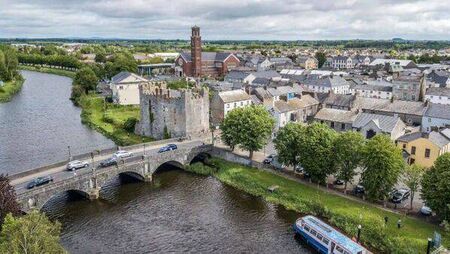
People's Park in Athy holds lifetimes of memories
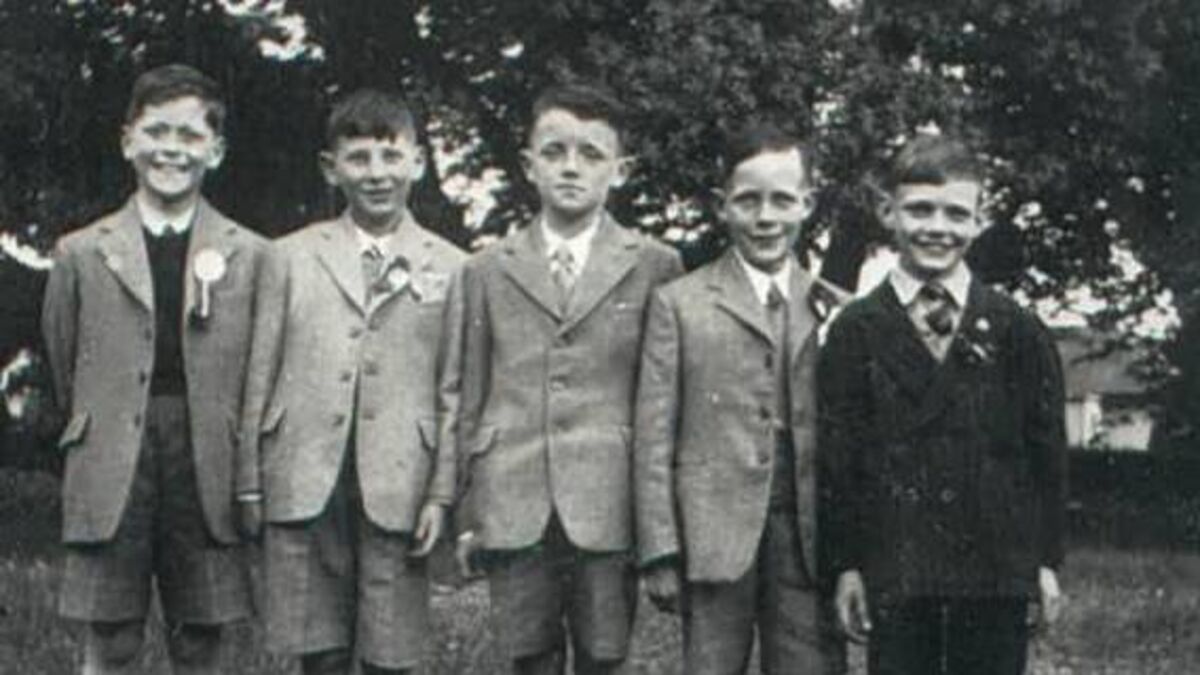
In the People’s Park in Athy over 70 years ago on their confirmation day were Frank Taaffe, Willie Moore, Teddy Kelly, Basil White, Paddy Dooley
THE People’s Park, or simply ‘the Park’ as we teenagers in the 1950s knew it, is today looking its best.
This is all due to the voluntary work of some men and women living in the vicinity of the park who commit themselves to a weekly clean-up of the park.
I salute them this morning for their commitment to maintaining the very first public park developed in the town of Athy, if not in the county of Kildare.
The generous men and women who every Wednesday evening at 6.30pm or thereabouts come together to do some work in the park are Maureen and John McCauley, Mary English, Michelle and Derek O’Brien and the O’Brien children, Jim Lawler, Sandra Burrell and Shane Black.
Rubbish collected is placed in black bags which are later collected for disposal by council workmen.
The group has worked for some years to improve the park, and they approached Kildare County Council some years ago with the idea of providing information panels throughout the park.
One of those panels indicates that the park has a mix of both native and non-native trees.
There are some exceptional trees, significant for their size and age, including Holly, Lime, Bhutan pine, Birch, Oak, Scots pine, Yew, Leyland cypress, Weeping elm, Beech yew, Whitebeam and Larch.
The Kildare Observer described in 1887 the People’s Park as a park ‘flanked by a row of trees… a boulevard in fact which is most luxuriant and of great natural beauty’.
Amongst the trees which grew there for a very short time were two rare Fir trees planted and railed in 1902 to mark the coronation of King Edward.
The trees were planted with some ceremony by Lady Weldon of Kilmoroney House and Mrs Waller, the local Church of Ireland Rector’s wife.
The trees were pulled up overnight and destroyed.
The third Duke of Leinster who died in 1874 created The People’s Park.
He also financed the building of the substantial house in Stanhope Place in 1829, now occupied by the parish priest but built originally to house all of the Catholic clergy of St Michael’s Parish.
One of the earliest references I found to the People’s Park was a newspaper report of the holding of the revived Kildare, Queens County and Carlow Horticultural Show after a lapse of seven or eight years in the Athy Park in September 1860.
When exactly the People’s Park was developed, I am unable to say with any certainty. I have in the past believed it was opened in the 1850s.
The building of the railway line to Athy in 1846 gave much needed employment to out of work Athy men during the Great Famine.
I wonder if the road from Leinster Street to the new railway station was extended to meet up with St Michael’s Church as part of a labour employment scheme during the famine?
The Church of St Michael’s was dedicated in 1841 to replace an earlier church in the back square.
The building of the church steeple was commenced in April 1856 around the same time as the building of the Church of Ireland rectory. This later work might support a belief that the road from the railway station to the Carlow Road was already in place.
What we now call Church Road or as known in my teenage years as the Crib Road was built around the same time as work on the railway.
If we can imagine the railway line cutting away a generous part of the Duke of Leinster’s land, he may well have decided to develop that part which was then isolated as a public park.
The walls which enclose the park are similar in all respects with the wall enclosing the rectory and the wall which extends all the way down to the Carlow Road.
Whether or not the park was developed in the early post famine years or in 1856 or thereabouts, it is now impossible to say.
Suffice to understand that the generosity of the Duke of Leinster gave Athy and generations of its people a truly magnificent town facility.
His gift coincided with the 19th century English movement for the creation of town parks which were seen as helping to improve public health for workers and the unemployed who lived in unfit, unsanitary housing.
The park which as teenagers the Offaly street boys and girls enjoyed every day holds wonderful memories for me.
The street pals with whom I shared my young life have for the most part passed away.
Only Willie Moore now in County Wexford, Paddy Doody now in England and myself survive to remember our friends who are gone to meet their maker.
You may ask why was Church Road known locally as the Crib Road?
The name came from the metal cribs which surrounded and protected the young trees planted at both sides of the road a hundred years or so ago.
In the 1950s those trees had grown to enormous sizes in width and height and for us exuberant teenagers offered shelter as we engaged in stone throwing battles with the fellows from Leinster Street.