Remembering Athy's fallen this Sunday
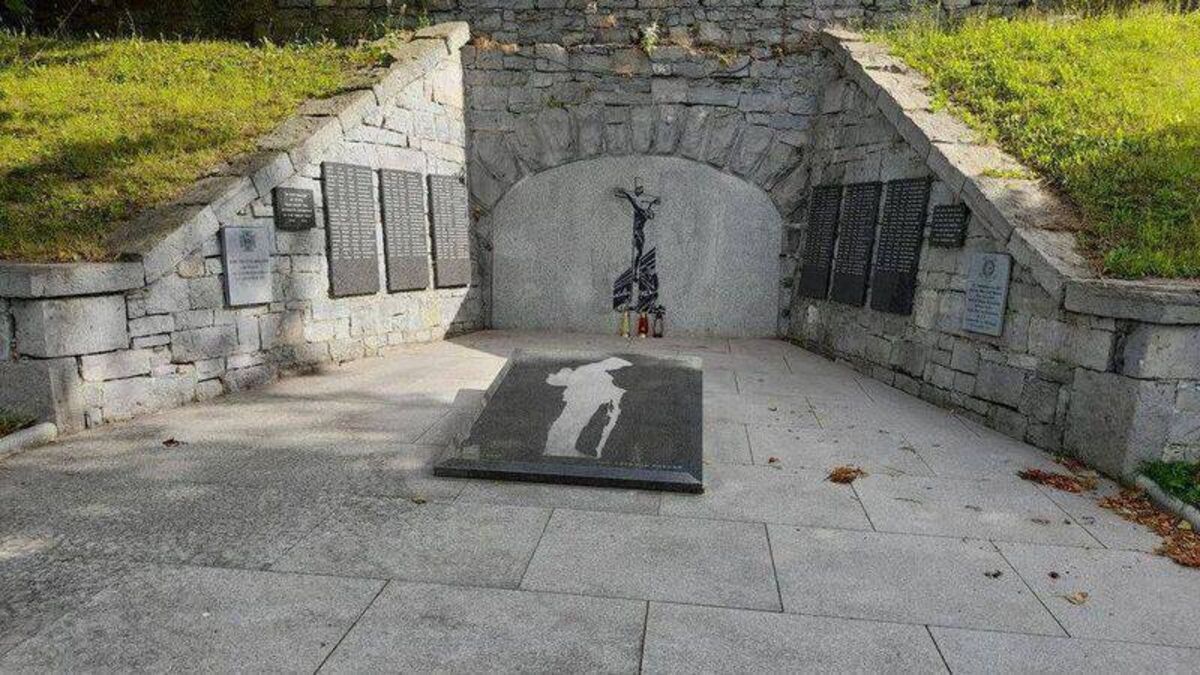
The war memorial at the old St Michael's Cemetery
I HAVE been writing since 1993 about the Remembrance Sunday ceremony in St Michael’s old cemetery. It was all started by three young fellows getting together to remember the men of Athy who died in World War I. The ceremony has since been extended to honour all local men and women who died in wars, including World War II, the Irish War of Independence, etc.
Next Sunday at 3pm the service, now organised by Athy Historical Society, will see the Church of Ireland Rector leading the prayers which in the past were always shared between the Church of Ireland Rector and our local Parish Priest.
Unfortunately, despite the fact that Fr Rigney left the parish over two months ago, his replacement, as I write this article, has not arrived to take up his position so I am unsure as to whether the Church of Ireland Rector will be joined by the new Parish Priest on Sunday.
World War I had a profound effect on the people of Athy. The majority of men in the town were unemployed, living with their families in unfit houses located in laneways off the main streets.
The major employer in Athy prior to 1914 was Minch Nortons and local foundries, of which Telfords, later Duthie Larges, was the largest.
It is no wonder that the young men of Athy responded so promptly to the British authorities call for volunteers as generous financial rewards were made available to their women folk.
More men from Athy and district enlisted in the British Army during the 1914-1918 war than many other towns in Ireland.
We can understand why that should be so, because of the prevailing local poverty which combined with the financial incentives offered by the War office and the oft repeated claim that the war would be over by Christmas 1914.
What could be expected of the young employed local men when the local Parish Priest and the Chairman of the Urban District Council spoke from public platforms in Emily Square urging them to enlist.
We don’t know how many young men enlisted and were paraded behind the local band marching up Leinster Street to reach the railway station.
At the end of the war 256 men from Athy and district were dead, with many of those now lying in unmarked graves scattered around the battlefields of France, Flanders and further afield. Four young local men, less than 20 years old, died in the war, while the oldest victim of the war was Christopher Power, aged 59 who died on the battlefield on the 28 April, 1915.
He died with four other Athy men, Joseph Byrne, James Dillon, James Holohan and Patrick Tierney who were killed in an artillery barrage in Belgium on 28 April. In the forthcoming service in St Michael’s Cemetery, the graves of six soldiers who died in Ireland will be remembered.
Also buried in St Michael’s Cemetery is an Athy nurse Eleanor Orford, who died on 3 September 1917 while serving in the Voluntary Aid Detachment.
The bodies of the vast majority of Athy men who died in the war were never recovered and today they lie in unmarked graves on or near the battlefields where they fell.
The telegraph boys from the local Post Office delivered telegrams to the parents or the mothers of the deceased soldiers from the War Office advising of each death.
It was a dreaded delivery which neighbours were aware of very quickly as the Post Office official, suitably suited, arrived at a neighbours door. How did the Kelly family of Chapel Lane deal with the shock of receiving three telegrams announcing the deaths of their sons.
There were several instances of multiple family deaths, the Flynn family lost two sons, as did the Hannons of Ardreigh House. Their first cousins also lost two sons in the war.
130 young men from the town of Athy lost their lives in the Great War and a total of 256 men from Athy and district, which includes Castledermot, Ballitore and surrounding country areas.
This was a very significant number given that the population of Athy and district was quite small.
Many former soldiers returned to their home town with injuries, loss of limbs and with a variety of health issues which gave Athy the name of ‘Cripplestown’.
Perhaps the greatest embarrassment imposed on the ex-soldiers was the lack of appreciation shown to them by the people of Athy after they returned home.
Events in Dublin in 1916 and the subsequent development of a Sinn Fein club in the South Kildare town created a hostility towards the ex-soldiers.
Indeed Athy had the first Sinn Fein club in the county of Kildare whose influence reached far wider than that of the Parish Priest and Council Chairman of previous years.
The Irish War of Independence was about to break out, making it very difficult for the ex-soldiers to remember their dead colleagues on Remembrance Sunday.
Marches were held locally on Remembrance Sunday for a few years, but they died out in the late 1920s or early 1930s.
The Athy soldiers of World War I were overlooked and forgotten until 1993 when John MacKenna, David Walsh and myself organised a number of events for Remembrance Sunday.
The graveyard ceremony has been held every year since then. Families of former soldiers took some time to attend St Michael’s Cemetery where the graves of six soldiers and that of Eleanor Orford, former World War I nurse are located.
Since the erection of the magnificent World War I memorial with the names of the Athy men who died in the War, the Remembrance Sunday ceremony takes place in front of the memorial.
The local historical society has done great work in continuing the Remembrance Sunday event in recent years and special thanks must go to Clem Roche and Michael Donovan who are to the fore front in the work of the society.
The Remembrance Sunday service will commence at 3pm on Sunday next, 8 November in St Michael’s old cemetery.