Living Greener: The industry that shaped generations
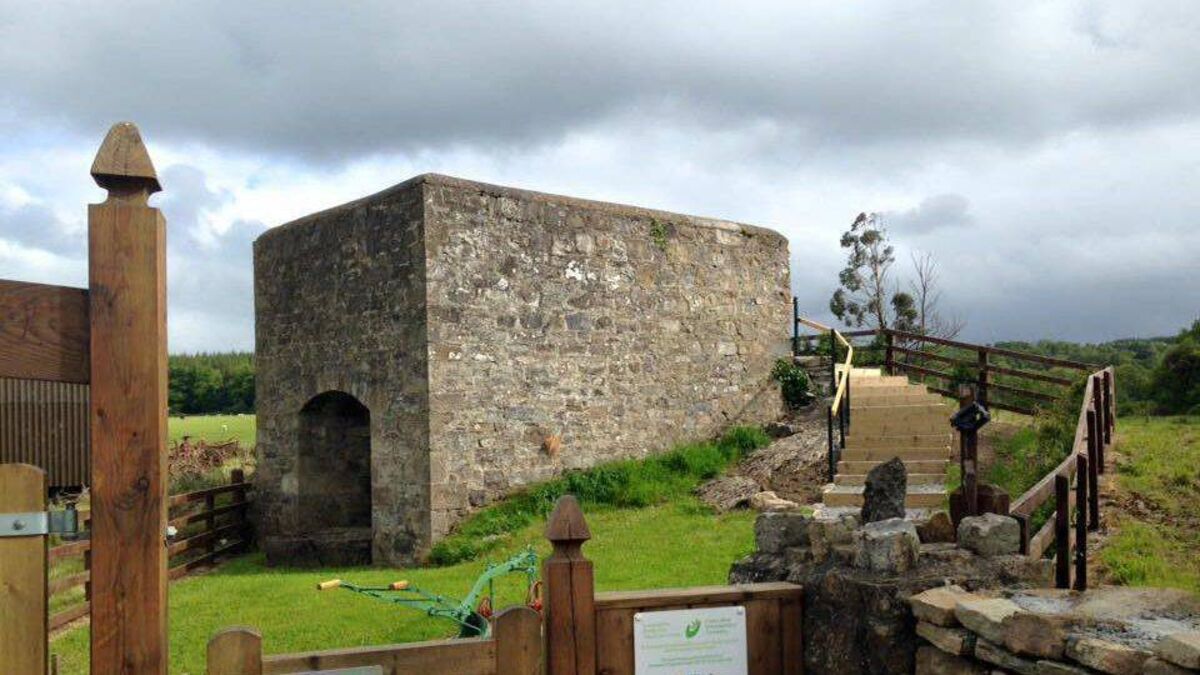
A lime kiln in Tuamgraney, Co Clare
EXPLORE the now-ruined estates of Co Kildare’s countryside and you occasionally find a stone cylinder, as much as several metres high and wide, open at the top and with a small door at the base.
Some resemble tiny medieval fortresses – but in fact, they are kilns for lime burning, a now-forgotten industry that sustained many communities before energy became cheap.
‘Lime’ here means neither the citrus fruit nor the tree, but to a white powder derived from limestone.
For at least 7,000 years humans created lime in kilns, as they might have hardened pottery or smelted ore, and used the material for dozens of purposes now largely replaced by fossil-fuel by-products – perhaps most commonly to create mortar for construction.
Irish farmers, though, found it most important to neutralise acid soils and multiply crop production – as much as fourfold, by some contemporary accounts.
For hundreds of years until the mid-20th century, lime supported a vast and vital network of village industry — quarries to mine the limestone, carts and barges to transport it, and specialists to monitor the burning.
In the late 1700s, according to one survey, County Cork alone was said to contain an amazing 23,000 kilns, or one every 80 acres.
Limestone is mainly coral and shells of long-extinct sea creatures, squeezed over aeons into a solid mass of calcium carbonate, or CaCO3.
When burned at 900 degrees C or more it vents carbon dioxide (CO2), leaving behind the volatile calcium oxide (CaO) – 'quicklime', 'burnt lime' or 'unslaked lime'.
Then, when combined with water – hydrated or ‘slaked’ — the quicklime became calcium hydroxide or Ca (OH)2 – “lime” — and could be put to many uses.
The earliest use of lime dates to between 7,000 and 14,000 years ago, and many ancient civilisations used it to create mortar between stones.
The Romans, however, took lime a step further, mixing it with various other ingredients to create an early version of cement.
In fact, their version has proven superior to our own in some ways, and — according to two papers released in the summer of 2013 — are ‘greener’, generating less carbon dioxide, than our cement manufacture.
Crushing rocks into Portland cement powder requires enormous quantities of energy and accounts for seven per cent of all industrial carbon emissions on the planet, and re-adopting the Roman technique could be one-more step toward keeping the climate under control.
Lime also forms the basis of whitewash, used for centuries to protect and brighten structures, fences, vehicles and even trees, without the alarming and unpronounceable stew of toxic ingredients in many modern paints.
Whitewash is fundamentally a mix of lime and water, although it could also contain salt, milk, linseed oil for waterproofing, or hair or cereal husks for strength.
The dried lime was safe to handle and even for animals to lick but remained mildly alkaline enough to disinfect barn and dairy walls.
Its brilliant whiteness was valued in places like Britain and Ireland, where the winters grow very dark – Irish cottages were traditionally whitewashed in spring and again before Christmas.
In sunnier climates, however, that same colour helped keep buildings cool.
Lime had many other uses: farmers rubbed it on their livestock’s feet as an antiseptic or painted it onto fruit trees to prevent fungal diseases.
Some mixed a bit of lime into well-water to disinfect it, or to preserve eggs for months without spoiling. Tanners used it to remove hair from hides, gardeners to repel slugs and snails, printers to bleach paper.
Even the corrosive quicklime, the calcium oxide that came straight from the kiln, had many uses before it was hydrated.
It kept pantries and store-rooms dry, as it sucked moisture from the air.
It caught fire easily – sometimes too easily – and was used to make an early, high-intensity lamp for the stage – the original limelight.
It also made a rather fearsome weapon, as it could sear the skin and blind the eyes; when Irish reformer Charles Parnell spoke at a political rally in 1891, someone in the crowd threw quicklime at his face, and “had not (he) shut his eyes in time, he would undoubtedly have been blinded,” his wife Katherine later wrote.
The most important use of lime for our ancestors, however, was in agriculture, and there it made a big difference in keeping Irish farms going before fertiliser – more on that next time.
Brian Kaller’s latest book, , is available from Academica Press and Amazon.com.