'I want to be able to look back and say Kildare was better because I was there': Martin Heydon’s first year as Agriculture Minister
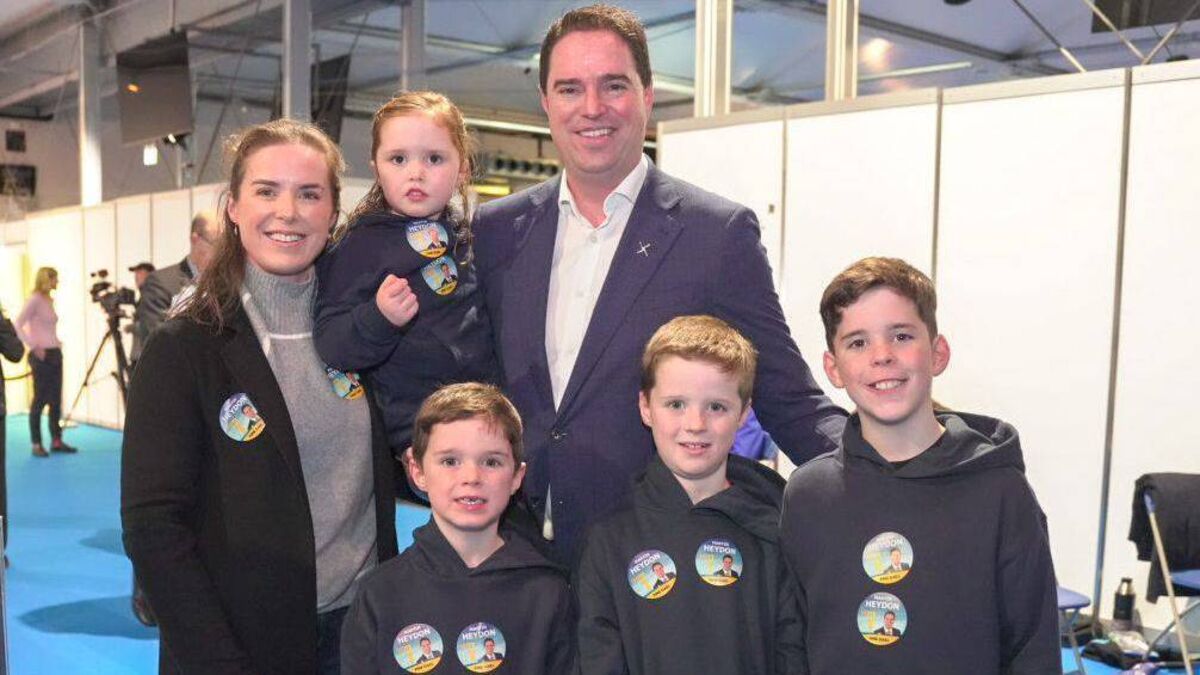
Martin Heydon with wife Brianne and kids Pádraic, John, Martin D and Juliette after he topped the poll in Kildare South last year Photo: Aisling Hyland
AS we near the end of 2025, it has been a year like no other for Minister for Agriculture, Food and the Marine and South Kildare TD Martin Heydon as he reflected on his new role, increased workload while maintaining his constituency work and balancing homelife.
For a minister with four young children at home, that matters: “We’re all pumped for Santa here,” he said, speaking to the Kildare Nationalist in the run-up to Christmas adding that Christmas allows him to mirror school holidays and simply be present.
“These are precious years and they go very quick.”
Appointed minister on 23 January last year, he describes the experience as “crazy busy”.
The department he leads employs over 4,000 staff, oversees 12 semi-state bodies and touches the lives of farmers, food workers and rural communities nationwide.
“When you’re a Cabinet Minister, decisions you make can have a direct impact on people’s lives,” he said. “That’s a lot of responsibility.”
While he was well prepared from his previous role as Minister of State in the same department, nothing quite prepared him for the volume and breadth of issues.
That reality has reinforced the importance of surrounding himself with a good team. Minister Heydon commended the work of all staff and local councillors that work hard to keep the show running smoothly.
“You really are dependent on having a good team. You cannot do this on your own.”
Despite the national and international demands of the role, the Minister remains acutely conscious of his local responsibilities.
“Kildare has waited 20 years to have someone at the Cabinet table,” he said. “I want to be able to look back and say Kildare was better because I was there, and that I had that influence.”
Foreign travel, EU meetings and Dublin-based duties mean he is “physically in Kildare less”, something he acknowledges can be a concern. But he insists the trade-off is worth it.
“There’s no downside for a constituency having a Cabinet Minister – it opens doors,” he said, pointing to progress on school extensions at Cross and Passion College in Kilcullen and Patrician Secondary School in Newbridge that benefited from quicker access to decision-makers.
A significant portion of his time is spent on the European stage. Monthly meetings of the EU Agri-Fish Council in Brussels are already demanding, but the workload is set to intensify further when Ireland assumes the EU Presidency next July.
“For six months, I’ll be chairing that body while we negotiate the Common Agricultural Policy,” he said. “It’s a phenomenal opportunity, but also a lot of responsibility.”
Trade missions have taken him as far afield as Japan, Korea and the United States, where Irish agri-food exports continue to grow at record pace. This year, exports are expected to surpass €20 billion for the first time, up from €8 billion in 2011.
“This isn’t about volume,” he stresses. “It’s about value.” Irish food, he explained, commands a premium abroad thanks to its pasture-based system and sustainability credentials. “There’s Irish beef on supermarket shelves in Seoul now that wasn’t there before.”
Looking back on 2025 When asked what he is most proud of after one year, the Minister pointed first to securing the extension of Ireland’s nitrates derogation, a negotiation many believed would fail.
“Not everyone thought we’d get it,” he said. “But we negotiated a very good deal.”
He also highlighted a €157 million investment to tackle bovine TB, calling it “the biggest step change ever” in addressing a disease that has plagued Irish farming for 75 years.
At home, he pointed to major local projects, including the opening of the Shackleton Experience and refurbishment of Emily Square in Athy.
One area he speaks about with particular passion is animal welfare. A public consultation on a new five-year strategy is currently underway, reflecting what he sees as a profound societal shift.
“People place a much greater value on animals now than they did a generation ago,” he said. “But it can be a polarising debate, it’s rarely black and white.”
A farmer by background, he is keen to ensure policy reflects both ethical standards and practical realities.
“Farmers are custodians of the land and animals. We need to get this right.”
The demands of the role come at a personal cost. Early starts, late nights and unpredictable schedules are routine.
“I’m definitely getting less sleep,” he remarked.
Yet living within an hour of Dublin allows him to get home after a long day.
He credits his wife and extended family with making the workload manageable.
“You have to put family time into the diary,” he said. “If you don’t, it gets filled with something else.”
As he heads into his second year as Minister, and towards one of the most significant EU roles of his career, the balance between politics, policy and personal life remains a work in progress.
Minister Heydon said his biggest lesson from the past year was to not be afraid to make hard decisions:
“I’ve never regretted when I’ve considered an issue, worked out the right thing to do, and made a decision,” he said. “My plan for 2026 is to continue to work in that way.”
But for now, with Santa on the way and a brief pause in the diary, he is content to be back home with the family.
“It doesn’t really matter what you’re doing,” he said. “Once you’re together as a family, it is the main thing.”