Kildare’s Addison scoops two awards at Young Scientists exhibition
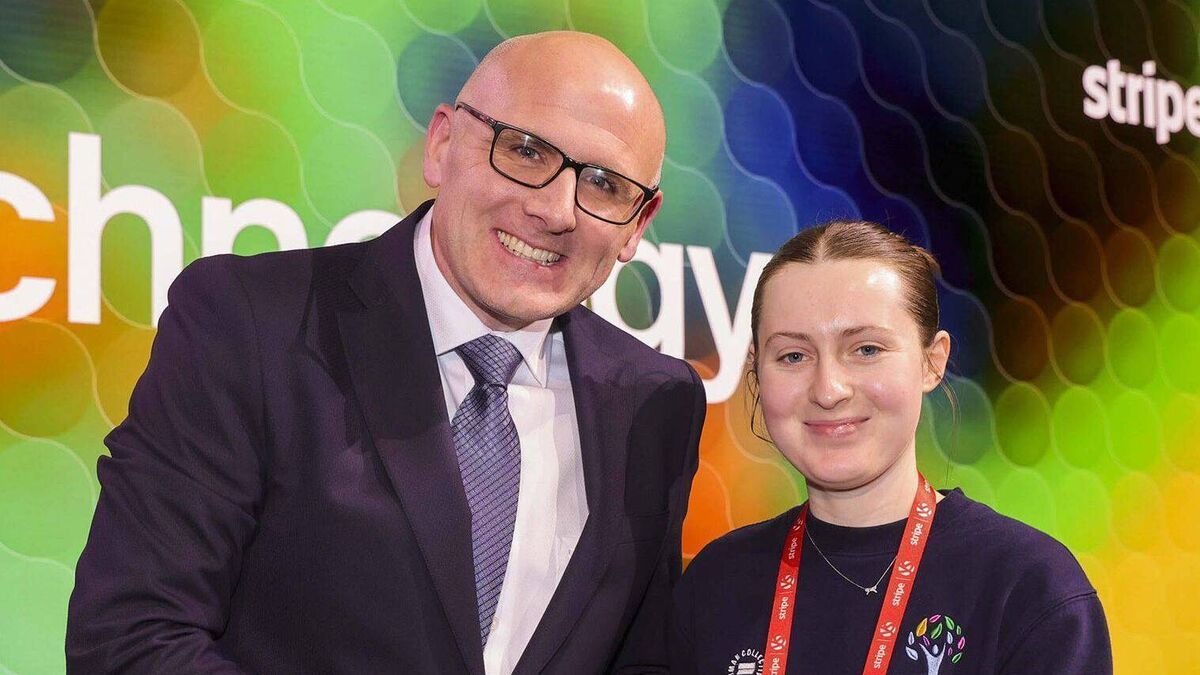
Addison Carey from Celbridge Community School receives the Intermediate Individual Award at the Stripe Young Scientist and Technology Exhibition from Ray McGrath, chair of the judging panel Photos: Fennell Photography
A STUDENT from Kildare picked up two awards at the Young Scientist and Technology Exhibition (YTSE) in Dublin’s RDS last week.
Addison Carey from Celbridge Community School won the prize in the Analog Devices Best Technology Award category, with her project ‘Developing a compression pipeline for deploying neural networks in wearable sleep apnoea detection’. She also won the Intermediate Individual Award for her project.
In all, there were six entries from Kildare among the 550 projects in the exhibition, with four of them from the same school – St Paul’s Secondary School in Monasterevin. The other two projects were Addison’s winning entry and one from Patrician Secondary School in Newbridge.
The students from Kildare joined over 1,000 colleagues from 221 schools from across Ireland in the RDS from a total of almost 2,000 entries in this year’s competition.
The St Paul’s entries looked at the speed of optimised computation, factors that affect the extending of extra-curriculars from primary to secondary, the effects of different football boots on leg injuries, and the development of a concussion suppression scrum cap. The Patrician Secondary School project focused on a reuseable filter for fertilizer-polluted water.
President Catherine Connolly and Stripe co-founder and former YSTE winner Patrick Collison officially opened the 2026 exhibition.
In her opening address, President Connolly underscored the national importance of the exhibition, saying: “When I look around today, I feel a sense of hope for the future – hope sourced in these brilliant young scientists who are full of creativity, curiosity and ingenuity. I can already see in your projects some of the leadership which we need to achieve a sustainable and cohesive future both on our island and across the world.”
Returning to the exhibition two decades after winning the top prize in 2005, Patrick Collison reflected on its impact: “The Young Scientist Exhibition changed my life. It was the first time I had the chance to do something I thought was interesting, just for its own sake, and then to have other people take it seriously. I don’t think I’d be where I am without it.
“If you’re ever worried all the big problems have been solved, no, absolutely not. We don’t know why people sleep; we don’t know how sleep works; we don’t know what’s going on in a thunderstorm.
“The good news is nothing’s been solved, everything is still in play, and teenagers can do great things.”
A panel of 85 judges, chaired by exhibition co-founder Dr Tony Scott (with Rev Tom Burke in 1965) and Stripe’s Ray McGrath assessed each project in detail. The judges are leading academics, researchers and industry experts across biological, physical, social and technological sciences.
Over 200 prizes were announced at Friday evening’s ceremony, with the overall winner receiving €7,500, a newly designed Stripe YSTE trophy reflecting the exhibition’s new visual identity, and the opportunity to represent Ireland at the European Union Contest for Young Scientists.
Alongside the main competition, the Primary Science Fair ran from Thursday to Friday, showcasing 60 projects from primary schools across the country.
The YTSE is designed to raise schools’ engagement in STEM subjects, and the exhibition invites students aged 12-19 years from all over the island of Ireland to showcase innovative science and technology projects, and attracts on average over 40,000 visitors.
The winner of the 2026 Stripe Young Scientist and Technology Exhibition was Aoibheann Daly, a fourth-year student from Mercy Secondary School, Mounthawk in Kerry, with her project ‘Glioscope: multi-task deep learning and causal AI for glioma & glioblastoma profiling’.
The winning project aims to helps doctors improve the treatment of brain cancer. The treatment and prognosis for brain cancer depends on the specific genetic mutations present, but there are currently no good methods for identifying these mutations. Doctors rely on taking samples of brain tissue, which is expensive, slow and carries a high risk of bleeding in the brain. Glioscope allows a doctor to predict what genetic mutation is likely to be present from a simple MRI brain scan, so they can make quicker treatment decisions and reduce risk for the cancer patient.