Mother of young Kildare man says his suicide could have been prevented after inquest
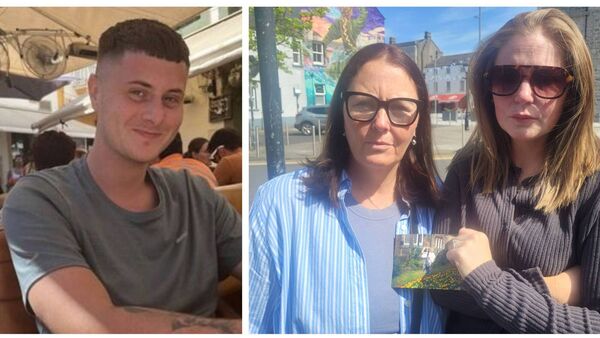
The late Kelvin Brennan and his mum and sister Noeleen Eustace and Shannon Brennan outside the coroner's court in Athy
THE MOTHER of a young Kildare man who took his own life last year has claimed his death was preventable if he had received the mental healthcare services he needed.
Kelvin Brennan (26) from St Joseph’s Avenue, Newbridge was found dead in a guest room of the Keadeen Hotel in Newbridge on 23 May 2025.
His mother, Noeleen Eustace, sharply criticised the mental health services available to her son and others like him who suffer from both mental health issues and a substance abuse disorder following an inquest into his death at Kildare Coroner’s Court on Thursday.
“I think (his death) could have been preventable. It wasn’t that he didn’t ask for help. He told them he was dying,” said Ms Eustace.
She said her son had suffered major issues with his mental health for 13 years.
While he had been attending a psychiatrist and had his last appointment just three weeks before his death, Ms Eustace said he was just continuously being prescribed medication when he really needed in-patient care.
Ms Eustace, who is a social care worker herself, said her son had been warning healthcare professionals that he would die if he did not get help.
“He said himself: ‘I need to be locked up’ but he didn’t want to end up in prison,” she recalled. “He told them he was a risk to himself and others.” During the inquest, evidence was heard that Mr Brennan’s body was discovered by a housekeeper in the hotel.
A garda witness confirmed that there was no sign of any third-party involvement in Mr Brennan’s death.
The hotel’s manager, Michael Masterson, said he had been alerted to what he described as “an upsetting scene” by the screaming of a housekeeper.
Mr Masterson said he had spoken earlier to Mr Brennan in the hotel as he was well known, and he recalled that the deceased had been “in fine form.” A postmortem showed that Mr Brennan had died as a result of asphyxiation.
The coroner, Loretta Nolan, said toxicology tests also showed a high level of alcohol and various drugs including cocaine and benzodiazepines in his body.
However, Dr Nolan said the pathologist who conducted the postmortem had concluded that the drugs were not a contributory factor in the death.
Recording a verdict of self-inflicted death, the coroner said it was not possible to state when exactly Mr Brennan may have died.
Speaking after the hearing, Ms Eustace welcomed the coroner’s findings as she “dreaded” a verdict of misadventure might have been recorded as it would have signalled an accidental death due to a drug overdose.
“People are very quick to jump on the drugs bandwagon,” she explained.
While acknowledging her son abused substances, Ms Eustace pointed out that he had previously made at least 10 other attempts to take his life including one occasion when she had discovered him.
She outlined how Kelvin had been brought to hospital but had been sent home afterwards from the emergency department because he was not considered sufficiently high-risk.
Ms Eustace said it had taken a long while to get her son diagnosed by the HSE’s Child and Adolescent Mental Health Services which meant they had “a lot of backtracking” over getting care for him over the years.
She also complained that it has taken nine months to get Kelvin transferred over to adult mental health services when he turned 18.
Ms Eustace said her son essentially needed in-patient treatment but had only ever spent nine weeks in St Patrick’s University Hospital in 2021.
She claimed he had subsequently been refused when he tried to be readmitted to the hospital.
Ms Eustace, who plans to write a book to tell her son’s story as part of advocating for improved mental healthcare services, said a major problem is the failure to recognise dual diagnosis – individuals who have both a drug addiction and mental health problems.
As a result, she said many people were just labelled as drug addicts.
“I am writing a book to get the truth out about my son because he wasn’t just a drug addict,” said Ms Eustace who emphasised how he had been diagnosed with Asperger’s as well as generalised anxiety, sensory processing disorder and dyspraxia at the age of 13.
“There are lots of people on the streets of Ireland who are not just drug addicts but who have mental health issues,” said Ms Eustace.
She expressed frustration at the government’s response to her campaign to have dual diagnosis recognised under mental health legislation as well as at the lack of specialist treatment for affected patients.
Ms Eustace said methadone programmes were quite successful but there was no similar resource available for people with a dual diagnosis.
In contrast, she noted that specialist treatment in the UK for such cases was “absolutely amazing.”