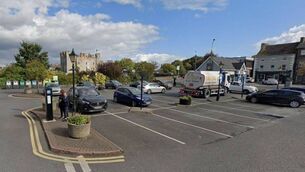
Rare 1921 autograph book from Curragh internment camp now free to view online
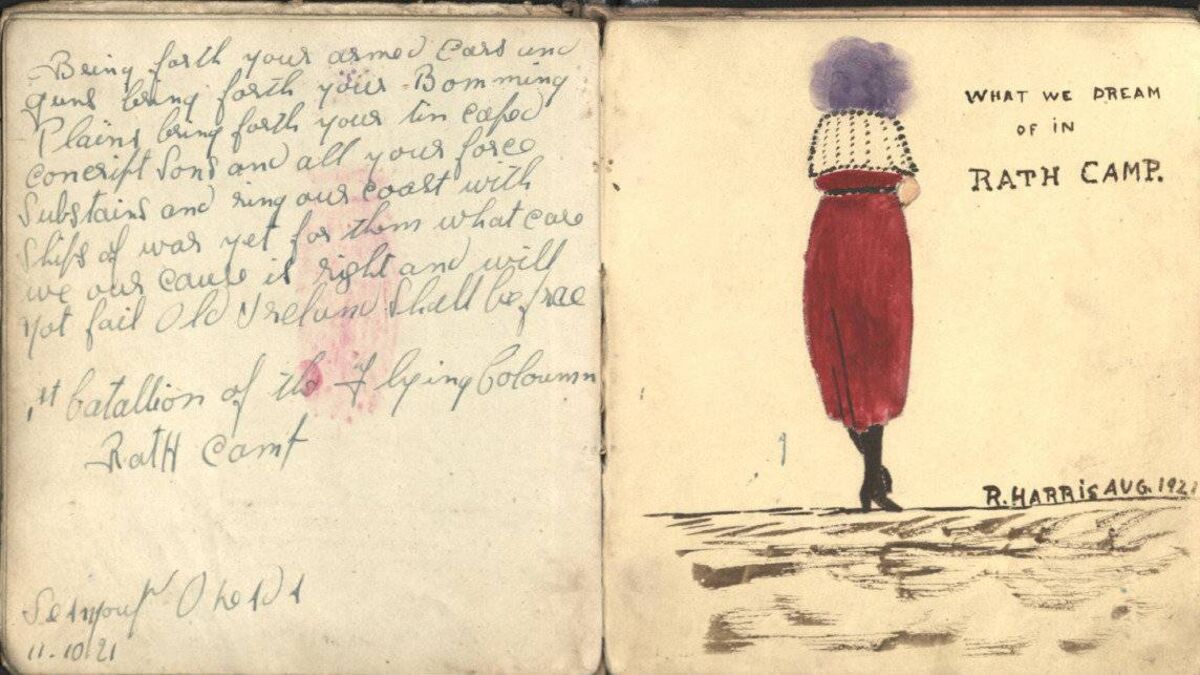
A drawing of a woman in 1920s fashion, drawn by an R Harris in August 1921
KILDARE County Council’s archive has had a fantastic revolutionary artefact deposited to it, which has now been digitised and is free to view online. The piece is an autograph book containing the writings of Republican men detained by British authorities at The Curragh Camp in 1921.
At that time, the mass arrest of republicans in the aftermath of Bloody Sunday, 21 November 1920, led to the creation of internment camps in Ireland, such as at The Curragh. Two camps were stationed there, including the Rath Camp, which was located in the south of The Curragh Camp military base and designed to hold 1,000 people, and the smaller holding camp, Hare Park, which was adjacent to Rath Camp and fit to hold 150 prisoners.
Both camps held famous republicans such as Todd Andrews, Desmond Fitzgerald, Sean Lemass and Frank Burke.
Autograph books were used to record information about internees, soldiers and prisoners of war during the 20th century and were used to gather signatures, poetry and drawings from fellow incarcerated men.
Kildare county archivist Karel Kiely, who worked as a Kildare genealogist for some 25 years, along with Mario Corrigan, was appointed archivist in 2021, after going back to college to become a fully-qualified archivist. Ms Kiely spoke to the about the autograph book and her work in general.
“They’re a very popular item [autograph books] because they give real insight into what life was like in the camps,” she said. “There aren’t really any formal records of the camps, so these are the only records we would have.”
The autograph book is one of three, and is very different to the type of records that are usually found in the county archives. “Our main priority is the records of local government,” said Ms Kiely. “We would have less of what they call private papers, like autograph books.”
The book was owned by a former internee of the camp, Tom Smyth of Grangebeg, Gilltown, Kildare, and was deposited by his son, Robert Smith, to the Kildare Archives.
Thomas Smyth was born on 14 July 1902 in Grangebeg, Gilltown and was the son of a farmer named Robert Smith and wife Margaret Delaney. He was member of Ballymore Eustace Company, a local branch of Irish Volunteers.
He was a notable member of the group and was involved in fundraising activities and a bank raid in Dunlavin.
On 6 March 1921, he was arrested with Art Doran in The Thatch, Ballymore Eustace and interned in the Rath Camp at The Curragh until his release on 8 December 1921.
During his time in Rath Camp, Mr Smyth would have passed time by possibly playing football with his fellow internees, and attending educational classes such as Irish language and history classes, which can be seen to be put to use in the book from the many entries that are written in Irish.
After that time, Tom Smyth moved to Dublin where he ran a shop at Mount Pleasant Avenue in Rathmines and married Margaret O’Flaherty in 1935. He died on 3 June 1982 and was buried in Palmerstown Cemetery in Dublin.
Ms Kiely reckons that what makes the book special its living link – Tom’s son, Robert Smith.
“What’s unique is that his son brought it in and was able to talk to me about his father. This is something he held in his hand, and the family retained for the last 100 years,” she said. “It’s survived all that time.”
Ms Kiely expressed gratitude to Mr Smith for his donation to the archive, and hopes other local custodians come forward with items for proper preservation.
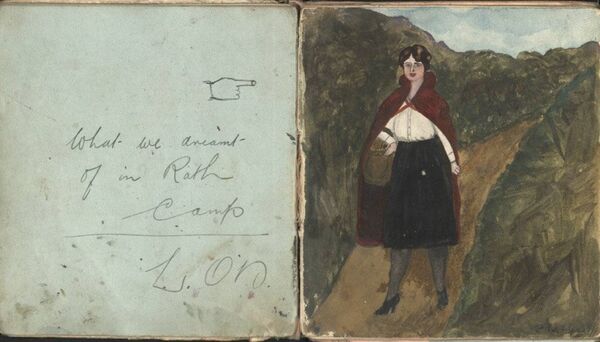
The autograph book, which is now the property of Kildare Archives, features poems, lyrics and other writings from men who were interned in the Hare camp during 1921. The book contains two drawings of women, both captioned with: ‘What we dream of in Rath Camp’ – a glance into the minds of interned men.
It also contains quotes from nationalist poetry, with many references to alcohol – probably a coping mechanism at the time.
Tom Smyth’s autograph book is one of three of its kind in the Kildare Archives, including the autograph book of Sylvester Delahunt from Tuckmill, Straffan. Sylvester’s book features six photographs and a water colour painting of the famous tunnel escape from the Rath Camp in 1921 by Frank Purcell of Cappagh, Kilcock.
“There’s a little ink drawing of the escape, where they tunnelled out of the camp, and to have that visual impression is amazing,” said Karel.
“Someone also had smuggled a camera in and took photographs – that makes it very unique. It’s very unusual to have photographs from inside an internment camp.”
Another autograph book exists in the archive, belonging to Joseph Kirwan, a man who was an internee in the Tintown Camp in 1923.
Thomas Smyth’s own signed entry can be found in the pages dated, 15 August 1921. It reads: ‘They offered us their dirty gold/Our comrades names to tell/And battered us with rifle butts/In lonely prison cells/To leave this place of banishment/We’d but one word to say/But sweeter for a felon’s life/Than of Ireland’s cause betray.’”
While having such a rare item digitised is important for public accessibility, Karel argues that it does cannot replace the original artefact. “It is nice to hold the original. Digitisation is fine, but it’s not the same,” she said.
Karel encourages Kildare folk to come forward with any historical records, including photographs, to better preserve them for future generations.
“A donation means it’s secure forever and made available to so many people,” she said. “Why should one person have it in a drawer when thousands of people could be accessing it?”
The newly-digitised autograph book can be freely accessed via the Kildare Archives website at https://onlinearchives.kildarecoco.ie.