Verdict of 'accidental death' returned for Kildare man who died in ambulance explosion
Naas General Hospital
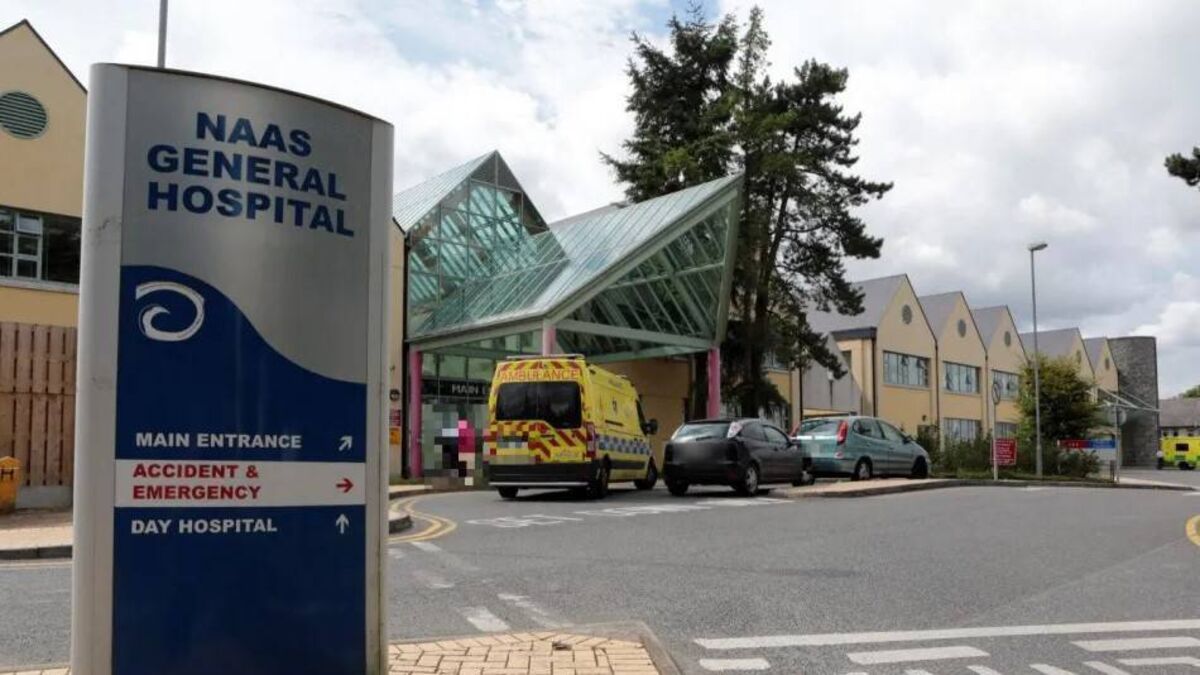
AN AMBULANCE parked outside the emergency department at Naas General Hospital exploded into a fireball within the space of 4-6 seconds killing an elderly patient in the rear of the vehicle nine years ago, an inquest has heard.
Christopher Byrne (79), a widower and father of five from Ard Brid, Suncroft, Co Kildare, suffered fatal injuries as flames engulfed the ambulance around lunchtime on 22 September 2016.
Two paramedics who had brought Mr Byrne to Naas General Hospital from his home also suffered minor injuries in the incident.
An inquest into the death of the retired stud groom and farm labourer at Kildare Coroner’s Court in Athy on Thursday heard the fire had been started after the valve of an oxygen cylinder placed on a trolley alongside the patient suddenly ignited.
However, an investigation by the Health and Safety Authority (HSA) was unable to establish a definitive explanation as to what caused the fire.
An advanced paramedic with the National Ambulance Service, David Finnegan, told the inquest that he had placed a portable oxygen cylinder on the trolley beside the patient after they had arrived in the ambulance at Naas General Hospital.
Mr Finnegan said he heard a click and a pop which was “not the norm”.
When he turned around, he saw a flame coming from the centre of the patient.
“I could hear the man scream. I could see the man was on fire,” said Mr Finnegan. “It all happened in a split second.” Mr Finnegan said the flames were coming up the man’s left side followed by thick black smoke.
He outlined how there were problems in trying to get Mr Byrne out of the ambulance before adding: “I knew the poor man was gone.”
Mr Finnegan added: “It was in my mind to try and get the cylinders out of the ambulance to try preventing further explosions but it was too hot to get at them.”
“I knew there was no more I could do,” he concluded.
Another paramedic, Stephen Lloyd, who was attending Mr Byrne in the ambulance, told the inquest that he had turned on the portable oxygen and when he looked around it was in flames.
Mr Lloyd said the flames were located where the tube connected to the cylinder which was “like a flame thrower.”
He tried to help the patient but the fire and the heat were “too great” before he was pulled out of the ambulance by his colleague.
Mr Lloyd described the incident as “an awful, terrifying experience”.
An HSA inspector, Vincent Darcy, gave evidence that CCTV footage had provided key information in establishing the sequence of events.
Mr Darcy said the first sign of a flame in the ambulance was recorded at 1.31pm by the side of Mr Byrne.
He told the hearing that there was a large explosion one second later after which flames spread rapidly through the ambulance.
Mr Darcy said Mr Lloyd made attempts to grab the patient, while Mr Finnegan opened a side door of the vehicle.
The witness said Mr Lloyd was driven back by the flames in his attempt to rescue Mr Byrne and was forced to run through the flames to exit the rear of the ambulance.
He outlined how the whole incident occurred in the space of 4-6 seconds.
In reply to questions from the coroner, Loretta Nolan, Mr Darcy said such oxygen cylinders had been modified since the incident with the fitting of a brass ring which acted as a “heat sink” designed to absorb any heat inside the valve which could cause combustible material to ignite.
Mr Darcy said the HSA had also issued a safety alert to raise awareness that oxygen cylinders have the potential to ignite from within the valve.
The HSA inspector said he was aware of seven similar previous incidents in the UK including Northern Ireland, none of which involved a fatality.
He said there were also one or two other similar cases in the UK since the incident in Naas, while he was also aware of between 10 and 20 other cases in the rest of the world.
Mr Darcy said the HSA investigation had ruled out various possible explanations for what caused the fire including someone smoking, faulty electrical equipment in the ambulance or some static discharge.
Cross-examined by Ronan Kennedy SC, counsel for BOC Gases – the provider of the oxygen cylinder – Mr Darcy confirmed the oxygen cylinders had been authorised and licensed by the Health Products Regulatory Authority.
The inquest heard that the HSA had submitted a file on its investigation to the DPP who decided that no prosecution should arise from the fatal fire.
A UK-based fire safety expert who assisted the HSA investigation, Aubrey Tyher, testified that the fire had started in the valve of the oxygen cylinder.
Dr Tyher said he found it had also shared some common features with similar previous incidents involving such equipment.
However, he had been unable to establish with any confidence what caused the fire to start.
Dr Tyher said it was probably caused by a combination of factors including “shock heating” when the valve was opened, contamination of combustible materials and particles within the valve which become heated.
Given the rarity of such incidents in valves, Dr Tyher said it was likely that several effects must occur together to ignite a fire.
The deceased’s son, Thomas Byrne, who lived with his father and acted as his full-time carer, told the inquest that his father had been diagnosed with cancer in 2014.
The witness said his father had subsequently undergone a tracheotomy and had his voice box removed.
He told his counsel, John Kennedy SC, that his father was unable to speak and he would lip read to try and understand him.
The inquest heard Mr Byrne had called the ambulance that day because his father felt sick and was struggling with his breathing.
Mr Byrne said he decided not to go in the ambulance but to follow his father with his bags.
When he arrived at Naas General Hospital, he was informed that his father had died in the ambulance after it had gone on fire.
A jury of six men and one woman returned a verdict of accidental death.
They also recommended that a review of the use of oxygen cylinders be carried out to minimise the build-up of heat in valves as well as for adequate firefighting equipment to be provided at all ambulance bases.
Offering her condolences to the deceased’s relatives on their loss, Dr Nolan described the manner of his death as “an awful tragic event”.
The coroner expressed hope that they could remember all the good times they had.
Mr Byrne’s family declined to make a comment on the outcome of the inquest.