Castledermot invites French visitors for tour of the town
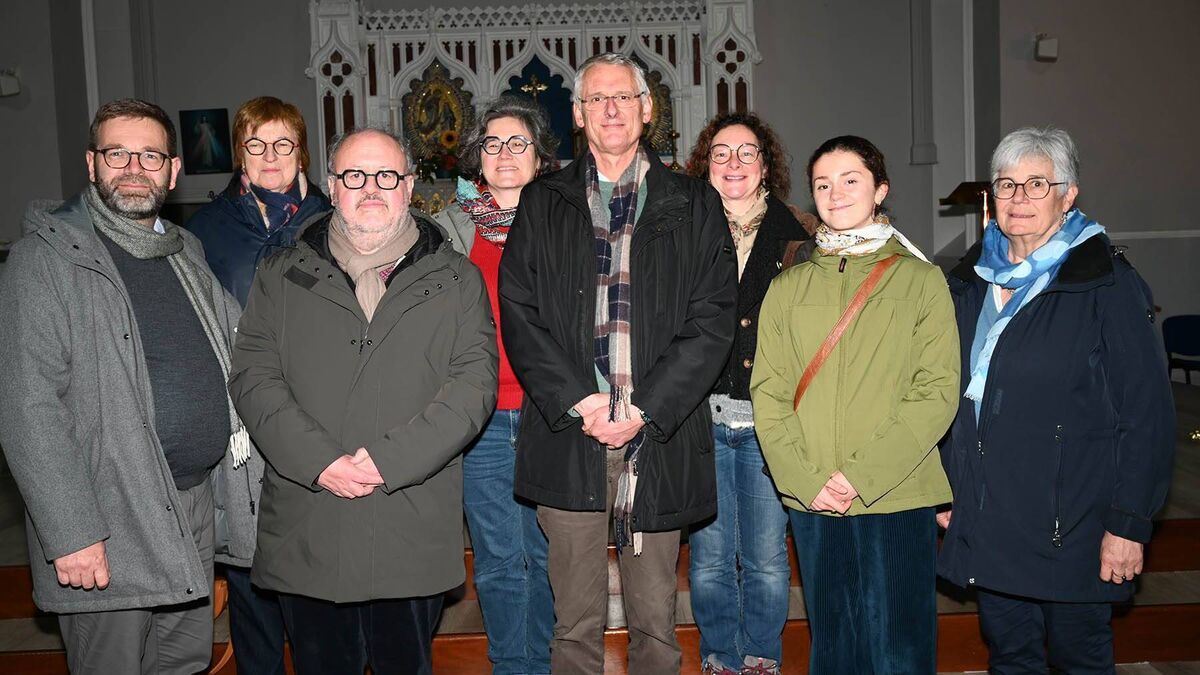
Frederic Lesain-Cayeux, Brigitte Marcotte, Michél Barbier, (Mayor) Laure Lesaiin-Cayeux, Philippe Mahuet (Parish Priest ) Sophie Togni Devillrrs, Jeanne Sellier and Beatrice Inzani Grouo from EU Normandy France
CASTLEDERMOT recently hosted a group of French visitors from the village of Eu, otherwise known as the burial place of St Laurence O’Toole The visit, organised by Father Tom Kennedy of the local parish, offered a rich cultural experience for the visitors and showcased some of Castledermot’s most cherished historical sites recently.
The French group arrived in Castledermot as part of a larger trip to the Archdiocese of Dublin.
Father Kennedy arranged for the group to visit Kilkea Church, where they were greeted by local archaeologist Sharon Greene. Ms Green, a member of the Castledermot Local History Group, provided an insightful talk on Laurence O'Toole’s life and legacy.
With the help of an interpreter from the group, the visitors were able to learn about the historical context of O'Toole’s birthplace and his enduring impact on both Irish and European religious history.
One of the highlights of the visit came as the delegation toured the church, where they marvelled at a stained-glass window depicting Laurence O'Toole.
The group’s fascination grew when local resident Adam Goodwin illuminated the window with a flashlight, casting the outline of O'Toole’s image for all to see. Michael Dempsey, member of Castledermot Local History Group who joined the group on the day, said they were all “greatly taken by this.” The visitors were also taken to Mullaghreelan Wood, the area believed to be the birthplace of Laurence O'Toole. There, they explored a monument in the churchyard dedicated to the saint, which had just been cleaned and re-lettered, and unveiled by Mrs Nabla Kane, wife of the late local historian Eamon Kane who originally put it there.
In addition to these sites, the group was introduced to the local history at St James's Cemetery in Castledermot. Reverend Ken Rue provided a detailed tour, highlighting the high crosses and the ancient swearing stone in the cemetery.
The stone, which has historical significance, was traditionally used in agreements and ceremonies, such as marriage contracts, where participants would shake hands through a hole in the stone to make deals and seal promises. The stone is one of 40 of its kind recorded in Ireland.
After a full day out exploring the area, the group had lunch with the Parish Council and were each presented with a special memento, religious figure to mark the visit, before concluding their busy itinerary with a fantastic choral mass written by local musician, organist and music teacher Brian Kehoe, and performed by the 80-person Assumption Choir.