Naas volunteers plant nearly 1,000 trees
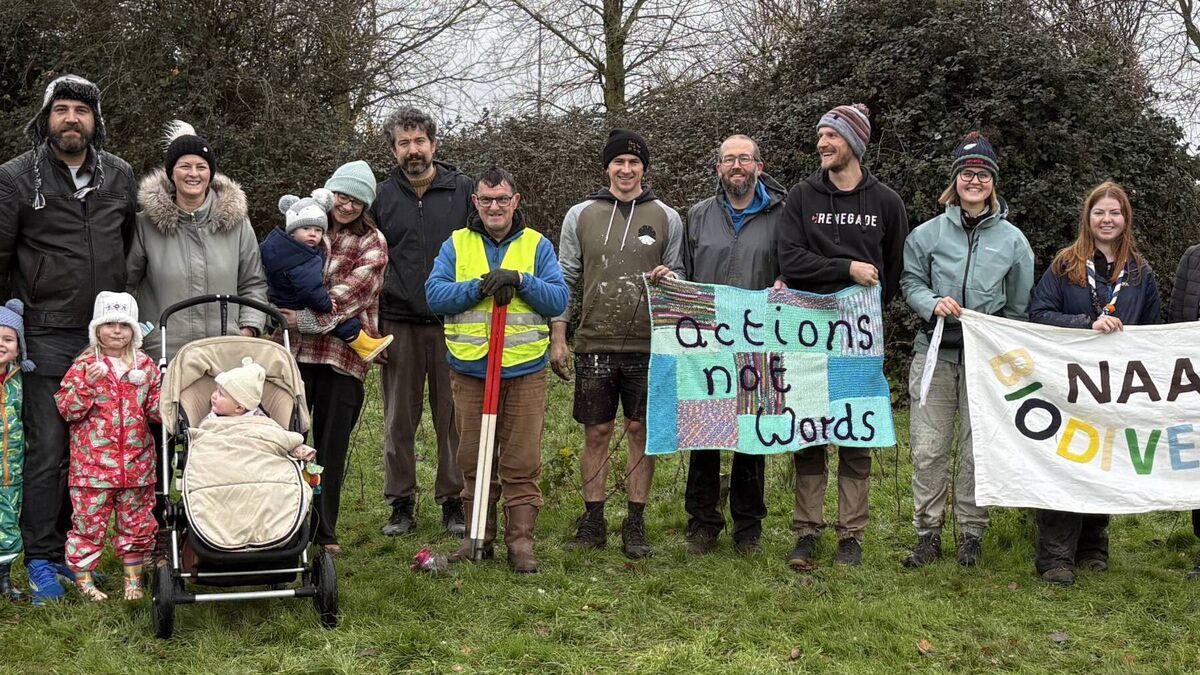
The team from Naas BioDiversity
Local volunteers with the Naas Biodiversity Group planted their fifth ‘Pocket Forest’ in the town last weekend, when they planted 950 native Irish trees at Ploopluck Bridge, near Finlay Park.
This brings the total trees planted by the group since being founded by Suzanne Murphy and other volunteers just five years ago to an astonishing 11, 840 trees.
The fifth annual pre-Christmas biodiversity event took place with locals of all ages and skill levels coming together to plant a range of Irish species that will support nature and biodiversity in the town, in coming years.
Naas Biodiversity Group only uses native tree species sourced in Ireland when planting forests, and uses only peat free compost, if compost is required.
The trees used in this forest were supplied by ‘Trees on the Land and include Birch, Hazel, crab apple, rowan ,alder, oak, scots pine, grey willow, guelder rose, blackthorn and hawthorn.
Previous forests can be found between Lakelands and Sundays Well, beside K Leisure, in Monread Park and behind Ballycane Church.
Naas Biodiversity Group have also planted hedgerows in Monread Park and at Ploopluck Bridge and Sarto Park.
In addition they have helped to plant trees at Naas Community College, Pipers Hill, the Community Gardens at Clongowes and are currently working with Scoil Bhride to plant trees before Christmas this year.
A pocket forest is a tiny urban forest containing densely planted native trees and is the brainchild of Japanese botanist Akira Miyawaki.
These mini forests are created by planting a diversity of native trees very close together, so that they grow faster, support more biodiversity and sequester more carbon than a conventional forest.
The density of the trees and the diversity of the species encourage species competition and very rapidly the pocket forest becomes a self-sustaining eco-system, that provides a much-needed habitat for wildlife in urban areas.
The result is a native forest that requires little maintenance or irrigation, and such pocket forests can be created in spaces as small as 15 meters squared.
This method is the brainchild of Japanese botanist Akira Miyawaki, and is a fast and efficient approach to forest restoration, particularly suited for urban areas by planting a diverse range of native species in dense configurations.