Living Greener: Espalier is cut above the rest
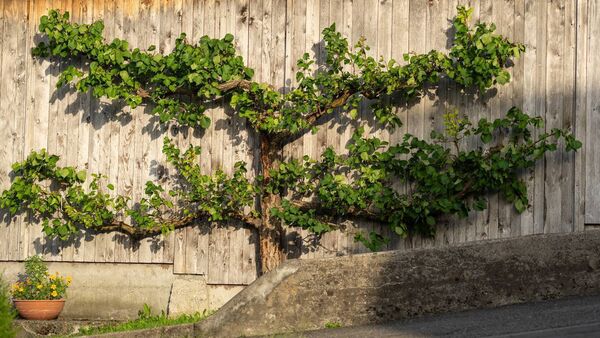
Espalier is a method of growing a dwarf fruit tree along a wall or fence
ALMOST anyone who has a backyard or garden would do well to keep a source of fruit, both for themselves and for neighbours; the jam jars and wine bottles people once exchanged on holidays were currency in an annual courtesy bank.
Most fruit trees, though, take years to mature and then take up more space than most people have.
Luckily, only a few centuries ago master gardeners developed a way to cultivate fruit in the thinnest of spaces — one that yields more fruit, more quickly, and with a longer growing season.
Espalier is a method of growing a dwarf fruit tree along a wall or fence, binding it to the structure for support, and pruning it aggressively so that it spreads flat across the vertical surface. The method was developed in the 16th century on these islands, where people needed fruit but where summers were too short and rainy for conventional fruit trees.
Think of the bonsai trees of Japan, tiny trees warped into artistically asymmetrical shapes—except espalier trees are shaped symmetrically for maximum fruit production.
It starts with planting a tree right against a south-facing wall or fence, and then pruning it so that it grows in only two dimensions. Its energy now goes into creating lateral growth and spurs, the branches that make flowers and fruit. When the tree spreads against a wall, its branches are generally pruned straight in a variety of shapes — radiating outward like bicycle spokes or a fan, stretching across the surface at 90 degrees from the stem like cross-hatching, or spreading out and then vertically like a candelabra. Whatever the shape, the principle is the same: since so little of the tree’s energy goes into conventional growth, in autumn it is covered in fruit.
Growing a tree against a wall has another advantage; if the tree faces south, both it and the wall receive the full light and heat of the sun, and the thermal mass of the wall absorbs that heat and provides shelter from the wind.
The wall can warm several degrees above the surrounding air, extending the tree’s growing season and helping protect it from frost.
Most gardeners start espaliers by tying a “maiden,” a one-year-old sapling that has not yet forked, to a wooden staff to keep it straight, and then tying the staff to a wall or fence.
They then tie the desired branches to the wall as they emerge, bending them to create the desired shape.
Because the bare winter branches look striking, and because they are covered in leaves or flowers at other times of year, espaliers would be a good way to cover the bare walls of houses, sheds, stables, chicken coops, or compost bins, or to brighten ordinary fencing.
Apples are the most common espalier tree, and pears are also commonly used where the climate allows.
I have also read that peaches, lemons, oranges, tangerines, figs, nectarines, plums, and even almonds can be trained this way in different climates.
Espaliers require about three years to mature from a malleable sapling to the desired shape, which is also when they would begin to deliver fruit.
The details, of course, vary widely depending on the type of tree and the climate.
In theory, espaliers can be grafted extensively like other fruit trees, so that a single tree could grow multiple varieties of apples. To graft an espalier tree, you slice off a young branch of the base tree and attach a cutting from a different variety, making sure that the green inner bark of one rests smoothly against the other.
You then bind them with a splint and wrap them in bandages — many arborists drip melted wax over the graft to stave off infection.
The tree that grows from a successful grafting will have the best of both worlds: the size and shape of your rootstock variety, but yielding the fruit of your scion variety. Nor are you limited to one scion; in theory, you can attach as many scions as your rootstock tree has branches.
You can even attach multiple kinds of apples; one man in Britain has grown a single tree, planted 25 years ago, that now produces 250 different kinds of fruit.