Living Greener: Turn waste into soil in weeks
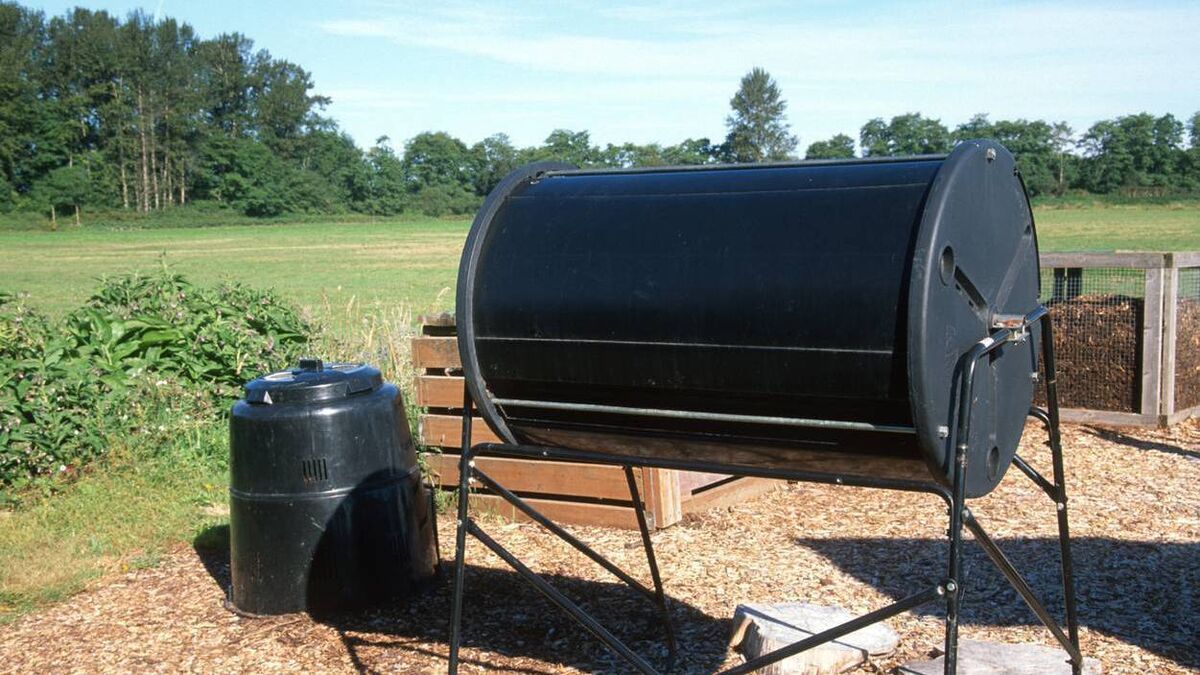
If you turn compost in a container every second day for few weeks you will soon have material to spread
AS long as there have been humans, we have taken the parts of plants we don’t eat and thrown them back onto the soil, knowing they would break down and return to the soil to create more plants.
These days, most of us are a bit tidier and have a compost bin, one that takes our kitchen waste and turns it back into garden soil in a year or so.
Ordinary composting, however, has some disadvantages that every gardener knows well. One can’t simply add bones or meat – and some gardeners even avoid eggshells – for fear of attracting vermin. Also, plants that have gone to seed cannot be added, or the resulting soil will be peppered with the beginning of next year’s weeds.
You can’t add diseased plants, or the diseases might remain in the resulting soil, ready to infect next year’s crops. Also, it takes a long time, and one loses much of the kitchen waste volume in the process of rotting down.
Imagine, then, a new kind of composting, one that avoids all these problems at once – no more weed seeds, no more disease, no more vermin. Imagine being able to compost almost everything and keep most of the biomass. Imagine, finally, that it only takes a few weeks.
What makes hot composting work is bacteria; instead of the usual variety of bacteria that break down over several months, hot composters find the right balance of materials – more on this in a moment — to attract aerobic, heat-generating bacteria.
Then, they oxygenate the soil by turning the compost regularly, and making sure the compost has enough mass – at least 1.5 metres on each side —to retain the heat it generates.
The bacteria generate heat just as your body does — between 55 and 65 degrees centigrade, hot enough to kill any weed seeds and diseases, hot enough to drive away most vermin, and hot enough to feed their fast action.
With this so-called Berkeley method, you first fill a container of the appropriate size with kitchen waste – that’s a lot of waste at once, so you might want to get all your neighbours’ materials together in a communal bin. Leave the compost for four days with no turning.
Then, turn the compost every second day for the next 14 days, making sure to turn it thoroughly from the outside in to get everything well mixed. By the 18th day, it should look like soil – but you still need to let it rest for several more weeks before planting in it.
I mentioned the right balance of materials to compost; the ratio one looks for is between 25 and 30 parts carbon-rich waste to one part nitrogen-rich waste, proportioned by weight.
Carbon-rich materials are typically dry and brown, like sawdust, cardboard, paper, dried leaves, straw and other, similar things.
Nitrogen-rich materials are typically moist and fresh, like kitchen waste, lawn clippings and vegetable scraps.
Sometimes carbon-rich materials are called “browns” and nitrogen-rich materials “greens” for simplicity, but these terms can be misleading: coffee grounds and animal manure, whatever their colour, would also be nitrogen-rich.
If the carbon/nitrogen ratio is too high in carbon, the compost will not get hot enough or break down quickly enough, and one must add something like manure or grass clippings.
If the mix has too much nitrogen, rather smelly bacteria will take over, and the mix might get slimy.
To get the right ratio, keep in mind that all plants have more carbon than nitrogen, so virtually all materials have a ratio of at least 1/1.
“Browns” like wood chips have a ratio of 400/1, newspaper has 175/1, straw has 75/1. “Greens” like vegetable scraps have about 25/1, grass clippings 20/1, and chicken manure has about 12/1.
Urine has a ratio of about 1/1 and is excellent to add to soil in whatever way does not violate your local ordinances.
Composting this way eliminates the harmful greenhouse gases that most of our food waste emits. It also generates heat that some people can use to heat their homes or water supply – I’ve taken a very hot shower outside on a very cold country morning, powered entirely by the bacterial heat of a hot compost bin.
Few inventions can have more of an impact on our society if widely implemented.