Remembering Athy's war dead
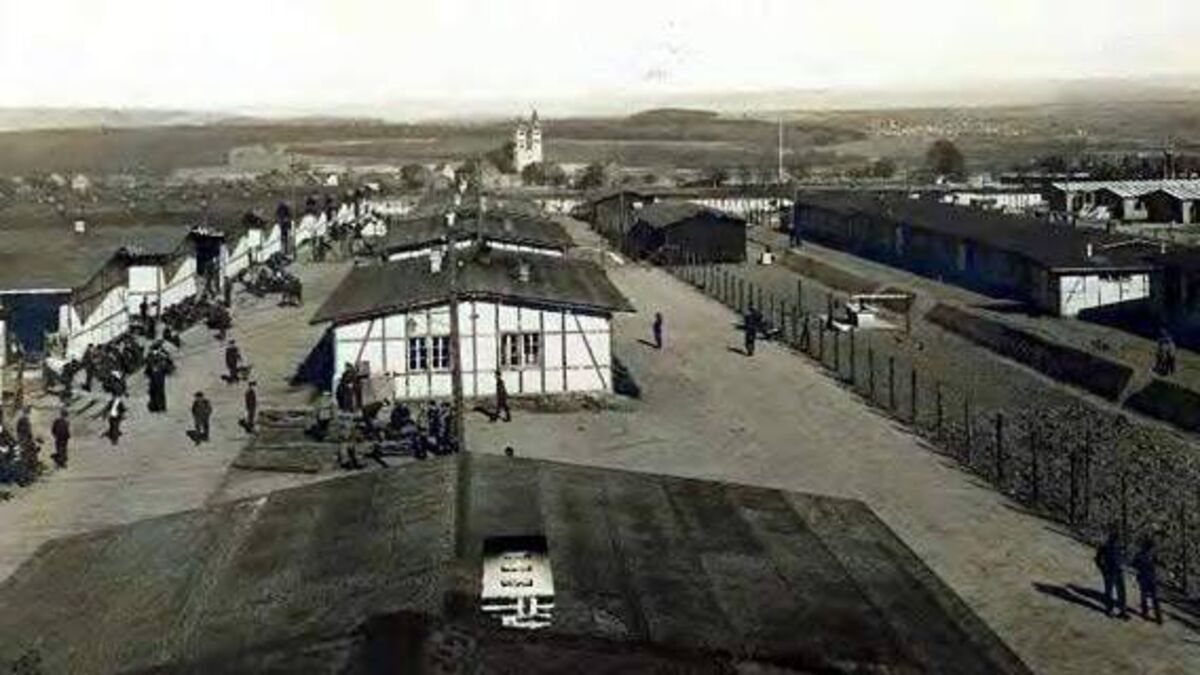
Several Athy men died in Prisoner of War camps like in Limburg
WHEN Lord Kitchener, Secretary of State of War, made his call to arms on 7 August 1914 the response from the men of Athy and district belied the town’s enveloping interest in Irish nationalism and represented the renewal of the century’s old tradition of British army service.
By mid-November seven Athy men had been killed in battle. Four of the seven casualties served in the Irish Guards. Their deaths did not appear to have an appreciable effect on recruitment in the South Kildare area.
Recruits continued to enlist, bolstered by press reports such as that in the Kildare Observer of 30 January 1915 which under the headline ‘Helping the Empire’ noted that “ .
In its continuing support for the war effort, Athy Urban District Council, in February 1915, expressed the desire to equip two beds to be called ‘The Athy beds’ in conjunction with the conversion of the State Departments in Dublin Castle for use as a Red Cross Hospital for wounded soldiers.
It subsequently transpired that the council was not legally empowered to make any such donation and consequently the provision of the Athy beds was not proceeded with.
The first identifiable expression of local concern regarding the progress of the war was found in the Kildare Observer on 31 October 1914. In a report headed ‘Athy Soldiers - Prisoners of War’ the newspaper claimed
The Battle of Mons opened on Sunday 23 August 1914 when British troops, including soldiers of the Royal Dublin Fusiliers, positioned themselves on a line between the Belgian towns of Mons and Conde. The Germans attacked and surrounded the Fusiliers, capturing many of them before the British troops retreated on 24 August. Amongst those captured by the Germans were Athy men Michael Bowden, Martin Maher and Michael Byrne. All three were to die while prisoners of war.
John Byrne died in Limburg Prisoner of War Camp on 27 September 1918, Martin Maher died at Niederzwhehren Prisoner of War Camp on 5 March 1915, and his colleague Michael Bowden died there on 23 May 1918. Bowden, who was a postman in Athy prior to the war, and Byrne, who was head gardener to local veterinary surgeon, John Holland, were photographed in Limburg Internment Camp and the photograph was subsequently published in the Saturday Herald of 10 June 1916.
While in Limburg, both men met the Dominican priest Fr Thomas Crotty who was sent from Rome to act as chaplain to the Irish prisoners. They had previously known Fr Crotty when he ministered in the Dominican Priory in Athy.
A wounded soldier of the Connaught Rangers regiment spoke in an interview of his experiences at the Battle of Mons.
Another soldier captured during the retreat from Mons was subsequently released as part of a seriously wounded prisoner exchange scheme arranged between Germany and Britain following the intervention of the Pope.
Private Thomas English of the 2nd Battalion Royal Dublin Fusiliers described in a press interview how the captured soldiers were put into cattle trucks and travelled for three days and nights before arriving at their destination in Germany.
The Prisoner of War camp held French, Belgian, British and Russian soldiers, all of whom Private English claimed were treated badly.
The war, which had been expected to end by Christmas 1914, had by early 1915 settled into a pattern which might reasonably have been expected to adversely affect recruiting in Ireland.
Despite this, arrangements continued to be made at local level to encourage further recruits from among the young men of the town and surrounding countryside.
At a recruiting concert held in the Town Hall, Athy in April 1915 it was claimed that the town of Athy, with a population of 4,000, had already sent 300 men to the front.
Two soldiers died at their homes in Athy in the early months of 1915. Thomas Flynn, aged 28 years, a Connaught Ranger, died on 26 February 1915. James O’Connell, of the Royal Warwickshire Regiment, died at home on 17 April 1915. Both were awarded full military funerals. Their coffins, wrapped in Union Jacks, were borne on horse drawn gun carriages accompanied by a firing party with rifles reversed on the journey to the local cemeteries.
The funeral corteges were followed by the local people who must have been impressed by the pomp and ceremony of military funerals which at the same time brought home to the onlookers the ongoing tragedy of war.
Thomas Flynn was the ninth Athy man to die since the start of the war and almost two months later James O’Connell became the thirteenth Athy victim of the war.