Archaeological book traces human activity in Kildare
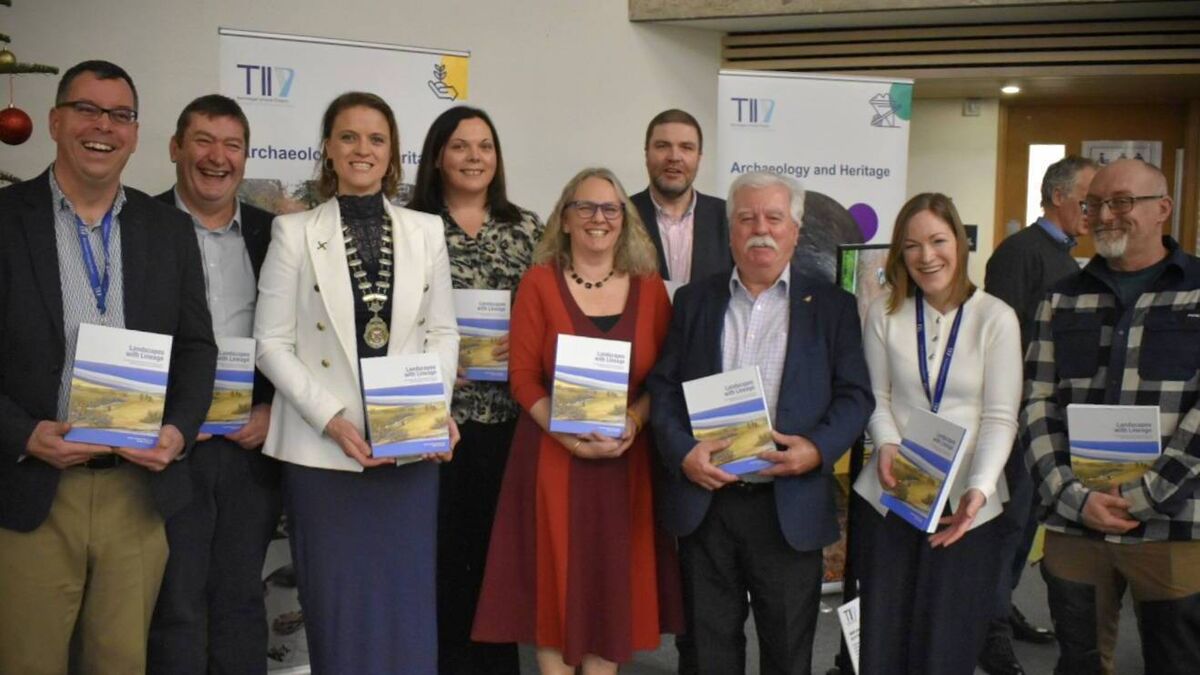
ames Eogan, Senior Archaeologist, TII, Colm Moloney, author, Rubicon Archaeology, Councillor Veralouise Behan, Leas-Cathaoirleach, Kildare County Council, Patricia Long, author, Rubicon Archaeology, Dr Sharon Greene, south Kildare archaeologist and former editor of Archaeology Ireland, Rónán Swan, Head of Archaeology & Heritage, TII, Noel Dunne, Project Archaeologist, TII, Lynda McCormack, Project Archaeologist, TII, Dr Ros Ó Maoldúin, author, Rubicon Archaeology
A BOOK covering almost the entirety of human existence in Kildare was launched in Athy recently.
‘Landscapes With Lineage’ is the latest title published in the Transport Infrastructure Ireland (TII) Heritage series and was launched in Athy Library by Dr Sharon Greene, an archaeologist from South Kildare, former editor of Archaeology Ireland magazine, and member of the County Kildare Monuments Advisory Committee.
The 302-page book, co-written by Colm Moloney, Patricia Long and Ros Ó Maoldúin, presents the results of archaeological investigations along a 27.5 km long slice of land that formed the M9 Kilcullen to Carlow motorway and Athy Link Road.
This was the most extensive archaeological investigation undertaken in this landscape. The motorway excavations revealed evidence of human activity spanning almost 9,000 years. Significant discoveries included stone tools used by the earliest hunter-gatherer communities who inhabited the area. Prehistoric ritual monuments, and a number of very significant Bronze Age, Iron Age and early medieval cemeteries. As well as the remains of rural farming settlements from all eras.
Scientific examination of charred seeds, charcoal and animal bones provided evidence that revealed changes in subsistence strategies and people's interactions with the environment over time. Analysis of the skeletal remains found at the burial sites shed light on the lives the people who lived in this area led, the diseases and illnesses they suffered from, and the rituals they followed when burying departed members of their communities.
The authors of Landscapes With Lineage marshal the evidence from the excavations and scientific analyses to examine how successive communities inhabited, modified and understood this landscape.
In collaboration with the National Museum of Ireland, guests at the launch were treated to a display of a selection of archaeological objects, including prehistoric stone tools and medieval pottery, uncovered during the excavations by archaeologists from Rubicon Archaeology.
“I was delighted to be asked to launch it, the invite came as quite a surprise,” said Dr Greene who is from Kilkea, and “very involved with the Castledermot Local History Group”.
Dr Greene said: “But of all the motorways, this is the one I would’ve loved to have been involved with.
“It’s great that TII have gone back and done this, because back then they were probably still the NRA!
“They have been really good producing these accessible books for everybody in the area who is interested in history. We’re very lucky to get this.
“I mean, 302 pages is an awful lot of stuff, from the Mesolithic Era, the Middle Stone Age, the time of the first recorded humans, all the way up to the Normans.
“That’s from 6,000 BCE to the 1500s,” she explained. (For contest that is a millennium older than Stonehenge and the earliest Pyramids.) Dr Green did her PhD in UCD on the settlement patterns on the north Mayo islands, “but I’ve been living back here for 20 years”.
“I have a great interest in High Crosses, medieval walled towns, and I’ve published a couple of things on Castledermot…and my research into local history continues.
“The picture on the front cover of ‘Landscapes with Lineage’ is an artist’s interpretation of the late Neolithic period on the banks of the River Lirr “just coming up to where the Castledermot exit is off the motorway, in modern day Prumplestown”.
“People’s appreciation for history, and their awareness has grown, and that’s why books like this are so important.
Colm Moloney, Director, Rubicon Archaeology and one of the book’s authors, said: “The publication of this book is the culmination of nearly 20 years of work for Rubicon Archaeology Ltd. We are delighted to have delivered it in partnership with Kildare County Council and Transport Infrastructure Ireland and are immensely proud of the high-quality result. This project is a significant milestone in the company’s development and I would like to thank the hundreds of employees, past and present, who contributed to its success – both in the field during the excavations and in the many years of post-excavation analysis and reporting since the fieldwork ended.” The book is richly illustrated with many specially commissioned maps, photographs, drawings and reconstructions.