Court order granted to remove Curragh encampment
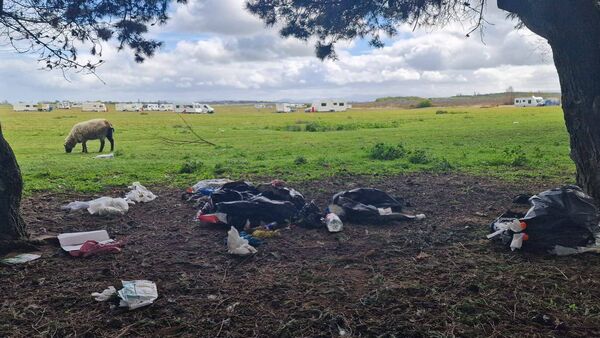
Rubbish dumped at the edge of the Cill Dara golf course
NEW calls have been made for stronger management and policing of the Curragh Plains following reports of littering, dumping and damage on the Curragh, with confirmation that a court order has been granted to remove recent encampments.
Speaking to the , Kildare South TD Seán Ó Fearghaíl said the Department of Defence had secured a court order approximately two weeks ago to remove encampments from the Curragh.
“Once the contingent arrived, the policy now in the Department is to immediately seek injunctive proceedings. So they went to court and got the order. I’m pleased the Department of Defence are acting speedily.”
However, he said the issue would continue to reoccur unless a proper long-term management system is put in place for the Curragh.
“The people of Kildare, Newbridge and the surrounding areas are sick and tired of this, and all the costs that are incurred and the damage that’s been done to the plains,” he said.
Deputy Ó Fearghaíl said it would be “unthinkable” for similar encampments to be allowed repeatedly in places such as Phoenix Park and argued the same standard should apply to the Curragh.
His comments come after concerns were raised by members of Cill Dara Golf Club over alleged anti-social behaviour, dumping and damage near the fourth hole of the course, where caravans have recently been stationed close to the railway line at the edge of the Curragh.
Club members reported littering, rubbish dumping and damage to greens, while staff said two greens were damaged overnight on Sunday, April 19.
Looking to the longer-term future of the Curragh, Deputy Ó Fearghaíl said the Government is considering the National Parks and Wildlife Service (NPWS) as the potential management body for the plains.
He said while this could be a workable solution, it would require careful handling and meaningful engagement with those who have long-established interests there, such as local farmers with sheep and those in the bloodstock industry who depend heavily on the Curragh.
“The Curragh is the centre of the universe as far as bloodstock is concerned,” he said.
He said that the Curragh Plains would need a much stronger visible ranger presence to respond quickly to illegal camping, dumping and misuse of the land.
“There would need to be high-visibility rangers on the plains that would be able to respond immediately to any attempted misuse,” he said.
While there are currently Curragh rangers, he said there are only a small number and they do not have sufficient resources or authority to deal with the scale of the issue.
He added that while smaller temporary gatherings may have taken place around major racing events in the past, the large-scale encampments seen in recent years were not historically a feature of life on the Curragh, and have been taking place each year for the last ten years approximately.
“This didn’t happen when I was a kid. I’ve lived here all my life. This sort of large-scale encampment was not a feature of life on the Curragh in the past.”