Eye on the Past: Landsdowne's evictions echoed over Kildare and Laois
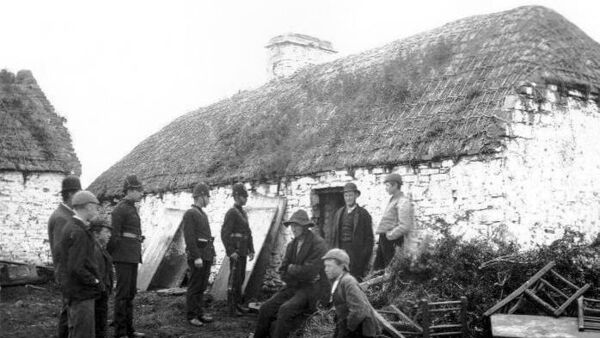
Family evicted by their landlord
THE Luggacurran evictions had their origin in the refusal of Lord Landsdowne to grant his Laois tenants rent reductions similar to those he had given tenants on his Kerry estates in 1886.
As a result of his refusal almost 70 per cent of the tenants adopted the Plan of Campaign which brought them into sharp conflict with Landsdowne’s local agent, Townsend Trench.
The leaders of the campaign were Fr John Maher CC Luggacurran, Denis Kilbride and John W Dunne, two local tenants of Lord Landsdowne who had large tracts of land sublet to local tenant farmers. Dunne held almost 1,200 acres while Kilbride had over 850 acres.
In November 1886, the Luggacurran tenants decided to withhold Landsdowne’s rents. The half year rents due that month were collected in Kavanagh’s hotel, Athy by Fr Maher, John W. Dunne, Denis Kilbride and Patrick Kelly.
Evictions soon followed, the first chosen for this unenviable honour was Denis Kilbride who was evicted on 23 March 1887.
The evictions were to continue throughout the following year and into 1889.
A number of those evicted came to live in Athy including John W Dunne, the Carberys, the Crannys, the Rigneys.
Families were evicted over a three-year period, some of which were subsequently able to return to the Luggacurran area following the re-settlement scheme of 1903.
On 24 July 1887 a Land League meeting was held in Luggacurran attended by the legendary agrarian agitator William O’Brien. A contemporary account states:
‘At 10.30 a.m. Wm. O’Brien arrived. He was met at the station (Athy) by a band and a sort of procession was formed but there was not a very large crowd. We then breakfasted at the house of Mr. Kilbride, who is a solicitor in Athy and brother of the Kilbride who was evicted by Lord Landsdowne. Both Kilbrides were there and their very pretty sister, all highly respectable people of the upper middle class, who in Ireland, are distinctly superior in manners and good breeding to our own middle class. With them and O’Brien and an Englishman named Westall, who seems to be a sort of commissioner from the “Spectator”, we proceeded by car to Luggacurran 10 miles, where a large number of people, say 3,000 were gathered.’ James Dempsey who lived at Emily Row, Athy and was the last Weigh Master of the town scales, remembered in 1948 the great Land meeting.
‘“Every cart, brake and vehicle capable of carrying people left Athy for Luggacurran that day,” he says. “The Procession, headed by Athy Fife and Drum Band, extended from Ballylinan to Athy.”
When they reached Luggacurran thousands of people from several counties were assembled there. He remembers how the crowd opened its ranks to let the Athy band march past.’ As the evictions continued throughout 1888 and 1889 collections were taken up throughout the country to finance the League’s opposition to Lord Landsdowne.
Once again, a local branch of the Land League was formed in Athy with the added difference that the ladies of the town also formed themselves into a women’s branch of the Land League. Local ladies prominent in the League included Mrs Anne Doyle, Woodstock Street; Miss Kinneen, Stanhope Street; Mrs Maher and Mrs Anthony.
Extra police were drafted into the area and the Town Hall, Athy was used to billet these men. A regular early morning and late evening scene around Athy was the police marching with rifles to and from the scene of the agrarian problems.
Boycotted by the evicted tenants and local sympathisers Lord Landsdowne’s agent was forced to call upon the services of the Land Corporation, the organised arm of the Irish landlords, to cultivate the Luggacurran lands.
Those men, who were mostly of Ulster stock, remained to work the estate up to 1903. In 1890 new tenants arrived to take the place of those evicted. This, understandably, created much bitterness amongst the former tenants, the legacy of which is never far from the surface, even to this day.
Approximately 60 holdings were taken over by the planters but even they found it impossible to sell their produce locally.
The Land Corporation stepped in and bought whatever remained unsold and in this way alleviated the undoubted hardship that might otherwise have resulted.
In 1891, the Land Commission purchased some of the planted lands under the Ashbourne Act and over the next few years the Land League Campaign petered out with the gradual resettlement of some of the former tenants.
Further purchases of Landsdowne’s lands in 1903 by the Land Commission led to a resettlement scheme under which some of the previous tenants or their representatives were given lands in and around the Luggacurran area.
Long before the final resolution of the Luggacurran problem, the Athy Land League had run its course and the 1892 General Election saw the election of M.J. Minch, the anti-Parnellite Nationalist as the south Kildare member of Parliament.
Minch’s election, which was to be repeated in 1895 and 1900, marked the end of Athy’s sporadic involvement in the Land League movement which for the town of Athy had first started with the meeting in 1872 of the local Tenants’ Defence Association.